
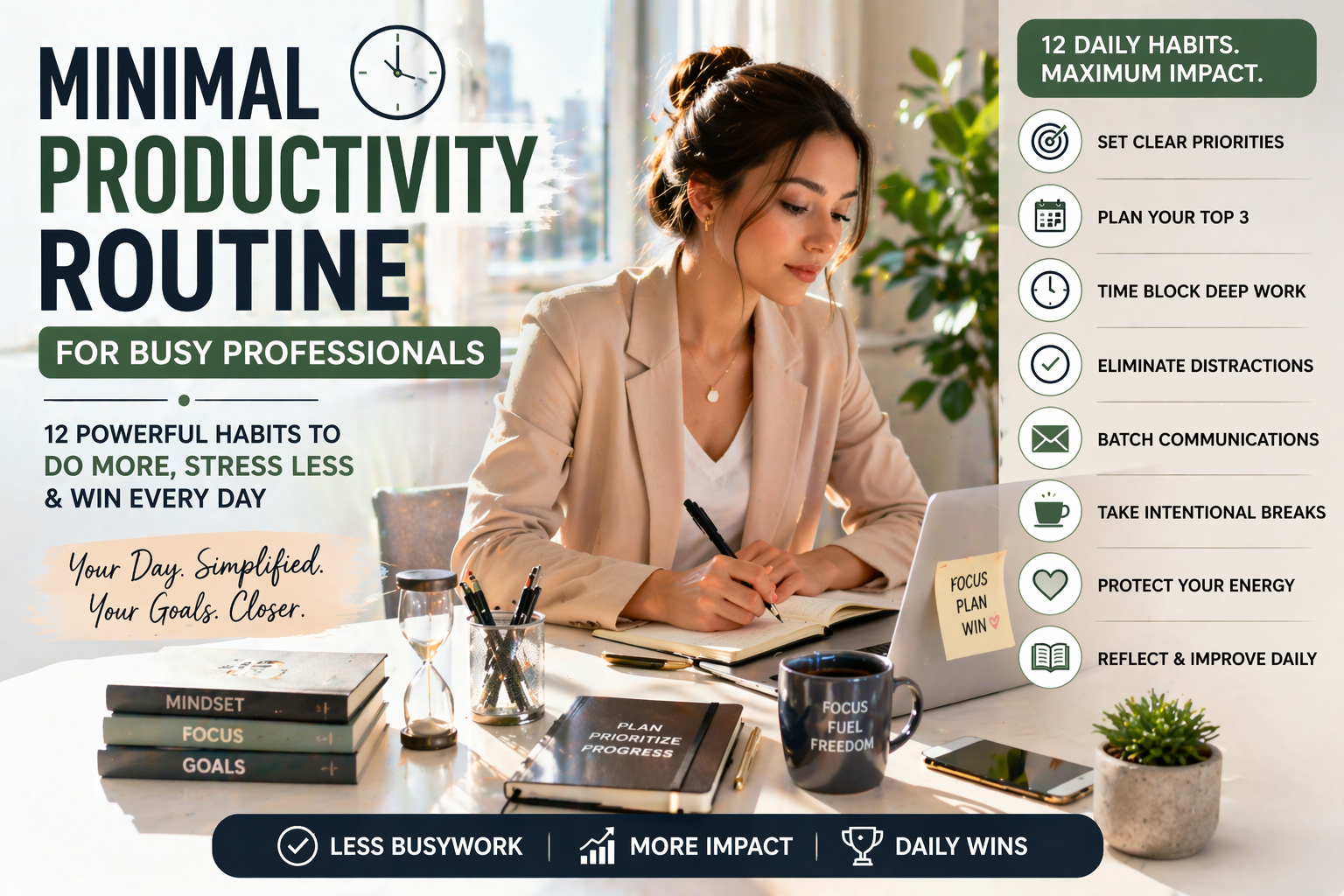
Table of Contents
INTRODUCTION
A minimal productivity routine for busy professionals is the most countercultural — and most effective — performance strategy available in today’s relentlessly overloaded work culture. We have been sold the myth that doing more, scheduling more, and optimising every waking minute is the path to professional excellence. The reality, increasingly validated by behavioural science, organisational psychology, and the lived experiences of the world’s highest performers, tells a profoundly different story.
More is not more. Better is more.
The most productive professionals in the world are not the ones with the longest to-do lists, the most complex time-management systems, or the most frenetic schedules. They are the ones who have mastered the art of deliberate subtraction — the ability to identify what truly matters, protect their energy fiercely, and build a daily routine so streamlined and intentional that every hour carries exponential weight.
At Apex Aesthetic, a minimal productivity routine for busy professionals, the principle of elegant minimalism extends far beyond interior design and skincare. It is a philosophy of living — one that applies, perhaps with its greatest force, to how you structure your professional day. This guide presents 12 powerful, beautifully minimal habits that will transform how you work, how you think, and how you experience the precious hours between sunrise and sleep. No complexity. No overwhelm. Only what works, ruthlessly curated.
Why a Minimal Productivity Routine Works Better Than Complex Systems
The productivity industry pulls in over $11 billion a year selling planners, apps, courses, and frameworks that promise to help you do it all. The cruel irony? Most of these systems collapse under their own weight — not because the underlying ideas are flawed, but because complexity breeds friction, and friction kills consistency.
Research from Stanford University’s Behavioural Design Lab confirms what high performers already sense: lasting behaviour change demands simplicity, specificity, and the lowest possible barrier to entry. That’s exactly why a minimal productivity routine for busy professionals outperforms elaborate systems — it eliminates the cognitive tax of managing the method itself, redirecting that mental bandwidth toward work that actually moves the needle.
This approach rests on three foundational principles:
- Subtraction before addition: Strip away everything non-essential before introducing a single new habit or tool
- Energy management over time management: Your calendar can’t manufacture more hours — but aligning tasks with your natural energy peaks multiplies the quality of every hour you already have
- Ritual over willpower: Willpower is a depleting resource; deliberate rituals put your best behaviors on autopilot, no conscious effort required
Every habit in this guide is built on these three pillars.
The 12 Habits of a Minimal Productivity Routine for Busy Professionals
Habit 1 — Design Your Tomorrow Tonight (10 Minutes)
The single highest-leverage productivity habit available to any busy professional costs nothing and takes less than ten minutes: designing your next day the evening before. This practice — sometimes called the “shutdown ritual” — closes the psychological loop on your current day and gives your subconscious mind a clear directive to process overnight.
The Apex Evening Design Protocol: a minimal productivity routine for busy professionals
- Review what you accomplished today without judgement.
- Write your three most important tasks (MITs) for tomorrow — and only three
- Block the time for these three tasks in your calendar
- Clear your desk and close all digital tabs
- Write a single closing sentence: “Today is complete. Tomorrow begins with clarity.”
Research published in the Journal of Experimental Psychology found that writing down incomplete tasks significantly reduces intrusive thoughts about those tasks, allowing for genuinely restorative sleep and sharper morning cognition.
Habit 2 — Protect Your First 90 Minutes Fiercely
Your first 90 minutes of professional work are your most neurologically powerful. Adenosine — the sleep-inducing chemical — has been fully cleared from your brain. Cortisol is at its natural daily peak, providing alertness and focus. Your prefrontal cortex is operating with maximum efficiency.
This window is too precious to waste on email, Slack notifications, or administrative tasks. Reserve it exclusively for your single most important cognitive work: strategic thinking, creative output, complex analysis, writing, or high-stakes decision-making.
The Apex First-90 Protocol of minimal productivity routine for busy professionals:
- No email or messages during this window – not even a quick glance
- One task only — multitasking during peak cognitive hours is a myth that costs 40% of productive capacity, according to the American Psychological Association
- Phone on airplane mode or in another room
- A clear, clean workspace with only the materials relevant to this single task
This one habit, consistently applied, will generate more professional output than almost any other productivity strategy you implement.
Habit 3 — The MIT Method: Three Tasks, No More
The minimal productivity routine for busy professionals lives or dies on this principle: three Most Important Tasks (MITs), identified each morning and pursued with full focus before anything else. Not ten. Not a colour-coded 47-item list. Three.
Why Three Works:
- Three is cognitively manageable — your working memory can hold three priorities simultaneously without degradation
- Three creates accountability — at the end of every day, you can clearly evaluate whether you succeeded
- Three forces prioritization — choosing three forces to confront, which tasks actually matter versus which merely feel urgent
The MIT Identification Framework: Ask yourself each morning: “If I could only accomplish three things today and everything else was impossible, which three would make the greatest difference to my professional goals?” Those are your MITs. Everything else is secondary — to be addressed only after your three priorities are complete.
Habit 4 — Implement Time Blocking for Deep Work
Time blocking — the practice of assigning specific, calendar-committed blocks of time to specific tasks — is the structural backbone of any effective minimal productivity routine for busy professionals. It transforms your abstract to-do list into a concrete, defended schedule.
The Apex Time Blocking Structure for a minimal productivity routine for busy professionals:
| Time Block | Type | Purpose |
| First 90 mins of work | Deep Work Block | MIT #1 — highest cognitive task |
| Mid-morning | Communication Block | Email and messages (30 mins max) |
| Pre-lunch | Deep Work Block | MIT #2 |
| Post-lunch (1–2 PM) | Administrative Block | Low-cognition tasks |
| Mid-afternoon | Deep Work Block | MIT #3 or creative work |
| End of day | Shutdown Block | Review tomorrow’s planning. |
The key is treating these blocks with the same inviolable respect as you would a meeting with your most important client. A blocked calendar is a defended calendar.
Habit 5 — The Two-Minute Rule for Inbox Zero
Email is a productivity killer dressed up as productivity. The average professional burns 28% of their working day managing their inbox — a staggering figure when you consider that the bulk of those messages are informational, low-priority, or simply unnecessary noise.
This is precisely where a minimal productivity routine for busy professionals pays its biggest dividends: fewer decisions, fewer re-engagements, and less mental residue. The two-minute rule — popularised by David Allen in Getting Things Done — captures this logic perfectly. If an email or task takes two minutes or less, handle it immediately rather than flagging it, filing it, or adding it to a list. The cognitive cost of returning to a deferred item consistently exceeds the time it would have taken to act on it in the first place.
The Apex Inbox Protocol: a minimal productivity routine for busy professionals:
- Process email in two dedicated windows per day (not continuously)
- Apply the 4D method to every email: Do it (under 2 mins), Delegate it, Defer it (with a specific time), or Delete it
- Unsubscribe from every newsletter and promotional list that does not directly serve your professional goals
- Set an auto-responder during deep work blocks — protect your attention without appearing unresponsive
Habit 6 — Single-Tasking as a Competitive Advantage
Multitasking is not a skill. It is a liability. Decades of neuroscience research consistently demonstrate that the human brain is structurally incapable of performing two cognitively demanding tasks simultaneously — what we call “multitasking” is actually rapid task-switching, and each switch costs approximately 23 minutes of cognitive re-engagement time.
For busy professionals, the commitment to single-tasking is not just a productivity upgrade – it is a competitive differentiator. In a world of distracted professionals, the one who brings complete, undivided attention to a single task produces work of categorically superior quality.
Practical Single-Tasking Implementation for a minimal productivity routine for busy professionals:
- Close all browser tabs except the one relevant to your current task
- Use website blockers (Freedom, Cold Turkey) during deep work sessions
- Keep your phone in a separate room during focused work
- Wear noise-canceling headphones as a physical signal — to yourself and others — that you are in focused mode
For a powerful framework that connects single-focus work with the qualities that define high-performing leaders, our guide on 7 powerful leadership qualities that define true Apex success is an essential companion reading.
Habit 7 — Strategic Breaks: The Pomodoro Principle Elevated
Sustained, unbroken focus is physiologically impossible for more than approximately 90–120 minutes. The brain’s ultradian rhythm — its natural cycles of high and low cognitive performance — operates in roughly 90-minute windows. Attempting to work through the trough of this cycle produces diminishing returns, errors, and accelerated mental fatigue.
The Apex Break Protocol: a minimal productivity routine for busy professionals:
- Work in 90-minute focused blocks, followed by a genuine 15–20-minute break
- During breaks: walk, stretch, hydrate, or practice 5 minutes of deep breathing — avoid phones and screens entirely
- The Pomodoro Technique (25-minute work / 5-minute break) works well for administrative tasks; extend to 45–90-minute cycles for deep creative or strategic work
Strategic breaks are not interruptions to productivity. They are the mechanism of sustained productivity — the recovery periods that make the next focus block possible.
Habit 8 — The Power of a Weekly Review (30 Minutes, Every Friday)
The daily MIT system needs a weekly calibration to remain aligned with your larger professional goals. The weekly review — 30 minutes every Friday afternoon — is the navigational check-in that ensures your daily execution is pointed in the right strategic direction.
The Apex Weekly Review Framework for a minimal productivity routine for busy professionals:
- Review the week: What did you accomplish? What stalled? What patterns emerged?
- Capture open loops: Everything unfinished, uncommitted, or unresolved
- Review your goals: Are your MITs this week moving you toward your 90-day and annual objectives?
- Plan next week: Block your three MITs for each day in advance
- Clear your desk and digital workspace: End the week with a clean slate
Habit 9 — Digital Minimalism: Audit Your Tools Ruthlessly
The paradox of productivity technology is that every new tool promises to save time while adding cognitive overhead, notification load, and decision fatigue to your day. A minimal productivity routine for busy professionals requires a ruthless, periodic audit of every digital tool in your workflow.
The Apex Digital Audit Questions for minimal productivity routines for busy professionals:
- Does this tool save me more time than it consumes?
- Does it reduce friction in my workflow or create new forms of it?
- Is there a simpler alternative that achieves 80% of the same outcome?
- If this tool disappeared tomorrow, would I genuinely notice?
The goal is not to use the fewest tools — it is to use the right tools. And the right tools are almost always fewer than you currently use.
Habit 10 — Protect Your Energy Architecture
Time management without energy management is a fundamentally incomplete system. You can have a perfectly optimised schedule and still produce substandard work if your physical and mental energy are depleted. The most productive professionals treat their energy as their primary resource — more precious and more renewable than time.
The Four Dimensions of Professional Energy (Per Tony Schwartz’s research at the Energy Project):
| Energy Dimension | Depleted By | Renewed By |
| Physical | Poor sleep, sedentary behavior, poor nutrition | Exercise, sleep, nutrition |
| Emotional | Conflict, negativity, unresolved stress | Connection, gratitude, purpose |
| Mental | Multitasking, overload, constant interruption | Single-tasking, creative play, learning |
| Spiritual | Meaningless work, value misalignment | Purpose-driven tasks, reflection |
Auditing and actively managing all four dimensions is the difference between sustainable high performance and the chronic burnout that claims the majority of high-achieving professionals.
Habit 11 — Master the Art of Strategic Saying No
Every “yes” to a non-essential commitment is a “no” to something that matters more. The ability to decline meetings, projects, collaborations, and obligations that do not align with your top priorities is not just a productivity habit — it is a form of professional self-respect.
The Apex No-Framework:
- Pause before committing to anything new: “Does this serve my top three professional priorities this month?”
- Offer a specific alternative where possible: “I cannot attend that meeting, but I will send a detailed written input by Thursday.”
- Use time-delayed responses to break the social pressure of immediate commitments: “Let me check my current commitments and come back to you by the end of the day.”
For the complete framework on achieving sustainable excellence through strategic prioritisation and the habits that define lasting professional success, our guide on master work-life harmony: 5 leader habits provides a powerful, actionable blueprint.
Habit 12 — Create an Environment That Commands Focus
Your physical workspace is not neutral. It is either actively supporting your focus or actively undermining it. The most minimal, intentional workspaces consistently produce the highest-quality work — not because emptiness is magical, but because every unrelated object in your visual field consumes a tiny slice of cognitive attention.
The Apex Focus Environment Checklist of Minimal Productivity Routine for busy professionals:
- Clean, clear desk surface — only current task materials visible
- Warm-toned, indirect lighting (overhead fluorescents increase cortisol and reduce creative thinking)
- A single plant for biophilic focus-enhancement
- Noise-canceling headphones or a consistent ambient sound profile (brown noise, classical music, or cafe ambience all show documented focus benefits)
- Phone in a separate room or drawer during deep work
Your environment shapes your behaviour before your willpower ever gets involved. Design it deliberately.
The Minimal Productivity Routine for busy professionals — Full Daily Schedule
| Time | Activity | Duration |
| Wake up | Morning intention + hydration | 10 mins |
| Pre-work | Movement + minimal morning routine | 30 mins |
| Start of work | Environment prep + MIT review | 5 mins |
| Block 1 | Deep Work — MIT #1 | 90 mins |
| Mid-morning | Email + communication window | 30 mins |
| Block 2 | Deep Work — MIT #2 | 60–90 mins |
| Lunch | Full break — no screens | 45 mins |
| Post-lunch | Administrative + low-cognition tasks | 45 mins |
| Block 3 | Deep Work — MIT #3 or meetings | 60 mins |
| End of day | Shutdown ritual + tomorrow’s design | 10 mins |
Common Productivity Mistakes Busy Professionals Make
- Confusing busyness with productivity: A full calendar is not a successful career. Results are.
- Over-engineering the system: Spending three hours optimising your task management app is not productive — it is procrastination with excellent branding.
- Neglecting recovery: Rest is not earned; it is required. Chronic work without recovery degrades every dimension of professional performance.
- Treating all tasks as equal: A minimal productivity routine demands the courage to prioritise ruthlessly — and to accept that some tasks will never get done because they were never worth doing.
- Ignoring the body-mind connection: Physical health is the infrastructure upon which all cognitive performance runs. Poor sleep, poor nutrition, and sedentary behaviour are productivity killers that no app can compensate for.
Frequently Asked Questions
How long does it take to build a minimal productivity routine for busy professionals?
Research on habit formation suggests that simple, low-friction habits can be automated in 21–30 days, while more complex behavioural changes require 60–90 days of consistent practice. Start with just two or three habits from this guide and build gradually. Consistency over completeness, always.
Can a minimal routine work in a demanding corporate environment?
Absolutely — and in fact, it works better in high-pressure environments precisely because it conserves cognitive and emotional resources rather than depleting them. Many of the world’s most senior executives are also among the most disciplined minimalists in their daily routines.
What is the single most impactful habit to start with?
The MIT method and the first-90-minute protection are tied for the highest immediate impact. If you implement only one habit from this guide today, protect your first 90 minutes of work from all interruptions and dedicate it entirely to your most important task.
CONCLUSION
A minimal productivity routine for busy professionals is not about doing less — it is about doing what matters, fully and with excellence. The professionals who consistently outperform are not the ones who work the most hours or manage the most complex systems. They are the ones who have had the discipline and the clarity to remove everything non-essential, protect their best energy, and direct it with unwavering focus toward what genuinely moves the needle.
The apex mindset demands this level of intentionality. Not as a rigid prescription, but as a living practice – to be refined, personalised, and deepened over time. Begin with two habits. Add a third when those two are automatic. Build the system slowly and sustainably and with the same commitment to elegant minimalism that defines every dimension of the Apex life.
Less. Better. Apex.
OUTBOUND LINKS
- Stanford Behavioral Design Lab
- Journal of Experimental Psychology
- APA Multitasking Research
- The Energy Project (Tony Schwartz)
INTERNAL LINKS
- 7 Powerful Leadership Qualities — https://apexaesthetic.blog/7-leadership-qualities-that-define-apex-success/
- Master Work-Life Harmony: 5 Leader Habits — https://apexaesthetic.blog/master-work-life-harmony-5-leader-habits/