
Table of Contents
INTRODUCTION
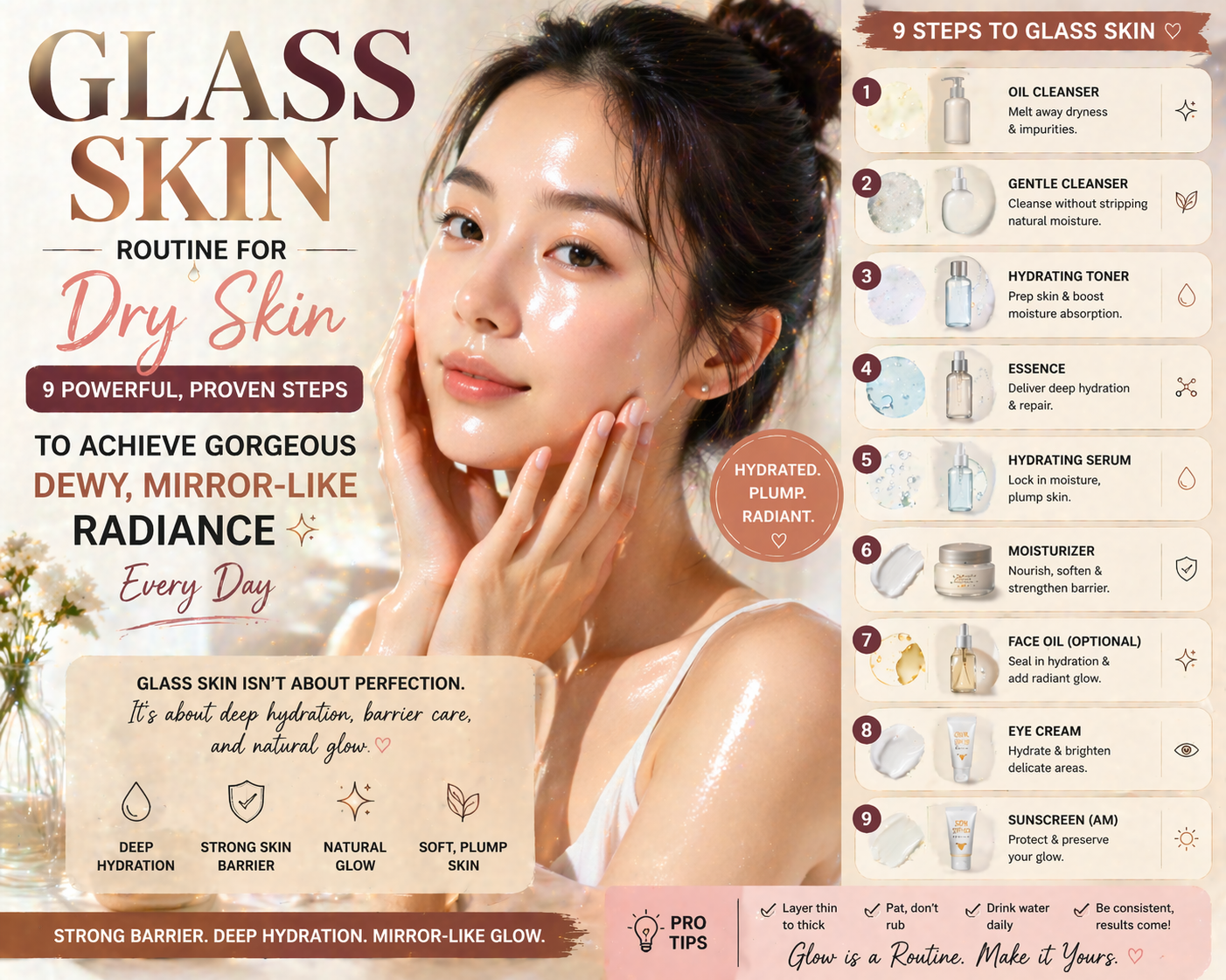
A complete glass skin routine for dry skin is the most sought-after — and most frequently misunderstood — beauty goal in the modern skincare conversation. The glass skin aesthetic, born from the meticulous world of Korean skincare, describes a complexion so deeply hydrated, so luminously smooth, and so perfectly even that it appears almost translucent—like a polished mirror catching light. It is a complexion that does not look made-up. It looks intensely, radiantly alive.
Here is the problem that millions of dry-skinned beauty enthusiasts face: almost every glass skin guide ever written was designed for normal or oily skin types. The dewy, plump, glowing complexion at the centre of the glass skin ideal is achieved through a relentless focus on hydration, and dry skin, which already struggles chronically with moisture retention and barrier integrity, requires an entirely different approach, entirely different products, and an entirely different understanding of what makes its specific biology work.
Dry skin is not a barrier to glass skin. Managed correctly, it is actually an extraordinary advantage. Because dry skin, once properly hydrated and protected, has a naturally fine texture and low sebum production that produces one of the most beautiful, pure expressions of the glass-skin aesthetic available—a luminosity so clean and so refined that oily skin types spend years trying to replicate it.
This guide is your complete, science-backed, Apex-crafted glass skin routine for dry skin—built from the ground up for your specific biology, your specific challenges, and your specific path to the most extraordinary version of your natural radiance.
What Is Glass Skin — And Why Does Dry Skin Achieve It Differently
Glass skin is not a product. It is not a filter. It is a clinically achievable skin state defined by three simultaneous characteristics: profound and consistent hydration, a completely smooth and even surface texture, and high reflectivity—the property that gives glass skin its characteristic mirror-like luminosity.
According to Healthline’s dermatology editorial team, glass skin results from a combination of excellent skin barrier function, high cellular hydration, and the elimination of surface irregularities (flaking, congestion, and textural unevenness) that scatter light rather than reflect it.
Why Dry Skin Has Unique Glass Skin Challenges
Dry skin’s primary glass-skin challenge is not the absence of radiance—it is the presence of the specific conditions that prevent radiance from showing.
- Chronic dehydration: Dry skin is deficient in both oil (sebum) and water content, meaning its cells are consistently under-hydrated at a cellular level
- Compromised barrier function: Without adequate lipid production, dry skin’s barrier allows transepidermal water loss (TEWL) to occur continuously, undermining every hydration effort
- Surface flaking and rough texture: Dead cell accumulation on the skin’s surface creates a dull, light-scattering texture that prevents the reflectivity that defines glass skin
- Tightness and fine line exaggeration: Dehydration makes fine lines and surface wrinkles temporarily more prominent, creating a texture that catches and diffuses light rather than reflecting it
The glass skin routine for dry skin in this guide addresses each of these challenges in sequence, building the conditions for genuine luminosity from the cellular level upward.
The 9-Step Glass Skin Routine for Dry Skin
Step 1 — The Balm or Oil Double Cleanse (Evening Only)
The glass skin routine for dry skin begins, paradoxically, with cleansing—and for dry skin, this means the gentlest, most lipid-preserving approach available. The K-Beauty double cleanse is the foundation of the glass skin method, and for dry skin, it requires careful product selection that prioritises barrier maintenance over aggressive purification.
Evening First Cleanse—Balm or Oil: An oil-based balm cleanser dissolves the day’s SPF, light makeup, and sebum at a molecular level without stripping the skin’s own lipid layer. For dry skin specifically, a cleansing balm (which contains more emollient waxes and less pure oil) is superior — it dissolves impurities while simultaneously depositing skin-identical lipids onto the skin’s surface.
Evening Second Cleanse—Cream or Milk Cleanser: Follow with the gentlest cream or milk cleanser available. The surfactant system should be entirely free of sulphates and use only the mildest glucoside or isethionate-based surfactants. For dry skin, micellar water can replace the second cleanse on days when the skin feels particularly vulnerable.
Morning Cleanse: In the morning, dry skin benefits most from a water rinse only — no cleanser. Overnight, dry skin produces minimal sebum and no environmental pollutants; stripping its natural morning lipids with even a gentle cleanser undermines the hydration base of your entire glass-skin routine.
Step 2 — Exfoliate Wisely: The Dry Skin Glass-Skin Rule
Surface texture is the enemy of glass skin, and gentle, strategic exfoliation is the tool that eliminates it. For dry skin, the cardinal rule is to exfoliate less frequently but more intelligently than oily skin types.
The Apex Dry Skin Exfoliation Protocol for Glass Skin:
| Exfoliant Type | Frequency for Dry Skin | Best Options |
| PHA (Polyhydroxy Acid) | 2–3x per week | Gluconolactone, lactobionic acid |
| Low-concentration Lactic Acid (5%) | 1–2x per week | Paula’s Choice, The Ordinary |
| Enzyme exfoliant | 2x per week | Papaya, pumpkin, bromelain enzymes |
| Physical scrub | Never creates micro-tears and worsens dryness | — |
PHAs are the ideal dry-skin exfoliants for glass skin because they also function as humectants—they attract moisture to the skin while removing dead cell accumulation simultaneously. This dual action produces the smooth, light-reflecting surface that glass skin requires without the potential dehydration risk of stronger AHAs.
Timing: Always exfoliate in the evening, not the morning. Morning exfoliation before sun exposure increases photosensitivity unnecessarily and removes the surface layer that your glass-skin routine needs intact for the rest of the day.
Step 3 — First Essence: The Most Underrated Glass Skin Step
The first essence is the most distinctly Korean step in the glass skin routine and the one most frequently omitted in Western skincare adaptations — a significant omission for dry skin enthusiasts, because first essences deliver the foundational cellular hydration that makes every subsequent product more effective.
A first essence is a very light, watery liquid applied directly after cleansing to freshly washed, still-damp skin. It contains fermented ingredients—galactomyces, bifida ferment lysate, and saccharomyces—that accelerate cell turnover, deeply hydrate at a cellular level, and create the translucent, even-toned base that is the hallmark of true glass skin.
Top First Essences for Dry Skin:
- SK-II Facial Treatment Essence: The original glass skin product; 90% galactomyces ferment filtrate; transforms skin texture visibly over 4–6 weeks
- COSRX Advanced Snail 96 Mucin Power Essence: Snail secretion filtrate provides extraordinary hydration for dry skin at a fraction of SK-II’s price
- I’m from Rice Toner: Rice extract brightens and deeply hydrates—ideal for dry skin seeking luminosity
Apply with gentle pressing motions, never swiping—this technique drives the essence into the skin rather than across its surface.
Step 4 — Layer Multiple Hydrating Serums (The Glass Skin Secret for Dry Skin)
This is the step that most dramatically differentiates the glass skin routine for dry skin from a standard moisturising approach. Rather than relying on a single, heavy moisturiser to deliver all the hydration the skin needs, the Korean glass skin method layers multiple lightweight hydrating serums—each one absorbed before the next is applied—building hydration depth that a single product can never achieve.
The Apex Three-Serum Hydration Stack for Dry Skin:
Layer 1—Hyaluronic Acid Serum (Applied to Damp Skin): Multi-molecular weight HA is applied immediately after essence while the skin is still slightly damp. The most critical application rule for dry skin: follow within 30 seconds with the next layer to seal the HA’s water-binding action before it can draw moisture from deeper skin layers instead of from the atmosphere.
Layer 2—Niacinamide Serum (4–5%): Niacinamide strengthens the ceramide production in your skin barrier, reduces the appearance of pores and unevenness, and brightens the complexion—all essential glass skin prerequisites. At 4–5% concentration, it delivers maximum glass-skin benefit without the flushing risk associated with higher concentrations.
Layer 3—Centella Asiatica (Cica) Serum: It’s anti-inflammatory, deeply soothing, and a powerful accelerator of the skin’s own barrier lipid synthesis. For dry skin specifically, cica serum in the evening routine accelerates overnight barrier repair, meaning you wake up to visibly plumper, smoother skin every morning.
Allow 60–90 seconds between each serum layer for optimal absorption.
Step 5 — Sheet Mask Weekly: The Glass Skin Intensive Treatment
Weekly sheet masking is one of the glass skin practices most frequently skipped in Western routines and most central to Korean glass skin maintenance — particularly for dry skin, which benefits dramatically from the occlusive, concentrated hydration delivery that sheet masks provide.
A sheet mask applied for 15–20 minutes creates a temporary seal over the skin’s surface, forcing the serum-saturated sheet to deliver its active ingredients without the competition of evaporation. For dry skin, the result is a visible, photographable plumping and brightening effect that lasts 24–48 hours and cumulatively improves skin texture and radiance with each weekly treatment.
Glass Skin Sheet Masks for Dry Skin — What to Look For:
- High hyaluronic acid and glycerin content — humectant saturation is essential
- Centella asiatica or snail mucin for barrier-supporting benefits
- No fragrance, no alcohol—dry skin is inherently more reactive and requires fragrance-free formulations
- Thin, adherent sheet material — cotton sheets lose serum quickly; bio-cellulose or hydrogel sheets maintain contact and reduce evaporation dramatically
Budget option: COSRX Ultimate Moisturising Honey Overnight Mask, applied as a sleeping pack on sheet mask nights, delivers comparable occlusive benefit at a fraction of the cost of premium sheet masks.
Step 6—Facial Oil: Dry Skin’s Glass Skin Superpower
This is the step that transforms a good glass skin routine into an extraordinary one for dry skin specifically. Facial oils—applied after serums and before moisturiser, or mixed directly into moisturiser—deliver the lipid-phase hydration that dry skin’s naturally low sebum production cannot provide on its own.
Why Facial Oil is Non-Negotiable for Dry Skin and Glass Skin:
According to research from the Journal of Cosmetic Dermatology, plant-derived facial oils containing linoleic acid and oleic acid directly replenish the skin’s lipid barrier, reducing TEWL and visibly improving the skin’s surface luminosity. For dry skin, this represents the closest thing to replicating the natural sebum that the skin underproduces.
Best Facial Oils for Dry Skin Glass Skin:
| Oil | Key Fatty Acid Profile | Texture | Best For |
| Rosehip seed oil | High linoleic acid | Dry/fast-absorbing | Brightening, anti-aging |
| Squalane | Stable, skin-identical | Ultra-light | All-purpose barrier support |
| Marula oil | Oleic + linoleic balance | Medium-weight | Plumping, radiance |
| Argan oil | High oleic acid | Lightweight | Overnight repair |
| Sea buckthorn (diluted) | Rare omega-7 | Use 1–2 drops only | Extreme radiance boost |
Apply 3–5 drops, pressed gently into the skin after your final serum layer and before moisturiser. Alternatively, mix 2 drops into your moisturiser for a single, luxurious application step.
Step 7 — Lock Everything In With a Ceramide-Rich Moisturizer
The moisturiser in a glass skin routine for dry skin performs two distinct jobs: sealing all the hydration layers beneath it while simultaneously contributing its own skin-identical lipids to the barrier. This makes ceramide-rich, emollient-heavy formulations the clear winner for dry skin—not the gel-based or water-gel moisturisers that work beautifully for oily skin but offer insufficient lipid support for dry skin’s specific needs.
Apex Moisturiser Selection for Dry Skin Glass Skin:
- CeraVe Moisturizing Cream: Three ceramides + hyaluronic acid + cholesterol; the clinical gold standard for dry skin barrier support
- Laneige Water Sleeping Mask: A K-Beauty hero product; tetrahexyldecyl ascorbate for brightening + sleeping capsules for overnight hydration delivery—the most distinctly “glass skin” moisturizer available
- Drunk Elephant Lala Retro Whipped Cream: Six African plant oils + ceramides; premium emollient-rich formula with a beautiful application experience
- Tatcha Dewy Skin Cream: Japanese tsubaki and hyaluronic acid in a luxuriously emollient formulation specifically designed for the glass skin aesthetic
Apply using upward, lifting strokes and include the neck—one of the most visible and most undertreated facial zones.
Step 8—Apply SPF That Enhances Rather Than Diminishes the Glow
SPF is non-negotiable every morning regardless of weather, season, or lifestyle—but for a dry-skin glass-skin routine, the formulation of your SPF matters enormously. Many conventional sunscreens leave a white cast, a matte finish, or a dry, chalky texture that directly undermines the luminous, dewy aesthetic you have spent the preceding seven steps building.
SPF Criteria for Dry Skin Glass Skin:
- Dewy or satin-finish formulation—look specifically for sunscreens marketed with skin-feel language like “serum-like”, “glassy”, or “second skin”.
- Hydrating base formulation: Look for SPFs containing hyaluronic acid, glycerin, or niacinamide as supporting ingredients
- No alcohol denat. in the top half of the ingredient list, alcohol-based SPFs are aggressively drying
- SPF 50 preferred—higher SPF formulations often contain more emollient vehicles to suspend the UV filters, making them naturally richer and more appropriate for dry skin
Top Dry Skin Glass Skin SPF Options: Beauty of Joseon Relief Sun Rice + Probiotics SPF 50; Purito Daily Go-To Sunscreen SPF 50 (contains no alcohol); and Anua Birch Juice Moisturising Sunscreen SPF 50.
For your complete morning skincare strategy from wake-up to walk-out, including how to build this glass-skin routine seamlessly into a full morning practice, our guide on aesthetic morning routines for students provides the complete Apex morning framework—beautiful, intentional, and perfectly curated for every skin type.
Step 9—The Glass Skin Lifestyle Pillars: Inner Radiance for Outer Luminosity
The ninth and most holistic step in the glass skin routine for dry skin is not a product application—it is the recognition that genuine glass skin is a whole-body state, not merely a topical achievement. The most luminous, most consistently glass-like complexions in the world belong to people who also prioritise specific internal habits that their topical routine alone cannot fully replicate.
The Internal Glass Skin Protocol for Dry Skin:
- Hydration: 2–2.5 L of water daily minimum—dry skin loses water through its compromised barrier more rapidly than other skin types, making internal hydration replenishment even more critical
- Omega-3 fatty acids: Clinical studies consistently demonstrate that omega-3 supplementation reduces TEWL and improves skin surface luminosity—prioritize oily fish, walnuts, flaxseed, and quality fish oil supplements
- Collagen peptides: Oral collagen supplementation has demonstrated measurable improvements in skin hydration and elasticity in multiple clinical trials—a particularly powerful intervention for dry skin and glass skin goals. For the complete science on collagen’s role in skin transformation, our guide on unlocking the benefits of collagen for ageless beauty is essential reading
- Sleep: 7–9 hours. Overnight is when skin produces 80% of its daily collagen, processes topical actives most effectively, and undergoes the barrier repair that produces morning luminosity. Sleep deprivation visibly and immediately diminishes the glass skin effect
- Stress management: Cortisol elevation directly impairs the ceramide synthesis that your barrier—and therefore your glass skin—depends on
The Complete Glass Skin Routine for Dry Skin — At a Glance
Morning Routine (7–10 Minutes)
| Step | Product Type | Key Ingredients | Dry Skin Specific Note |
| 1 | Water rinse only (no cleanser) | — | Preserve overnight sebum |
| 2 | First essence | Galactomyces, HA, fermented ingredients | Press in; do not swipe |
| 3 | HA serum (on damp skin) | Multi-weight hyaluronic acid | Seal within 30 seconds |
| 4 | Niacinamide serum | 4–5% niacinamide | Brightens + barrier supports |
| 5 | Facial oil (2–3 drops) | Squalane, rosehip, marula | Press, never rub |
| 6 | Rich ceramide moisturizer | Ceramides, glycerin, emollients | Upward lifting strokes |
| 7 | Dewy-finish SPF 50 | HA, no alcohol denat. | Final step, every day |
Evening Routine (10–15 Minutes)
| Step | Product Type | Key Ingredients | Dry Skin Specific Note: |
| 1 | Cleansing balm (first cleanse) | Plant oils, emollient waxes | Removes SPF + impurities |
| 2 | Cream cleanser (second cleanse) | Mild surfactants, ceramides | 30-second maximum cleanse |
| 3 | PHA or lactic acid (2–3x week) | Gluconolactone, lactic acid 5% | Smooth texture for reflectivity |
| 4 | First essence | As morning | Foundational cellular hydration |
| 5 | HA serum | Multi-weight HA | On slightly damp skin |
| 6 | Cica or peptide serum | Centella, peptide complex | Overnight barrier repair |
| 7 | Facial oil (3–5 drops) | Rosehip, argan, or squalane | The dry-skin glass-skin edge |
| 8 | Rich night moisturizer | Ceramides + shea + fatty acids | Richer than morning formula |
| 9 | Sheet mask (1x weekly) | HA + centella + snail mucin | Replace steps 5–8 on mask nights |
Glass Skin Progress Timeline for Dry Skin
| Timeline | What You Will Notice |
| Weeks 1–2 | Immediate improvement in surface feel; reduced tightness; skin feels consistently comfortable |
| Week 3–4 | Visible improvement in surface texture; fewer dry patches; early luminosity increase |
| Week 6–8 | Measurable improvement in skin tone evenness; consistent dewy quality appearing in natural light |
| Month 3 | Full glass skin effect beginning to manifest; deep, stable hydration; genuine mirror-like luminosity |
| Month 6+ | Skin completely transformed, barrier rebuilt, glass skin sustainable with consistent maintenance |
The Most Common Glass Skin Mistakes Dry Skin Makes
- Using gel-based or mattifying products: Glass skin for dry skin requires richness and emollience—avoid every product with “oil-free”, “mattifying”, or “shine control” in its description
- Over-exfoliating: Two to three gentle exfoliation sessions per week is the maximum for dry skin. More than this strips the barrier faster than it can rebuild, preventing the smooth surface that glass skin requires
- Skipping facial oil: Oil is not optional for dry glass skin—it is the lipid-phase bridge between deep hydration and visible surface luminosity that no water-based product can replicate
- Using SPF that mattifies: A matte SPF applied over a perfectly layered hydration stack will eliminate the glass skin effect within 60 seconds of application. SPF formulation is a glass skin decision, not just a sun protection one
- Expecting results without internal support: Topical glass skin routines for dry skin achieve their maximum potential only when supported by adequate hydration, omega-3 supplementation, sleep, and stress management
Frequently Asked Questions About Glass Skin Routine for Dry Skin
Can dry skin naturally achieve glass skin?
Yes—and in some ways more beautifully than oily or combination skin. Dry skin’s low sebum production means it has naturally fine pores and an inherently smooth surface texture. Once the hydration deficit and barrier compromise are addressed through the right routine, dry skin achieves a luminosity that is distinctly pure and refined. The challenge is not the potential—it is ensuring the right foundational conditions are consistently maintained.
How long does it take to get glass skin with dry skin?
Visible improvement in surface texture and hydration occurs within 2–4 weeks of consistent routine application. The full glass skin effect — deep, stable luminosity with mirror-like reflectivity — typically emerges at the 8–12 week mark. This timeline assumes consistent daily morning and evening routine compliance, including weekly sheet masking and internal hydration practices.
What is the most important product in a glass skin routine for dry skin?
For dry skin specifically, facial oil is the unique and irreplaceable product that the skin type requires above all others. HA serums and ceramide moisturisers are essential in any glass-skin routine, but they are insufficient for dry skin alone—the lipid-phase support of a well-chosen facial oil is what makes the difference between a hydrated complexion and a genuinely luminous, glass-skin complexion.
Is glass skin achievable without Korean beauty products?
Absolutely. The Korean beauty methodology—layering, double cleansing, essence application, and sheet masking—is a framework, not a brand requirement. Many European, American, and Indian skincare brands formulate products that perform the same functions with equal clinical efficacy. The principles matter; the country of origin does not.
CONCLUSION
The glass skin routine for dry skin is proof that the most coveted beauty aesthetic in the contemporary world is not the exclusive territory of any single skin type—it is the reward for anyone willing to understand their skin’s specific biology and build a routine that addresses it with precision, patience, and genuine intelligence.
Dry skin, given the right glass-skin protocol, does not merely achieve the glass-skin aesthetic. It perfects it. The fine pores, the lack of excessive shine, and the naturally even texture of a well-managed dry complexion create a version of glass skin that is perhaps the most beautiful expression of the aesthetic available—luminous, pure, deeply radiant, and entirely authentic.
Build the routine. Maintain the consistency. Trust the biology. Your glass skin is already inside your dry complexion—waiting for exactly the right conditions to emerge.
Explore the full Apex Beauty & Wellness collection for more expert-curated, science-backed guides to your most luminous, powerful self.
- Aesthetic Morning Routine for Students — https://apexaesthetic.blog/aesthetic-morning-routine-for-students/
- Benefits of Collagen for Ageless Beauty — https://apexaesthetic.blog/benefits-of-collagen-for-ageless-beauty/
- Quiet Luxury Home Decor Ideas— https://apexaesthetic.blog/quiet-luxury-home-decor-ideas/
- How to Stop Overthinking Everything—https://apexaesthetic.blog/how-to-stop-overthinking-everything-everything