
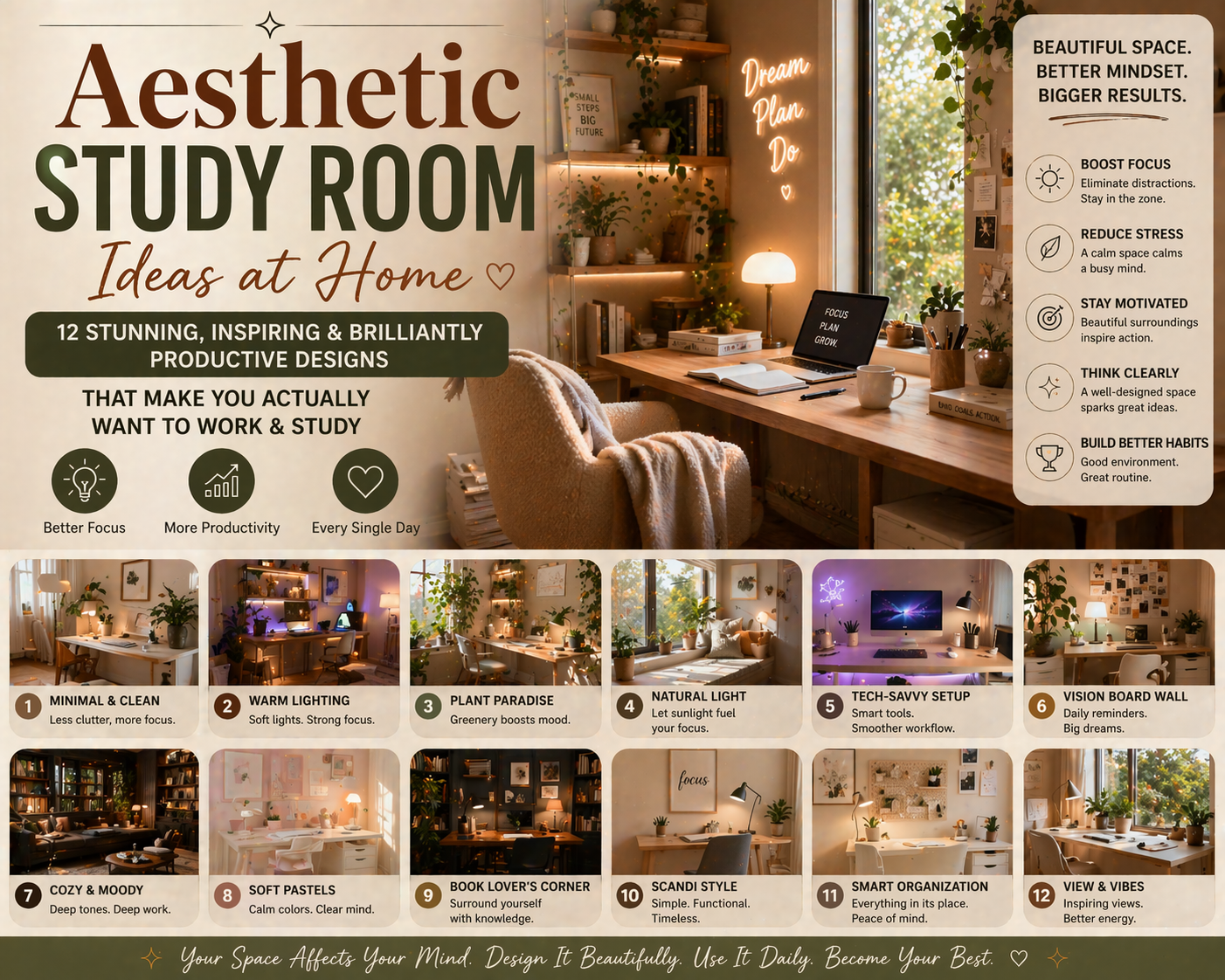
Table of Contents
INTRODUCTION
The best aesthetic study room ideas at home are built on a profound but frequently overlooked truth: the environment in which you work directly determines the quality of work you produce—not through motivation, not through willpower, but through the neurological and psychological mechanisms by which physical space shapes cognitive state. A beautiful, curated, intentionally designed study space does not merely look impressive in photographs. It changes how you think, how long you focus, how much you produce, and how you feel about the work itself.
We are living through the permanent normalization of remote and hybrid work—a structural shift in professional life that has made the home study or home office not a temporary accommodation but a primary professional environment. And yet the vast majority of home study spaces in 2026 are still afterthoughts: a folding table against a wall, a chair borrowed from the kitchen, books stacked haphazardly on whatever surface was available, and lighting that would embarrass a budget hotel. The research on how this affects cognitive performance is unambiguous.
At Apex Aesthetic, we approach the home study with the same design intelligence we bring to every other space: as a curated, intentional environment that serves both function and beauty with equal priority—because the false choice between the two is the most persistent and most damaging myth in home design. The 12 aesthetic study room ideas at home in this guide will show you exactly how to design a space that is simultaneously as beautiful as it is productive—a room you genuinely want to enter, stay in, and do extraordinary work within.
Why Your Study Room Aesthetic Directly Impacts Your Performance
The connection between physical environment and cognitive performance is not aesthetic philosophy—it is neuroscience. Your workspace is not a passive backdrop to your thinking. It is an active participant in every thought you produce within it.
The Science of Environment and Cognitive Performance
Research published in the Journal of Environmental Psychology consistently demonstrates that visual clutter increases cortisol levels and measurably reduces the prefrontal cortex’s capacity for focused cognitive work. A study from Princeton University found that physical clutter in the visual field competes for neural resources with the task at hand, reducing performance on tasks requiring attention and working memory by up to 20%.
Conversely, environments characterized by order, natural elements, appropriate lighting, and personally meaningful objects produce measurable increases in focus duration, creative output quality, and subjective sense of well-being during work. The aesthetic study room is not a luxury. It is a performance asset — and for anyone who works or studies from home, it may be the most important performance investment available.
The Three Pillars of a High-Performance Aesthetic Study Space
- Visual calm: A space with sufficient order, tonal cohesion, and managed surface density that the visual system can settle rather than scan constantly
- Environmental quality: Lighting, air quality, temperature, and acoustic environment calibrated to support sustained cognitive work
- Personal resonance: Objects, art, and details that communicate your identity, your values, and your aspirations — creating the psychological ownership that makes a space genuinely motivating rather than merely functional
All 12 of the following aesthetic study room ideas at home address at least two of these three pillars simultaneously.
12 Stunning Aesthetic Study Room Ideas at Home
1 — Choose a Tonal Color Palette That Supports Focus, Not Distraction
Color is the most immediately impactful and most affordable design decision in any aesthetic study room transformation—and for study spaces specifically, the wrong palette can actively undermine the cognitive work you are trying to do within it.
The Color Psychology of Productive Study Spaces:
Research in environmental color psychology, summarized by the Pantone Color Institute, demonstrates that:
- Cool blues and greens: Reduce perceived stress and improve sustained attention — ideal for analytical and writing work
- Warm neutrals (cream, warm white, greige): Create psychological safety and comfort without the stimulation that competes with focus
- Deep greens and forest tones: The most universally recommended study environment color—a biophilic connection that reduces fatigue during long work sessions
- Bright reds and oranges: Stimulating and energizing but counterproductive for sustained concentration—use only as very small accents, if at all
The Apex Study Room Palette Recommendation: Choose one of three proven focus palettes:
- Warm neutral (cream/greige walls + natural wood + deep green accent): The most versatile and broadly effective study environment palette
- Quiet blue-grey (soft blue-grey walls + white + aged brass): Ideal for analytical, research, and writing-intensive work
- Forest study (deep sage or forest green wall + warm white + natural wood): The most dramatically focus-supportive color environment—even a single deep green accent wall behind the desk creates measurable biophilic benefit
2 — Invest in a Desk That Reflects Your Professional Seriousness
Your desk is the gravitational center of any home study space—the surface where your most important work occurs and the visual anchor around which every other design element orbits. In an aesthetic study room at home, the desk is both a functional tool and a statement about how seriously you take your professional life.
The Apex Desk Selection Criteria:
- Material: Solid wood (oak, walnut, or pine with a quality finish) or a quality composite with a natural material surface. MDF with cheap laminate creates visual inauthenticity that subtly undermines the space’s premium feel
- Size: Never compromise on desk size — a study desk should be large enough for your primary screen, a notebook, and working materials simultaneously without crowding. For most home study setups, a 140–160cm width is the practical minimum
- Height: Standard desk height (72–75cm) works for most seated setups; standing desk converters or adjustable-height desks add flexibility that reduces physical fatigue during long work sessions
- Aesthetic style: Match your desk style to your chosen palette—natural oak for warm neutral palettes, white or painted wood for cool blue-grey, and dark walnut for forest study aesthetics
The minimalist desk surface rule: Apply the quiet luxury principle to your desk surface at all times—only the tools relevant to your current work should be visible. Everything else belongs in a drawer, a shelf, or a container. A clear desk creates a clear mind.
3 — Design a Layered Lighting System for Every Work Mode
Lighting is the single most performance-critical element in any aesthetic study room at home—and the most frequently compromised. Poor lighting (harsh overhead fluorescents, insufficient task light, or blue-spectrum LEDs) creates eye fatigue, reduces cognitive clarity, disrupts circadian rhythm during evening work, and makes a space feel institutional rather than personally curated.
The Apex Three-Layer Study Room Lighting System:
Layer 1 — Ambient (Background): Warm white LED bulbs (2700–3000K) in the room’s main overhead fixture. If dimmable, install a dimmer—the ability to reduce ambient light for deep focus sessions is one of the highest-impact study environment upgrades available for under $20.
Layer 2—Task (Work-Specific): A quality adjustable desk lamp positioned to illuminate your working surface without glare on your screen. The lamp base should complement your design palette—aged brass, matte black, or natural ceramic are the most aesthetically coherent choices for a premium home study.
Layer 3—Accent (Atmospheric): A secondary warm-toned light source that creates dimensional depth and evening atmosphere—a small shelf lamp, an LED strip behind a monitor (warm white, never RGB), or a single candle. This accent layer transforms the space from a daytime office to an evening study sanctuary.
Screen considerations: Position your monitor perpendicular to (not facing or backed against) any window to prevent glare during daylight hours. A monitor that faces a window creates constant eye adjustment between bright external light and a darker screen surface—a major source of cognitive fatigue during long work sessions.
4 — Build a Purposeful Bookshelf That Is Both Functional and Aesthetic
A well-curated bookshelf in a home study performs double duty: it provides functional storage and reference access while simultaneously serving as the room’s most intellectually characterful design element. In aesthetic study room ideas at home, the bookshelf is the most personal design statement available—communicating your intellectual interests, your creative influences, and your professional identity in a single curated visual.
The Apex Study Bookshelf Formula:
- Organize by project or subject cluster, not by alphabet or color alone: Books organized by how you actually use them are both more functional and more authentically personal than purely aesthetic arrangements
- Edit ruthlessly: Only books you have read, are currently reading, or genuinely intend to read should be on visible shelves—decorative books with no personal relevance undermine the shelf’s intellectual authenticity
- Punctuate with meaningful objects: A small plant, one sculptural object of personal significance, a framed photograph or print—punctuate every second or third shelf section with one non-book element
- Leave empty space: Shelves that are 70–80% full read as curated; shelves at 100% capacity read as storage
For more inspiration on how to style shelves and surfaces with the kind of quiet authority that transforms a functional room into a genuinely beautiful space, our comprehensive guide on quiet luxury home decor ideas is a powerful companion resource—the same principles of editorial restraint that define the quiet luxury aesthetic apply perfectly to the home study.
5 — Add a Biophilic Element: Plants as Productivity Allies
Plants are among the most evidence-supported focus and well-being enhancers in any home study environment—and among the most aesthetically impactful additions available at any budget. The biophilic effect of natural elements in working environments is well-documented: plants reduce cortisol, improve air quality, reduce acoustic reverberation, and increase subjective feelings of calm, creativity, and purpose.
Best Plants for Aesthetic Study Rooms:
| Plant | Aesthetic Character | Light Requirement | Study Benefit |
| Peace lily | Elegant, arching white flowers | Low-light tolerant | Air purification |
| Pothos (marble queen) | Trailing, lush, photogenic | Low–medium | Low maintenance, fast growth |
| ZZ plant | Architectural, dark glossy leaves | Low light | Thrives on neglect |
| Snake plant | Vertical, structural, minimal | Low light | Night oxygen production |
| Fiddle leaf fig | Statement size, tropical | Bright indirect | Visual focal point |
| Monstera | Dramatic, sculptural | Medium indirect | Improves humidity |
Position your primary plant where it is visible from your primary working sightline—not behind you (where it is invisible during work) but in your visual periphery or on your desk surface, where its presence contributes to the biophilic benefit during work.
6 — Create a Curated Gallery Wall or Single Statement Art Piece
Art in a home study is not decoration. It is an environmental anchor that communicates your intellectual and creative identity, provides visual interest during cognitive rest moments, and elevates the space from a functional workspace to a genuinely personal and inspiring environment.
The Two Aesthetic Study Rooms Art Approaches:
Approach 1 — Single Statement Piece: One large-format artwork (minimum A1 size) positioned behind the desk or on the primary sightline wall. This creates immediate visual authority and establishes the room’s aesthetic character in a single decision. Abstract art in the room’s accent color, a vintage map of a personally significant place, or a large-format photographic print all work powerfully in this role.
Approach 2—Curated Gallery Wall: A thoughtfully assembled collection of 6–9 works in complementary frames, mixing types (photography, illustration, typographic prints, and personal photographs) around a cohesive theme or color palette. For a home study, themes such as architecture, typography, maps, nature, or personal achievements create a personally resonant gallery that motivates rather than merely decorates.
Budget art sources: Unsplash and Pexels for free-to-print photography; Etsy for affordable original prints and illustrations; museum digital archives (Rijksmuseum and Met Museum) for public-domain masterwork downloads; local artist markets for genuinely original, personally meaningful pieces.
7 — Manage Cables and Clutter With Design Intelligence
The greatest enemy of an aesthetic study room at home is not bad furniture or poor lighting—it is visible cable chaos and surface clutter. Every exposed power cable, every scattered stationery item, every unmanaged pile of papers is a visual cortisol trigger that accumulates cognitive cost throughout the work session.
The Apex Cable and Clutter Management System:
- Cable management trays: Under-desk cable organizers with velcro ties ($10–$25) that consolidate all power cables into invisible bundles
- Cable clips along the desk’s back edge: Keep charging cables routed along the desk’s rear edge where they are accessible but invisible from the primary sightline
- Wireless peripherals, where possible: A wireless keyboard and mouse eliminate the two most visually disruptive cable runs on any desk surface
- Closed storage for working materials: A single drawer unit, desk organizer tray, or small cabinet adjacent to the desk keeps all non-current materials hidden without becoming inaccessible
- The end-of-day clear: A 3-minute end-of-session clearing ritual—returning all materials to their designated places—ensures every work session begins in a clean, focused environment rather than yesterday’s visual residue
8 — Choose a Chair That Supports Both Your Body and Your Aesthetic
Your study chair is the piece of furniture you will spend the most time in physical contact with—and the one most frequently chosen purely on function (or price), with aesthetic consideration entirely absent. In an aesthetic study room at home, your chair is both a health investment and a design statement.
The Apex Study Chair Selection Matrix:
| Priority | Budget Option | Investment Option |
| Ergonomics | Ikea Markus ($230) | Herman Miller Aeron, Steelcase Leap ($800–$1,400) |
| Aesthetic (minimal) | Branch Ergonomic Chair ($329) | Humanscale Freedom ($800+) |
| Aesthetic (cozy) | Accent chair + laptop table ($150–$300) | Custom upholstered task chair ($400–$800) |
| Posture support | Lumbar pillow + standard chair ($50–$120) | Standing desk + anti-fatigue mat ($400+) |
The cozy study corner alternative: For those who work better in a more relaxed posture, a well-proportioned armchair with a small side table for a laptop, notebook, and coffee creates a warm, intimate study environment that is both aesthetically extraordinary and deeply conducive to certain types of cognitive work (reading, writing, creative thinking). This approach works best in a dedicated room rather than a shared space.
9 — Use Scent to Create a Focus-State Ritual
Scent is the most neurologically direct sense—processed by the brain’s limbic system before it reaches conscious awareness—making it one of the most powerful environmental triggers for specific cognitive states. A consistent, beautiful scent associated exclusively with your study space creates a Pavlovian focus trigger: after 2–3 weeks of consistent use, simply smelling the scent initiates the focused state you have trained yourself to associate with it.
The Apex Study Room Scent Palette:
- Rosemary: Clinically demonstrated to improve memory recall and alertness — ideal for studying and memorization-intensive work
- Peppermint: Increases alertness and cognitive stamina — excellent for long afternoon work sessions when energy dips
- Lemon and citrus: Bright, stimulating, and mood-elevating — effective for morning work sessions and creative tasks
- Cedarwood and sandalwood: Grounding and calming without sedating — ideal for anxiety-prone or easily distracted workers who need focus without overstimulation
Application: A reed diffuser or ultrasonic essential oil diffuser creates a consistent, gentle scent presence without the naked flame of a candle (which can be distracting or prohibited in some environments). Alternatively, a single soy candle lit at the beginning of a focus session and extinguished at the end creates a powerful behavioral anchor—the act of lighting the candle signals to the nervous system that focused work begins now.
10 — Design a Dedicated Reading or Reflection Corner
The most aesthetically extraordinary home study spaces include a secondary zone — separate from the primary desk — dedicated to reading, reflection, and the less structured cognitive work that generates insight, creativity, and strategic thinking. This reading corner communicates that the space is not merely a productivity machine but a space for genuine intellectual and creative life.
Creating the Apex Study Reading Corner:
- An armchair or chaise lounge of exceptional comfort and appropriate scale—this is the single most important piece in the reading corner; prioritize comfort and material quality above all
- A small side table for a cup of tea or coffee, a notebook, and a current book—at the right height for comfortable reach from the seating
- A floor lamp providing warm, directional reading light — positioned to illuminate the reading surface without glare
- A small footstool or ottoman transforms a reading chair into a genuinely restful experience, dramatically increases time spent in the corner, which is the goal
- The personal touch: A framed photograph, a meaningful small sculpture, a treasured object—one piece that makes this corner uniquely, unmistakably yours
11 — Incorporate Natural Materials for Warmth and Authenticity
The aesthetic study room at home in 2026 is defined, above all else, by its relationship with natural material—the same principle that drives both the Japandi and quiet luxury design movements that are shaping the decade’s most admired interiors. Natural materials—wood, linen, ceramic, stone, and rattan—create warmth, tactile authenticity, and visual depth that no synthetic material can replicate.
Natural Material Integration for the Aesthetic Study:
- Desk surface: Natural wood grain — left natural or lightly oiled, never heavy gloss or synthetic laminate
- Accessories: Ceramic pen holder, wooden letter tray, stone or concrete bookend—replace plastic stationery containers with natural alternatives
- Floor treatment: A jute, sisal, or natural wool rug under and around the desk zone grounds the workspace and reduces acoustic reflection
- Window treatment: Sheer linen panels or bamboo blinds — natural light management that adds material warmth
- Stationery: Even your daily tools contribute to the aesthetic—a quality leather-covered notebook, a weighted brass pen, a wooden ruler—natural material stationery elevates the entire desk surface
For the complete exploration of how natural materials and intentional spatial design create environments that support both extraordinary performance and genuine daily beauty, our guide on how to build self-discipline daily explores the powerful relationship between physical environment design and the daily discipline practice that produces exceptional work.
12 — Personalize With Intention: Make It Yours, Not a Template
The twelfth and most important of all aesthetic study room ideas at home is also the most personal: the decision to make your study space authentically, unmistakably yours rather than a reproduction of someone else’s Pinterest board. A space that reflects your specific intellectual passions, your professional identity, your creative influences, and your personal history is a space that genuinely motivates you—because it communicates back to you, every time you enter it, exactly who you are and what you are building.
The Apex Personalization Principles:
- Display evidence of your actual intellectual interests—not books you think you should have read, but books you have genuinely loved
- Include one personal memento or meaningful object that has nothing to do with productivity—a photograph, a souvenir from a significant journey, a gift from someone important
- Make one bold aesthetic choice that is purely yours—a color no one else would choose, an art piece that surprises visitors, a collection of objects that tells a story only you fully understand
- Resist the template—the most beautiful study rooms in the world are not the ones that most closely replicate an aesthetic trend; they are the ones that most authentically express the person who works within them
Budget Planning for Your Aesthetic Study Room at Home
| Element | Budget Tier | Investment Tier |
| Desk (solid wood, 140cm+) | $150–$300 | $400–$800 |
| Chair (ergonomic) | $80–$230 | $400–$1,400 |
| Desk lamp (brass/ceramic) | $25–$60 | $80–$200 |
| Bookshelf | $60–$150 | $200–$500 |
| Wall paint (focus color) | $20–$50 | $50–$100 |
| Rug (natural fiber) | $40–$100 | $100–$300 |
| Plants + pots (×2) | $20–$50 | $60–$150 |
| Art (1 statement piece) | $20–$60 | $100–$400 |
| Cable management | $15–$40 | $40–$80 |
| Scent (diffuser + oil) | $15–$40 | $50–$120 |
| Total | $445–$1,080 | $1,480–$4,050 |
Frequently Asked Questions
How small a space can work as an aesthetic study room?
A dedicated 2m x 2m corner can function as a genuinely aesthetic, high-performance study space. The key is treating it as a complete, intentionally designed zone — not an afterthought in a larger room. Use a facing wall for your desk and art, position your chair away from the primary room traffic, and define the space with a rug. Small study corners that are beautifully designed outperform large but chaotic study rooms in every measurable productivity and well-being metric.
Should a home study be in a separate room, or can it be part of a bedroom?
A separate room is always preferable for focus quality — the neurological association between a dedicated space and focused work is one of the most powerful productivity mechanisms available. However, a thoughtfully designed bedroom study corner—separated from the sleep zone with physical elements (a bookshelf divider, a distinct rug zone, and dedicated lighting)—can function effectively. The critical rule: never have the desk where it is visible from the bed, as this compromises both sleep quality and study focus.
What is the single most impactful change for an existing home study?
Lighting, without exception. Replacing harsh overhead fluorescents with warm white bulbs and adding a quality desk lamp costs under $50 and produces an immediately transformative atmospheric shift that makes the space feel warmer, more personal, and more conducive to sustained cognitive work.
CONCLUSION
The aesthetic study room ideas at home in this guide are ultimately an invitation to a fundamental reframe of what your home workspace is for. It is not just a place to execute tasks. It is the environment in which your professional life unfolds—the physical context of your thinking, your creating, your learning, and your building. Treating it with the same design intelligence, the same intentionality, and the same aesthetic ambition that you bring to your living room or bedroom is not self-indulgence. It is strategic self-investment in the conditions that produce your best work.
The most productive people in the world almost universally work in environments they have deliberately designed for performance. Join them. Design your study space with apex intention—and watch what becomes possible inside it.
OUTBOUND LINKS
INTERNAL LINKS
- Quiet Luxury Home Decor Ideas — https://apexaesthetic.blog/quiet-luxury-home-decor-ideas
- How to Build Self-Discipline Daily — https://apexaesthetic.blog/how-to-build-self-discipline-daily/
- Body Care Routine for Glowing Skin — https://apexaesthetic.blog/body-care-routine-for-glowing-skin/
- Morning Habits That Change Your Life — https://apexaesthetic.blog/morning-habits-that-change-your-life/