
Table of Contents
INTRODUCTION
The morning habits that change your life are not mysterious. They are not reserved for the extraordinarily disciplined, the naturally motivated, or the fortunate few who wake up eager at 5 AM without an alarm. They are a finite, well-documented, neurologically coherent set of daily practices — available to every person who chooses to implement them — that compound quietly and relentlessly into outcomes that, viewed from outside, can look almost miraculous: extraordinary health, high creative output, emotional resilience, professional excellence, and a quality of daily life that most people attribute to talent or luck rather than to the morning hours they cannot see.
The morning is the most neurologically powerful window in the human day. Before the accumulation of decisions, social interactions, information inputs, and emotional demands that characterize the waking hours, the brain exists in a state of relative clarity, low cortisol, and high neuroplasticity. The habits practiced in this window are not simply behaviors — they are instructions delivered to the brain at its most receptive moment, shaping the neural architecture that determines how you think, feel, and perform for the entire day that follows.
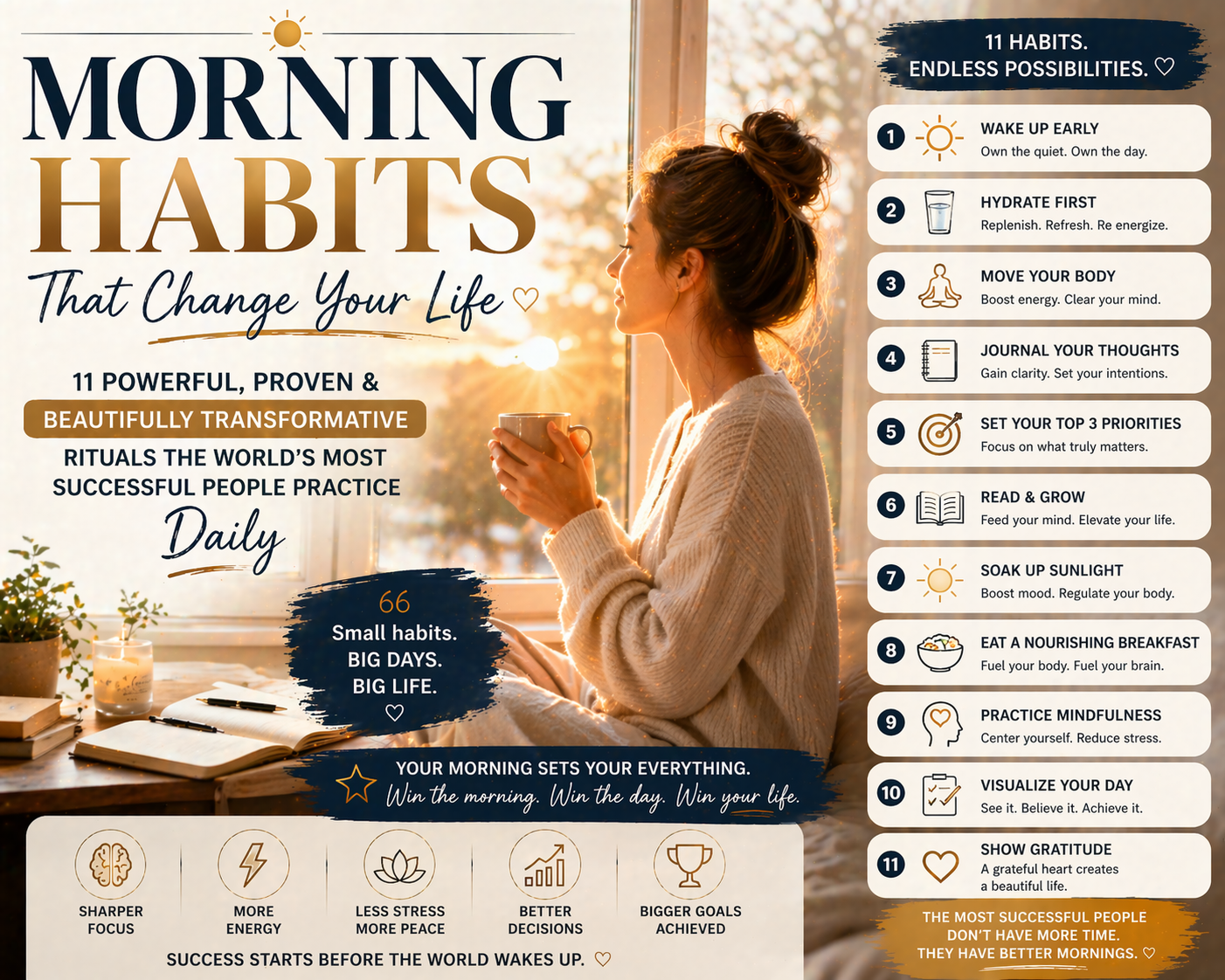
This guide presents 11 morning habits that change your life — not as a rigid prescription to be followed with military exactitude, but as a menu of evidence-based, Apex-curated practices from which you can build the personal morning framework that resonates most deeply with your specific biology, your specific aspirations, and your specific version of the extraordinary life you are building. Each habit is grounded in research, illustrated with practical implementation guidance, and connected to the larger Apex philosophy of intentional, beautiful, purposeful living.
Your life changes in the mornings. This is how.
The Neuroscience of Morning — Why the First Hours Are Everything
Before exploring the specific morning habits that change your life, it is worth understanding precisely why mornings carry disproportionate transformative power — because understanding the mechanism makes every subsequent practice more compelling, more motivating, and more correctly applied.
The Morning Brain: What Makes It Uniquely Receptive
The morning neurological state is defined by the convergence of several biological processes that occur simultaneously in the first 90–120 minutes after waking:
Cortisol Awakening Response (CAR): In the first 30–45 minutes after waking, cortisol levels surge by 50–100% above baseline — a natural, beneficial phenomenon that primes alertness, motivation, and executive function. This is not the stress cortisol associated with chronic pressure; it is the performance cortisol that evolution designed to help us engage with the day’s demands. Leveraging this window for focused, purposeful activity captures a biological advantage that disappears by mid-morning.
Adenosine clearance: During sleep, adenosine — the sleep-inducing neurotransmitter — is completely metabolized. The morning brain, having cleared this neurological “sleepiness load,” operates with significantly greater cognitive clarity than it will at any point during the day after subsequent adenosine re-accumulation begins.
Neuroplasticity peak: According to research from Harvard Medical School’s Neuroscience Department, the brain’s capacity for forming new neural connections — learning, habit formation, behavioral change — is highest in the morning, making it the optimal window for introducing new practices that you want to become automatic.
Default Mode Network Transition: The transition from sleep (unconscious processing) to waking activates the brain’s default mode network in a particularly creative, insight-generating state — one that many artists, writers, and strategic thinkers across history have identified as the source of their most original ideas.
The Compound Effect of Morning Habits
The reason morning habits that change your life work at the scale they do is not the individual impact of any single practice — it is compounding. Each morning habit practiced consistently creates three types of return simultaneously:
- Immediate return: The direct benefit of the practice itself (clarity from journaling, energy from movement, protection from SPF application)
- Cascade return: The improvement in every subsequent decision and action throughout the day that flows from the beginning in an optimal state
- Compound return: The cumulative neural pathway reinforcement that makes the habit progressively more automatic, effective, and self-sustaining over time
One morning habit practiced daily for 365 days is not simply 365 individual acts. It is a fundamentally different neural architecture — a new version of the person who performs it.
11 Morning Habits That Change Your Life
Habit 1 — Wake at a Consistent Time, Including Weekends
The most foundational of all morning habits that change your life costs nothing, requires no product, and demands only one form of discipline that the body will eventually make effortless: waking at the same time every single day. Circadian rhythm consistency — the alignment of your sleep-wake cycle with a reliable, predictable schedule — is the biological prerequisite for every other morning habit’s optimal functioning.
Why consistency matters more than timing: Sleep research from Stanford University’s Center for Sleep Sciences demonstrates that the quality of morning cognitive function is determined far more by wake-time consistency than by how early or late that time is. A person who consistently wakes at 7:30 AM will outperform a person who wakes at 6:00 AM on weekdays but 9:30 AM on weekends — because the weekend sleep irregularity creates what researchers term “social jet lag,” shifting the circadian phase and degrading morning cognitive clarity for the following 2–3 days.
Practical implementation: Set one alarm. Honor it as a non-negotiable. On days when earlier waking feels impossible, your consistent time remains the anchor — not an aspirational early time that you override with snooze. Consistency for 21–28 days creates sufficient circadian entrainment for waking to feel natural rather than forced.
Habit 2 — Protect the First 30 Minutes From All Digital Input
The single most disruptive thing you can do to a powerful morning is to reach for your phone within moments of waking. The algorithm, the news feed, the notification stream — these are not neutral information sources. They are attention capture systems specifically engineered to generate anxiety, comparison, and reactive emotional states that directly undermine the neurological advantages of the morning window.
What happens neurologically when you check your phone first thing:
- Cortisol spikes beyond the productive CAR level into reactive stress cortisol
- The default mode network’s creative morning state is immediately displaced by externally driven information processing
- Decision fatigue begins before you have made a single decision of your own
- The emotional tone of your morning is determined by whatever the algorithm decided to show you, not by your own intentions
The 30-minute digital-free morning window: Reserve the first 30 minutes exclusively for yourself. No phone, no news, no social media, no email. During this window, every other habit in this guide can be practiced without interference. This single boundary, maintained consistently, may be the highest-leverage behavioral change available in the entire morning habit repertoire.
Habit 3 — Hydrate Before Caffeinating
The body wakes from 7–9 hours of fasting and mild dehydration. Reaching for coffee before water is the most widespread morning nutritional mistake — caffeine is a mild diuretic, meaning that caffeine before rehydration compounds the dehydration state rather than addressing it.
The Apex Morning Hydration Protocol:
- 500ml of room-temperature water within 5 minutes of waking, before any food or caffeine
- Optional additions: a pinch of pink Himalayan salt (electrolyte replacement), a squeeze of lemon (gentle liver support and vitamin C), or a teaspoon of apple cider vinegar (digestive activation)
- Delay your first coffee by 60–90 minutes after waking — during this window, the cortisol awakening response provides natural alertness; caffeine added during the CAR peak creates tolerance and blunts the coffee’s later effectiveness
The visible skin benefits of consistent morning hydration compound over weeks into measurable luminosity improvements — connecting this habit directly to the body care and skin-glow practices explored in our guide on a body care routine for glowing skin.
Habit 4 — Move Your Body: The Morning Exercise Imperative
Exercise is the single most comprehensively evidence-supported habit for improving virtually every dimension of human wellbeing simultaneously — and morning is the window in which its neural and hormonal benefits are maximized. Morning exercise triggers a cascade of neurochemical changes that improve mood, focus, memory consolidation, and stress resilience for 4–6 hours post-exercise — precisely the window that overlaps with most people’s primary professional productivity period.
The Morning Exercise Menu for Different Schedules:
| Time Available | Recommended Practice | Primary Benefit |
| 10 minutes | Brisk walk or light yoga flow | Cortisol regulation, mood elevation |
| 20 minutes | Bodyweight circuit or stretching | Circulation, focus, energy |
| 30 minutes | Running, cycling, or swimming | Cardiovascular, BDNF production, full benefit |
| 45–60 minutes | Full strength + cardio session | Maximum neurological and physical benefit |
BDNF — the brain fertilizer of morning exercise: According to research published in Nature Neuroscience, aerobic exercise triggers the release of Brain-Derived Neurotrophic Factor (BDNF) — a protein that promotes the growth and connection of new neurons, sharpens memory, accelerates learning, and produces the mental clarity that high-performing people often describe as their most productive post-exercise experience. Even 20 minutes of moderate-intensity morning exercise produces measurable BDNF elevation that lasts through the morning work session.
Habit 5 — Practice Your Non-Negotiable Skincare and Body Care Ritual
The morning skincare ritual is not merely a vanity practice — it is one of the morning habits that change your life at both a physical and psychological level. Performed consistently, it produces compounding physical results (barrier health, UV protection, radiance) while simultaneously generating the daily psychological signal of self-respect and self-investment that research consistently identifies as a key component of high achievers’ morning routines.
The Apex Apex Morning Beauty Ritual (5–10 Minutes):
- Gentle cleanser (or water rinse for dry skin types)
- Vitamin C serum for antioxidant protection
- Ceramide moisturizer
- Broad-spectrum SPF 50 — the non-negotiable, year-round, every-day final step
For the complete science-backed morning skincare framework, our guide on the glass skin routine for dry skin and the skin barrier repair routine steps provides the full Apex beauty morning protocol across all skin types.
The body dimension: Extending your morning care ritual to include body moisturizer applied within 3 minutes of your shower — a 90-second addition — begins the compound process of whole-body radiance that separates genuinely luminous people from those who care only from the neck up.
Habit 6 — Journal With a Structured Morning Protocol
Journaling is among the most consistently research-supported morning practices for improving cognitive clarity, emotional regulation, goal achievement, and creative output — and yet it is also the practice most frequently abandoned due to the absence of structure. Unstructured journaling often degrades into rumination; structured journaling produces clarity.
The Apex 10-Minute Morning Journal Protocol:
Section 1 — Gratitude (2 minutes): Write three specific, concrete things you are grateful for — not generic (“my family”) but particular and sensory (“the way the morning light looked through the kitchen window while I made coffee”). Specificity is the variable that produces the neurological shift from habitual listing to genuine emotional activation.
Section 2 — Intention (3 minutes): Write today’s three Most Important Tasks. Not your full to-do list — three items, in order of priority. This reduces decision overhead throughout the day and creates a clear daily success metric.
Section 3 — Affirmation and Vision (5 minutes): Write 2–3 affirmations in the present tense, followed by 3–5 sentences describing your ideal version of today in vivid, sensory detail. This visualization practice activates the same neural pathways engaged during actual performance of the visualized activity — a finding replicated across sports psychology, business performance research, and clinical psychology literature.
Habit 7 — Read for 15–20 Minutes Every Morning
The most consistently cited morning habit among the world’s highest-achieving people — from executives to artists to scientists — is daily reading. Not news consumption, not social media, not email — deliberate, focused reading of books, longform articles, or substantive content that contributes to learning, perspective, and the quality of thinking they bring to their work.
Why morning reading compounds differently than evening reading: Morning reading occurs when the brain’s learning consolidation from overnight sleep is freshest, when the prefrontal cortex is most receptive, and when the material read is most likely to be integrated into the day’s thinking and decision-making. Ideas encountered in morning reading appear in afternoon conversations and decisions in a way that late-night reading does not replicate.
The Apex Morning Reading System:
- Always have one active book in each of two categories: one professional/intellectual (directly relevant to your work or growth goals) and one expansive (history, biography, philosophy, literature — broadening your reference frame beyond your immediate domain)
- Read physically if possible — research consistently shows superior retention from physical book reading compared to digital reading due to reduced distraction and improved spatial memory encoding
- 15–20 minutes is the minimum effective morning reading window; extend to 30–45 minutes as the habit becomes established
Habit 8 — Design Your Day Before It Designs You
The morning habits that change your life include at least one practice of deliberate daily design — the act of explicitly deciding, before the day’s demands begin to arrive, how that day will be structured, prioritized, and experienced. Without this practice, the default is to be perpetually reactive — responding to other people’s agendas, interruptions, and urgencies — rather than acting from your own clearly established priorities.
The 5-Minute Daily Design Practice:
- Review your three MITs from your journal
- Block their time in your calendar — treat these blocks as inviolable meetings with your most important client
- Identify any potential obstacles to completing each MIT and decide how you will handle them if they arise
- Set one “reach goal” for the day — something that would make the day feel genuinely significant if accomplished
- Close the calendar and begin work — no further replanning until the day’s end review
This practice takes 5 minutes and dramatically reduces the decision overhead, reactive behavior, and end-of-day dissatisfaction that characterize undesigned days.
Habit 9 — Spend 5–10 Minutes in Natural Light and Stillness
Exposure to natural light within the first 30–60 minutes of waking is one of the most powerfully documented circadian regulation tools available — and one of the rarest intentionally practiced habits in modern life. Natural morning light entering the eyes (not through a window but ideally outside, or in front of one) suppresses residual melatonin, solidifies the cortisol awakening response, and sets the circadian clock for the following 24 hours.
The Apex Morning Light and Stillness Practice:
- Stand or sit at an open window or outside for 5–10 minutes while performing another morning habit (drinking your morning water, reading, stretching)
- In winter or low-light environments, a 10,000 lux SAD lamp used for 20–30 minutes during your morning routine provides a comparable circadian benefit to natural light exposure
- Combine light exposure with 5 minutes of stillness — no phone, no audio, no input — simply observing the morning environment with open attention. This practice, deceptively simple, produces a measurable reduction in baseline anxiety that compounds over weeks of consistent practice
Habit 10 — Curate Your Morning Environment the Night Before
The most sustainable morning habits that change your life are the ones that require the least friction to begin — and the greatest contributor to morning habit friction is an environment that does not support the habits you intend to practice. Preparing your morning environment the evening before is a form of present-self care for your future self.
The Apex Evening Environment Preparation:
- Set out your workout clothes next to your bed
- Place your journal open on your desk with a pen ready
- Fill a large glass of water and position it where you will see it first upon waking
- Charge all devices in a room other than your bedroom
- Prepare your breakfast components in advance, where possible
- Lay your morning skincare products in the sequence you will use them
Each of these evening actions removes a decision or a friction point from your morning self, reducing the activation energy of each habit to its minimum and dramatically increasing the probability of follow-through. The connection between environmental design and daily habit consistency is explored in full depth in our guide on how to build self-discipline daily — the foundational Apex Mindset resource that this guide extends and complements.
Habit 11 — Review Your Long-Term Vision Weekly Within Your Morning Practice
The final habit distinguishes a powerful morning routine from a merely productive one: the practice of periodically reconnecting your daily habits to the larger vision and values that make them meaningful. Daily routines without this periodic recalibration can become mechanical — you execute the habits because the habit says to, not because you are deeply connected to why they matter.
The Apex Weekly Morning Vision Review (15 minutes, one morning per week):
- Review your 90-day goals: Are your current daily habits moving you toward these goals, or are they maintaining your current baseline without building toward them?
- Assess energy and alignment: Which of your current morning habits feel energizing and genuinely valuable? Which feel like obligation without return? Modify accordingly — the best morning routine is the one that you sustain, which means it must remain personally resonant
- Write a single sentence of recommitment: “This week I am building toward [specific outcome] by [specific morning habit].” This sentence is your morning compass for the following seven days
- Express one act of gratitude for your progress: Explicitly acknowledging how far you have come — not just how far you have yet to go — is the neurological bridge between discipline and genuine motivation
For the complete science of how morning environment design interacts with your study and workspace to create the conditions for extraordinary daily output, our guide on aesthetic study room ideas at home provides the physical-space dimension that complements and completes this morning habits framework.
The Morning Habits That Change Your Life — Full Sequence
The 60-Minute Apex Morning Blueprint
| Time | Habit | Duration |
| Wake | Consistent wake time — no snooze | 0 mins |
| First 5 mins | 500ml water — no phone | 5 mins |
| Mins 5–25 | Movement (walk, yoga, exercise) | 20 mins |
| Mins 25–35 | Morning skincare + body care ritual | 10 mins |
| Mins 35–45 | Journaling (gratitude + intention + vision) | 10 mins |
| Mins 45–60 | Reading + natural light exposure | 15 mins |
| Begin work | Daily design (3 MITs blocked in calendar) | 5 mins |
The 30-Minute Minimum Viable Morning (For Constrained Days)
| Time | Habit | Duration |
| Wake | Consistent wake time | 0 mins |
| First 2 mins | Water + no phone | 2 mins |
| Mins 2–12 | Movement (minimum 10-minute walk) | 10 mins |
| Mins 12–20 | Morning skincare | 8 mins |
| Mins 20–28 | Journaling (3 gratitudes + 3 MITs only) | 8 mins |
| Mins 28–30 | Daily design | 2 mins |
The Morning Habits Timeline — What to Realistically Expect
| Timeline | What Changes |
| Week 1 | High friction; significant effort; notice existing patterns more clearly |
| Weeks 2–3 | Reduced friction; first habit becoming partially automatic; energy improvement |
| Week 4–6 | Clear daily improvement in focus and mood; habit stack feeling natural |
| Month 2–3 | Compounding results are visible; mornings are becoming the day’s favorite hour |
| Month 4–6 | Habits are largely automatic; measurable life changes in health, work, and relationships |
| Year 1+ | Fundamental identity shift; life measurably, verifiably different |
The Most Common Morning Habit Mistakes
- Starting with all 11 habits simultaneously: Choose two or three habits and make them unbreakable before adding more. The compound effect of three mastered habits far exceeds eleven partial ones
- Grading your morning against an ideal rather than against yesterday: The question is never “did I perform my morning perfectly?” — it is “did I perform my morning better than if I had no morning practice at all?”
- Treating the morning routine as a performance for others: Your morning habits are for you — not for a social media audience, not for a productivity comparison with colleagues. Design them entirely around what actually serves your biology and your goals
- Abandoning the routine after one missed day: One missed morning is an anomaly; two in a row is a concerning pattern; three in a row is a new habit. Apply the “never miss twice” rule with compassion and consistency
- Neglecting the evening preparation that makes the morning possible: The morning routine begins the night before — with sleep, environment preparation, and the mental closure of today’s work
Frequently Asked Questions
What time should I wake up for the most effective morning routine?
The optimal wake time is determined by your natural chronotype (your biological preference for morning or evening waking), your sleep schedule (ensuring 7–9 hours before your wake time), and the time required to complete your chosen morning habits before your first professional commitment. There is no universally optimal time — there is only the time that allows you to complete your routine consistently and still arrive at your work well-rested.
How many morning habits should I start with?
Two to three habits, practiced for a minimum of 30 consecutive days before adding more. The most powerful starting combination for most people is consistent wake time + digital-free morning window + morning hydration. These three establish the foundational neurological conditions for every other habit’s optimal functioning.
Can morning habits really change your life, or is that an overstatement?
The research says no — it is not an overstatement. Longitudinal studies on daily habit intervention consistently demonstrate that structured morning practices produce measurable improvements in self-rated wellbeing, professional performance, physical health outcomes, and relationship quality over periods of 3–12 months. The word “change” is accurate. The mechanism is compounding: daily consistent action, applied across multiple life dimensions simultaneously, produces cumulative change of a magnitude that occasional intensive effort can never replicate.
What is the single most impactful morning habit?
Based on the breadth and depth of supporting research, morning exercise produces the largest simultaneous return across the highest number of life dimensions — physical health, mental clarity, emotional resilience, stress management, and creative output. If you choose to adopt just one habit from this guide starting tomorrow, please consider dedicating 20 minutes to morning movement before anything else.
CONCLUSION
The morning habits that can change your life will be available to you tomorrow morning. This will not happen in three months when conditions are ideal. Not when you have more willpower, more time, or more motivation. Tomorrow morning — with whatever time you have, whatever energy you possess, and whatever morning you can reasonably design in the life you are currently living.
Begin with one habit. Practice it with the same commitment you would give to the most important meeting of your week. Add a second when the first is automatic. Build the morning slowly, deliberately, and with the deep understanding that what you are constructing is not simply a routine — it is the daily architecture of your most extraordinary life.
The Apex life does not begin at some future milestone. It begins in the morning. It begins tomorrow. It begins now.
Explore the full Apex Mindset, Beauty & Wellness, and Design & Curation collections — and discover the complete framework for the most intentional, beautiful, and extraordinary version of your daily life.
OUTBOUND LINKS
- Harvard Medical School Neuroscience — https://hms.harvard.edu/news/brain-morning
- Stanford Center for Sleep Sciences — https://sleep.stanford.edu/
- Nature Neuroscience — BDNF and Exercise — https://www.nature.com/neuro
INTERNAL LINKS
- Body Care Routine for Glowing Skin — https://apexaesthetic.blog/body-care-routine-for-glowing-skin/
- Glass Skin Routine for Dry Skin — https://apexaesthetic.blog/glass-skin-routine-for-dry-skin/
- Skin Barrier Repair Routine Steps — https://apexaesthetic.blog/skin-barrier-repair-routine-steps/
- How to Build Self-Discipline Daily — https://apexaesthetic.blog/how-to-build-self-discipline-daily/
- Aesthetic Study Room Ideas at Home — https://apexaesthetic.blog/aesthetic-study-room-ideas-at-home/