
Table of Contents
INTRODUCTION
A complete night skincare routine for glowing skin is not simply the bookend to your morning routine — it is, scientifically speaking, the more important half of your entire skincare practice. While your morning routine protects and prepares your skin for the day’s environmental assault, your night routine does something categorically more powerful: it activates the biological repair systems that produce genuine, lasting transformation. The glow you wake up to tomorrow morning is built tonight — in the hours between when you close your eyes and when you open them — and what you apply to your skin before sleep is the single greatest determinant of how radiant, how even, and how genuinely healthy your complexion becomes over time.
Here is what most skincare enthusiasts do not fully appreciate: the skin operates on a circadian rhythm that is almost perfectly inverse to your waking hours. During the day, the skin’s primary biological function is barrier defense — protecting against UV radiation, environmental pollution, and pathogenic exposure. At night, that defensive posture relaxes, and an entirely different biological program activates: cell division accelerates, collagen synthesis peaks, repair enzymes engage, and the skin’s permeability to topical products increases by up to 80% compared to daytime. You are not simply moisturizing before bed. You are delivering actives to a biological system that is actively seeking the exact ingredients you are providing.
At Apex Aesthetic, we have designed this night skincare routine for glowing skin to align perfectly with the skin’s overnight biology — using the right actives in the right sequence to maximize every one of the 7–9 hours your skin spends in its most receptive, most regenerative state. These 9 steps are science-backed, elegantly practical, and strategically sequenced for the most transformative overnight results available in any non-prescription skincare protocol.
Why the Night Skincare Routine Outperforms the Morning Routine for Skin Transformation
The supremacy of nighttime skincare is not opinion — it is chronobiology, the study of biological processes as they relate to time cycles.
The Skin’s Night time Biology — What Actually Happens While You Sleep
According to research published in the Journal of Investigative Dermatology, the skin undergoes the following documented processes during sleep:
- Cell mitosis peaks between 11 PM and 4 AM: Skin cells divide at their fastest rate during deep sleep — producing fresh, new cells that replace damaged surface cells at the fastest daily rate
- Collagen synthesis accelerates: Growth hormone (GH), released primarily during deep sleep, directly stimulates collagen production. Poor sleep literally reduces collagen output, while quality sleep consistently increases it
- TEWL increases during sleep: Counterintuitively, the skin loses more water overnight than during waking hours — making nighttime moisturization even more critical than morning application
- Skin permeability increases by up to 80%: The relaxation of the stratum corneum’s barrier function during sleep dramatically improves active ingredient penetration — meaning retinol applied at night is absorbed far more effectively than an equivalent application at noon
- Inflammatory cytokine clearance occurs: The skin clears the accumulated inflammatory markers from daytime environmental stress during sleep — a process that optimal nighttime skincare can meaningfully accelerate
Why Your Night Skincare Routine Determines Your Morning Glow
The luminosity you notice on your skin in the morning — that freshness, plumpness, and radiance — is not simply the result of horizontal position and hydration during sleep. It is the direct output of the repair and renewal processes activated during the night. A well-constructed night skincare routine for glowing skin amplifies every one of these biological processes, producing a morning glow that compounds visibly week over week.
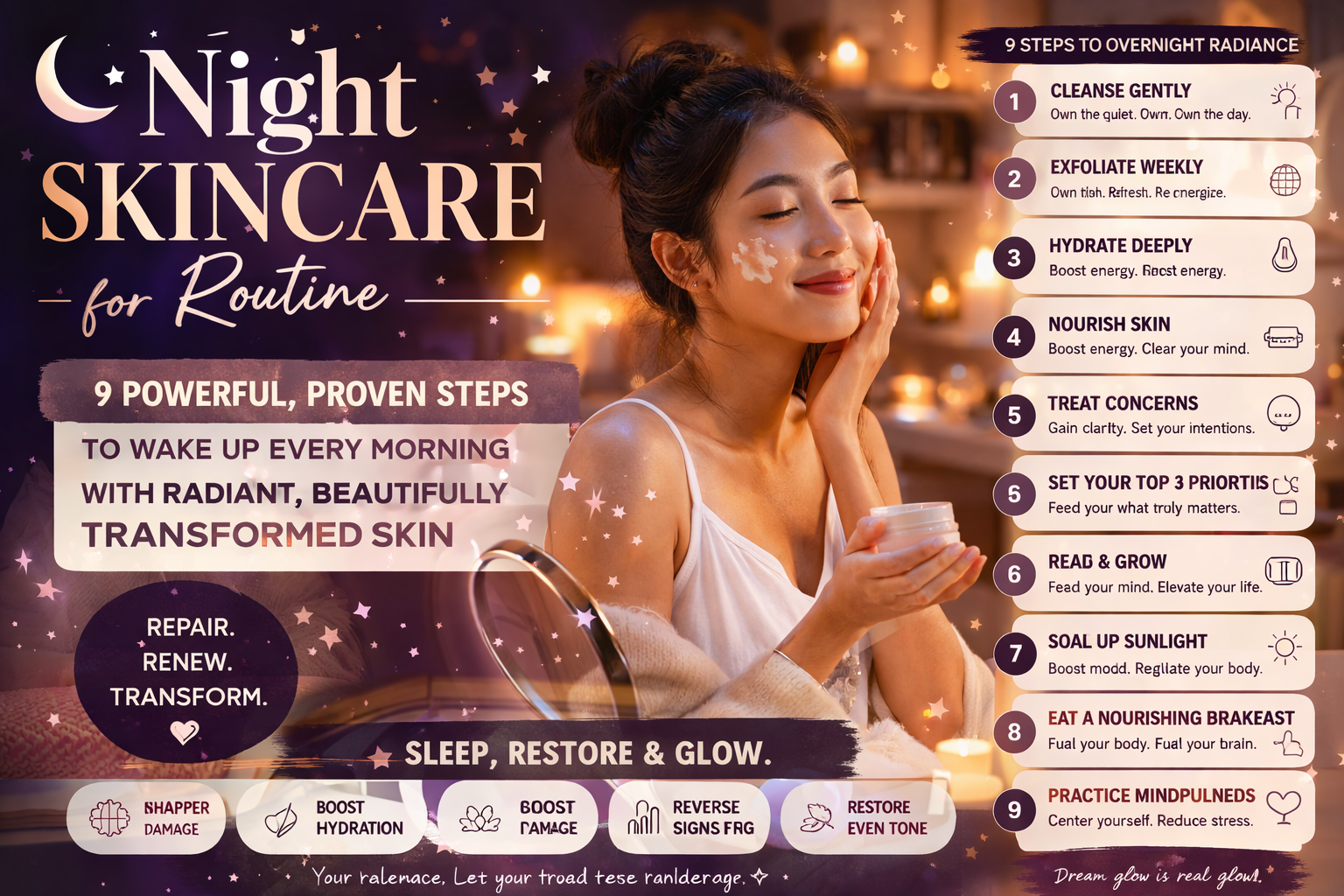
The 9-Step Night Skincare Routine for Glowing Skin
Step 1 — The First Cleanse: Remove the Day’s Full Environmental Load
Your night skincare routine for glowing skin begins with the most thorough cleanse of your daily routine — and for anyone wearing SPF (which should be everyone), this means a dedicated first cleanse specifically designed to dissolve and remove the day’s SPF, pollution particles, and oxidized sebum before a second water-based cleanse addresses the skin’s water-soluble residue.
Why Double Cleansing Is Non-Negotiable at Night: SPF formulations — particularly mineral sunscreens containing zinc oxide and titanium dioxide — are not fully removed by water-based cleansers alone. Residual SPF left on the skin overnight blocks pore drainage, disrupts the skin microbiome, and creates a film that prevents your precious nighttime actives from reaching the skin cells they are designed to treat.
First Cleanse Options:
- Cleansing balm: Emollient, effective, deeply nourishing — press onto dry skin, massage for 60 seconds, emulsify with a small amount of water, rinse. Ideal for dry, sensitive, and mature skin types
- Cleansing oil: Faster application, equally effective SPF removal — massage onto dry skin, add water to emulsify, rinse. Better for oily and combination types
- Micellar water (high-concentration): For minimal makeup days — use a saturated cotton pad with firm, held contact rather than wiping strokes
Second Cleanse: Follow immediately with your chosen gentle, pH-balanced water-based cleanser for 45–60 seconds to remove the water-soluble residue (sweat, microbiome byproducts, environmental pollution) that oil cleansing leaves behind.
Step 2 — An Exfoliating Toner or Treatment (2–3 Nights Per Week)
Night is the optimal and only appropriate time for exfoliating actives — they increase photosensitivity and should never be followed immediately by UV exposure. Two to three evenings per week, after your double cleanse, apply your chosen chemical exfoliant before any subsequent hydration or treatment layers.
The Nighttime Exfoliant Selection Guide:
| Skin Concern | Best Exfoliant | Concentration | Frequency |
| Dullness / uneven tone | Glycolic acid | 5–10% | 2x per week |
| Texture / roughness | Lactic acid | 5–10% | 2–3x per week |
| Breakouts / congestion | Salicylic acid (BHA) | 1–2% | 2x per week |
| Sensitivity / redness | PHA (gluconolactone) | 3–5% | 3x per week |
| Mixed concerns | AHA/BHA combination | Low concentration | 1–2x per week |
Critical note: Never combine exfoliating acids with retinol in the same evening application — this combination dramatically increases irritation risk. Alternate: exfoliation nights and retinol nights.
Step 3 — Hydrating Toner or Essence: The Foundation of Overnight Glow
On non-exfoliation nights, a hydrating toner or essence applied to freshly cleansed, still-damp skin creates the foundational hydration layer upon which all subsequent actives and moisturizers work more effectively. This step is particularly important at night because of the increased TEWL that occurs during sleep — the skin will lose more water overnight regardless, making pre-sleep surface hydration a meaningful counterbalance.
Key Ingredients for the Night Hydration Toner:
- Hyaluronic acid (multi-molecular weight): Deep and surface hydration
- Beta-glucan: Anti-inflammatory, deeply soothing, barrier-supportive
- Centella asiatica: Accelerates barrier repair and overnight skin healing
- Fermented ingredients (galactomyces, bifida lysate): Improve cellular renewal and skin translucency over time
Apply with clean hands using the gentle pressing technique — hands over cotton pads, always, at night. The body temperature of your hands improves product penetration; cotton pads reduce the total amount of product reaching the skin.
Step 4 — The Vitamin A (Retinol) Revolution: Your Overnight Skin Transformer
This is the single most impactful active in any night skincare routine for glowing skin — and the one with the largest and most robust clinical evidence base. Retinol (vitamin A) and its derivatives (retinaldehyde, retinyl esters, prescription tretinoin) are the only topical actives with Level A clinical evidence for simultaneously:
- Accelerating cell turnover to reveal fresh, evenly pigmented skin cells at the surface
- Stimulating collagen synthesis to improve skin firmness and reduce fine lines
- Regulating sebum production to reduce the underlying driver of breakouts
- Improving hyperpigmentation by normalizing melanocyte activity
- Reducing the appearance of enlarged pores through progressive cell turnover
The Apex Retinol Introduction Protocol for Night Skincare:
| Phase | Concentration | Frequency | Duration |
| Introduction | 0.025–0.05% | Every 3rd night | Weeks 1–4 |
| Building | 0.05–0.1% | Every other night | Months 2–3 |
| Maintenance | 0.1–0.3% | Nightly | Month 4 onward |
| Advanced | 0.3–0.5% | Nightly | Year 2 onward |
The sandwich method for retinol beginners: Apply a thin layer of moisturizer first, then retinol, then moisturizer again. This “sandwich” reduces irritation while allowing active penetration — a clinical technique particularly effective for sensitive and dry skin types beginning retinol.
Retinol alternatives for very sensitive or reactive skin: Bakuchiol (plant-derived, gentler, comparable efficacy in several clinical trials), retinaldehyde (one step closer to retinoic acid than retinol, more effective but gentler than prescription tretinoin).
Step 5 — A Targeted Treatment Serum Addressing Your Primary Skin Goal
After retinol has been applied and allowed to fully absorb (10–15 minutes), a targeted treatment serum addresses your specific primary skin concern with focused active ingredient delivery. This step is distinct from your hydrating toner — these serums contain clinical-concentration actives rather than broad-spectrum hydration.
Primary Skin Goal → Recommended Night Serum:
| Skin Goal | Key Ingredient | Why It Works at Night |
| Brightening / pigmentation | Tranexamic acid, alpha arbutin, kojic acid | Melanocyte inhibition works cumulatively; no photosensitivity concern |
| Anti-aging / firmness | Peptide complex (matrixyl, argireline) | Collagen signaling occurs primarily during overnight repair cycles |
| Hydration / plumpness | Hyaluronic acid + ceramides | Overnight increased permeability maximizes deep HA delivery |
| Barrier repair | Centella, ceramide NP, panthenol | The skin repairs its barrier most actively during sleep |
| Breakout control | Niacinamide + zinc | Sebum regulation and pore minimization with zero photosensitivity |
Apply 3–5 drops to the full face and neck using gentle upward pressing motions. Allow 2–3 minutes of absorption before proceeding.
For the complete science on how peptides drive overnight skin transformation at a cellular level, our guide on the astounding power of peptides for plump, ageless skin is an essential nighttime skincare companion read.
Step 6 — A Rich Night Moisturizer: The Overnight Barrier Seal
Your night moisturizer performs a different function than your daytime formula — it is not primarily about protecting against environmental exposure but about sealing the hydration and actives beneath it while simultaneously contributing its own nourishing ingredients to the overnight repair process.
The Ideal Night Moisturizer Criteria:
- Richer than your daytime formula: Night moisturizers should contain more emollient components (shea butter, squalane, plant oils, fatty alcohols) than daytime equivalents — they benefit from the absence of SPF’s texturizing requirements
- Ceramide-rich: Ceramides applied at night support the barrier rebuilding that occurs most actively during sleep
- Fragrance-free: Particularly critical at night — skin is more permeable during sleep, meaning fragrance allergens penetrate more deeply than during daytime application
- Avoid vitamin C in night moisturizers: Vitamin C is best reserved for morning application where it provides maximum antioxidant benefit against UV-generated free radical damage
Apex Night Moisturizer Recommendations:
- Laneige Water Sleeping Mask: The definitive glass skin overnight moisturizer — sleeping capsules that release hyaluronic acid and brightening actives throughout the night
- CeraVe Moisturizing Cream: Ceramide-rich, clinical-grade, fragrance-free barrier support at an outstanding value
- La Mer Moisturizing Cream: The luxury investment; kelp-derived Miracle Broth for exceptional overnight transformation
- First Aid Beauty Ultra Repair Cream: Colloidal oatmeal + ceramides + shea — ideal for sensitive and dry skin types
Step 7 — Facial Oil as the Final Sealing Layer (Optional but Powerful)
A facial oil applied as the final product in your night skincare routine for glowing skin is the step that most dramatically differentiates an exceptional overnight routine from a merely adequate one. Applied last — after all water-based serums and moisturizer have been absorbed — a facial oil creates an additional occlusive layer that significantly reduces overnight TEWL, delivers lipid-phase nourishment that water-based products cannot, and produces the particularly deep, plump luminosity visible on well-cared-for skin the morning after application.
Best Facial Oils for Night Use:
- Rosehip seed oil: Naturally high in trans-retinoic acid (a retinol precursor) and linoleic acid — a potent brightening and skin-renewing oil ideal for overnight use
- Bakuchiol oil: Plant-derived retinol alternative in oil form — gentle, deeply nourishing, and particularly appropriate for sensitive skin on retinol-free nights
- Marula oil: Deep, reparative, anti-aging — oleic and linoleic acid balance that suits most skin types
- Squalane: Ultra-lightweight, skin-identical emollient — seals without heaviness; appropriate for all skin types including oily
Apply 3–5 drops, pressed firmly into the skin over the moisturizer. This is not rubbing — it is deliberate, firm pressing that drives the oil into the moisturizer’s surface rather than creating friction-based heat.
Step 8 — Under-Eye Treatment: The Area That Shows Aging First
The under-eye skin is the thinnest skin on the body (approximately 0.5mm compared to 2mm on the cheeks) and the area that shows the cumulative signs of aging, dehydration, and inflammation first and most visibly. A dedicated under-eye treatment applied every night produces compounding improvements in darkness, puffiness, and fine lines that morning-only application can never match.
The Apex Nighttime Eye Treatment Protocol:
- Caffeine eye serum: Apply first to constrict under-eye blood vessels and reduce the oxidized hemoglobin accumulation that creates dark circles
- Retinol eye cream (0.025–0.05%): The most clinically validated anti-aging treatment for the under-eye area — use only formulations specifically designed for eye use, as standard retinol concentrations are too strong for this delicate zone
- Rich eye cream with peptides and ceramides: Seal the caffeine and retinol treatments with a generous layer of peptide and ceramide-rich eye cream that nourishes and repairs the barrier throughout the night
Application technique: Ring finger only, gentle tapping — never rubbing. Apply in a semicircle from the inner corner of the eye along the orbital bone, not directly on the waterline or lid.
Step 9 — Sleep Optimization: The Environmental Factors That Complete Your Night Routine
The ninth and most holistic step in the night skincare routine for glowing skin is one that most skincare guides never mention because it falls outside the category of products — but it is as clinically significant as every serum in your routine: the optimization of your sleep environment and sleep quality for maximum skin repair.
The Apex Sleep Environment for Skin Glow:
- Silk or satin pillowcase: Eliminates the mechanical friction and cotton-fiber moisture absorption that degrades skin and hair while you sleep. Silk pillowcases reduce the sleep compression lines that, over the years, become permanent facial wrinkles
- Bedroom humidity (40–60%): The most overlooked skin care variable — dry bedroom air directly increases overnight TEWL, undermining your entire moisturizing routine. A cold-mist humidifier running while you sleep is one of the highest-impact, lowest-cost skin care investments available
- 7–9 hours of consistent sleep: Research consistently demonstrates that sleep deprivation measurably reduces collagen production, increases cortisol (which impairs barrier function), and produces visible skin dullness and puffiness. Consistent, quality sleep is the most powerful anti-aging intervention available — more powerful than any product in your routine
- Sleeping position: Back sleeping minimizes the gravitational distortion of facial tissue and eliminates pillow compression — the leading mechanical cause of accelerated facial aging
The discipline required to protect and optimize your sleep environment connects directly to the evening habits explored in our guide on evening routine for better sleep — the perfect companion post to this night skincare protocol.
The Complete Night Skincare Routine for Glowing Skin — At a Glance
Every Night
| Step | Product | Timing |
| 1 | Oil cleanser / balm (first cleanse) | Evening |
| 2 | Gentle water-based cleanser (second cleanse) | Evening |
| 3 | Hydrating toner / essence | Immediately post-cleanse |
| 4 | Retinol (0.025–0.3% depending on phase) | After toner; allow 10 mins to absorb |
| 5 | Targeted treatment serum | After retinol absorbs |
| 6 | Rich ceramide night moisturizer | Final water-based layer |
| 7 | Facial oil (optional) | Absolute final sealing layer |
| 8 | Under-eye treatment (caffeine + retinol eye cream) | Before or after moisturizer |
| 9 | Sleep environment optimization | Ongoing nightly |
2–3 Nights Per Week (Alternating With Retinol)
| Step | Product | Note |
| After 2nd cleanse | Chemical exfoliant (AHA/BHA/PHA) | Never on same night as retinol |
| After exfoliant absorbs | Hydrating toner | Standard routine continues |
Night Skincare Routine Progress Timeline
| Timeline | What You Will Notice |
| Week 1–2 | Skin feels noticeably more hydrated by morning; some initial retinol adjustment |
| Week 3–4 | Visible texture improvement; reduced dullness; morning skin feels more plump |
| Month 2 | Luminosity increasing; hyperpigmentation beginning to fade; pores appearing smaller |
| Month 3 | Consistent morning glow; significantly improved skin evenness and tone |
| Month 4–6 | Full transformation visible; skin appears younger, smoother, and more radiant than pre-routine |
Common Night Skincare Mistakes That Block Glowing Skin
- Using the same moisturizer morning and night: Your PM moisturizer should be richer, heavier, and more emollient — the absence of SPF’s texturizing demands means you can and should deliver significantly more nourishment overnight
- Applying retinol on top of damp skin: Damp skin increases retinol penetration dramatically — for beginners, this dramatically increases irritation risk. Always apply retinol to fully dry skin
- Skipping the double cleanse: SPF residue left overnight is a barrier to every other product in your night routine and a significant contributor to congestion and dullness
- Combining retinol and AHAs on the same night: The combination’s irritation potential far exceeds either product’s individual risk. Alternate on separate evenings
- Neglecting the neck and décolletage: These areas receive the same cellular renewal signals at night and age at the same rate as the face — extend every step below the jawline without exception
How Your Night Routine and Morning Routine Work as a Complete System
The night skincare routine for glowing skin and your morning practice form a complete circadian skincare system — each half serving the skin’s dominant biological function during its respective time period:
- Morning routine: Protection (antioxidants, SPF, lightweight hydration for environmental defense)
- Night routine: Repair and renewal (retinol, actives, rich hydration, barrier sealing)
For the complete morning skincare side of this system, our guides on glass skin routine for dry skin and skin barrier repair routine steps complete the full 24-hour Apex skincare architecture. And for extending your glow practice from face to whole body, our body care routine for glowing skin is the essential next step.
Frequently Asked Questions
At what age should you start a night skincare routine?
A basic PM routine (double cleanse + moisturizer) is appropriate from the mid-teens onward. Adding a retinol or targeted serum is appropriate from the early to mid-20s when the skin’s natural cell turnover rate begins to slow measurably. The earlier a consistent nighttime routine is established, the more significant its compound benefit over decades.
Can I apply moisturizer and go straight to sleep?
Yes — in fact, applying your night moisturizer and immediately sleeping (on a silk pillowcase, in a humidified room) is the ideal scenario for maximum ingredient absorption during the peak repair window. The only step that benefits from a brief absorption wait before sleep is retinol, which should be applied 10–15 minutes before moisturizer to avoid dilution.
Is it necessary to use a separate night cream from my daytime moisturizer?
Not strictly necessary — but highly beneficial. A dedicated night moisturizer without SPF can be formulated with richer emollients, higher active concentrations, and heavier occlusives that would feel inappropriate under makeup or during outdoor activities. The absence of SPF also removes the texturizing agents that typically limit how much nourishment a daytime formula can deliver.
How long before I see results from a night skincare routine?
Hydration improvement is visible within 1–2 weeks. Texture and tone improvement typically becomes visible at 4–8 weeks. Hyperpigmentation and anti-aging results from consistent retinol use require a minimum of 3–6 months. Patience is not optional in skincare — it is the mechanism.
CONCLUSION
The night skincare routine for glowing skin is not a luxury — it is a biological imperative. Every night that you fail to support your skin’s overnight repair processes with appropriate actives, hydration, and environmental optimization is a missed compounding opportunity — one that the morning routine, however excellent, cannot fully compensate for.
Begin tonight. Begin with the double cleanse and a rich night moisturizer if nothing else. Add retinol in week three. Layer in your targeted serum at month two. And allow the extraordinary overnight biology of your own skin — supported by these nine evidence-based steps — to produce the most luminous, genuinely healthy version of your complexion that you have ever woken up to.
The most powerful skincare transformation in your life happens while you sleep. Give it what it needs.
OUTBOUND LINKS
- Journal of Investigative Dermatology — https://www.jidonline.org/
INTERNAL LINKS
- Peptides for Plump, Ageless Skin — https://apexaesthetic.blog/peptides-luxury-skincare-for-plump-ageless-skin/
- Evening Routine for Better Sleep — https://apexaesthetic.blog/evening-routine-for-better-sleep/
- Glass Skin Routine for Dry Skin — https://apexaesthetic.blog/glass-skin-routine-for-dry-skin/
- Skin Barrier Repair Routine Steps — https://apexaesthetic.blog/skin-barrier-repair-routine-steps/
- Body Care Routine for Glowing Skin — https://apexaesthetic.blog/body-care-routine-for-glowing-skin/