
Table of Contents
INTRODUCTION
Understanding the exact skin barrier repair routine steps is the single most transformative shift you can make in your entire approach to skincare — and yet it remains one of the most misunderstood chapters in the modern beauty conversation. Millions of people invest in sophisticated serums, high-performance actives, and luxury moisturizers, only to find their skin becoming increasingly reactive, dull, dehydrated, or breakout-prone. The frustrating irony is that in most of these cases, the skincare itself is the culprit. Over-exfoliation, fragrance exposure, aggressive cleansing, incompatible actives, and the relentless pursuit of “doing more” are systematically dismantling the very structure that healthy, glowing skin depends upon: the skin barrier.
Your skin barrier is not simply the outermost layer of your face. It is a living, intelligent, profoundly sophisticated biological system — the front line between your skin’s internal ecosystem and the external world of UV radiation, environmental pollutants, bacteria, and climate extremes. When it is healthy, it is invisible in the best possible way: your skin feels comfortable, looks luminous, and performs optimally without drama. When it is compromised, everything changes. Redness, stinging, flaking, unexpected breakouts, tightness, and a persistently dull complexion are the distress signals of a barrier under siege.
At Apex Aesthetic, we have crafted a complete, science-backed, elegantly minimal framework for understanding and executing the skin barrier repair routine steps that actually work — without complexity, without overwhelm, and without spending a fortune. This guide will change how you think about your skin, permanently and for the better.
What Is the Skin Barrier — And Why Does It Break Down?
Before executing your skin barrier repair routine steps, you need a clear understanding of what you are repairing. The skin barrier — formally called the stratum corneum — is the topmost layer of the epidermis. It is composed of flattened, dead skin cells (corneocytes) bound together by a matrix of lipids including ceramides, cholesterol, and fatty acids. Dermatologists often describe this structure as a “brick and mortar” model: the corneocytes are the bricks, and the lipid matrix is the mortar that holds them together.
This structure performs four essential functions simultaneously:
- Prevents transepidermal water loss (TEWL) — keeping your skin plump and hydrated
- Blocks environmental aggressors — pollutants, bacteria, UV-generated free radicals
- Maintains the skin’s acid mantle — the slightly acidic pH environment (4.5–5.5) that supports healthy microbiome and inhibits pathogenic bacteria
- Regulates the skin’s immune response — moderating inflammation and healing
According to research published by the National Institutes of Health, a compromised skin barrier is the primary underlying mechanism in conditions including eczema, rosacea, psoriasis, and acne — making barrier health the most clinically significant skin parameter across all skin types and concerns.
The Most Common Causes of Skin Barrier Damage
Understanding how damage occurs is as important as knowing how to reverse it:
- Over-exfoliation: Using AHAs, BHAs, retinol, or physical scrubs too frequently strips the lipid layer faster than it can regenerate — the single most common cause of barrier dysfunction in self-managed skincare
- Harsh surfactants: Sulfate-based cleansers disrupt the acid mantle and remove essential skin lipids with every wash
- Fragrance and essential oils: Contact sensitizers that trigger inflammatory responses in the barrier even when no visible irritation occurs
- Environmental extremes: Low humidity (air conditioning, central heating), extreme cold, and high UV exposure all accelerate TEWL
- Stress and sleep deprivation: Cortisol elevation impairs the barrier’s lipid synthesis and delays repair mechanisms
- Incompatible ingredient combinations: Layering Vitamin C with retinol, or niacinamide with Vitamin C (without adequate formulation buffering), can cause localized irritation that cumulatively weakens the barrier
How to Identify a Damaged Skin Barrier
Before beginning your skin barrier repair routine steps, confirm that barrier damage is the underlying issue you are addressing.
The Key Signs of a Compromised Skin Barrier
| Symptom | What It Indicates |
| Persistent tightness after cleansing | Severe dehydration / TEWL |
| Stinging or burning from products | Compromised acid mantle |
| Increased sensitivity to products previously tolerated | Reduced barrier resilience |
| Unexpected breakouts in new areas | Bacterial penetration through barrier gaps |
| Flakiness without dryness | Disrupted corneocyte turnover |
| Redness and inflammation without a clear cause | Inflammatory cascade from barrier dysfunction |
| Dull, flat, lackluster complexion | Impaired light reflection from irregular surface cells |
If you are experiencing three or more of these symptoms simultaneously, your skin barrier is likely compromised and requires the dedicated repair protocol in this guide.
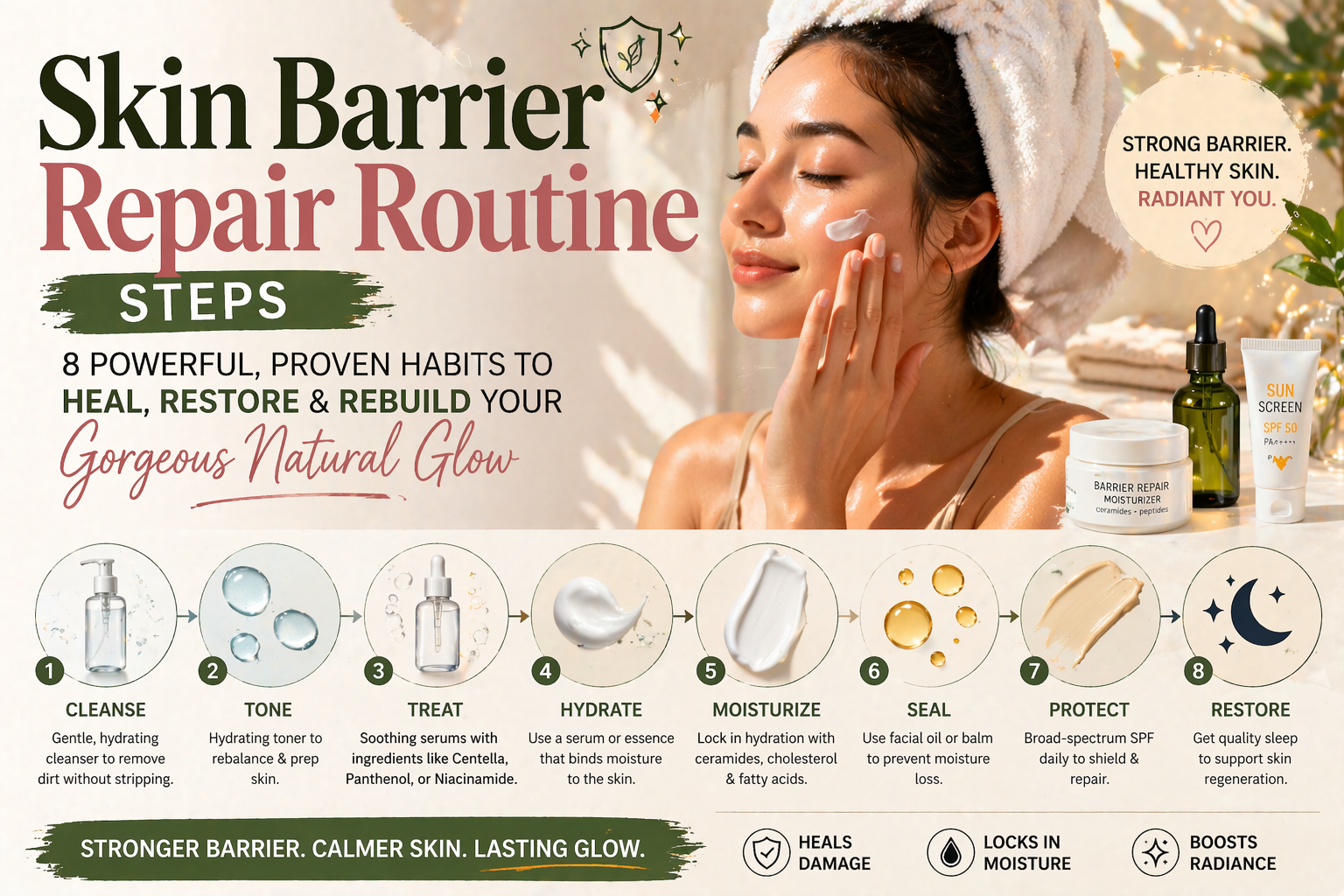
The 8 Skin Barrier Repair Routine Steps
Step 1 — Stop All Active Ingredients Immediately (Days 1–14)
The first and most critical of all skin barrier repair routine steps is also the most counterintuitive for skincare enthusiasts: stop everything that is working against you before introducing anything that might help. For the first 14 days of your barrier repair protocol, discontinue all exfoliating actives — retinol, AHAs (glycolic, lactic, mandelic acid), BHAs (salicylic acid), vitamin C, and any physical exfoliants.
This is not permanent. This is strategic recovery — giving the barrier’s lipid layer the uninterrupted time it needs to begin rebuilding without continued assault. Many people see significant improvement within the first week of this step alone, which is itself diagnostic confirmation that their routine was the primary barrier disruptor.
What to discontinue immediately:
- All acids (AHA, BHA, PHA)
- Retinoids and retinol in any concentration
- Vitamin C serums (particularly L-Ascorbic Acid formulations)
- Physical exfoliants and brushes
- Clay masks and purifying treatments
- Alcohol-based toners and astringents
- Any product that has previously caused stinging or tingling
Step 2 — Switch to an Ultra-Gentle, pH-Balanced Cleanser
Your cleanser is the most frequently used product in your routine — applied twice daily, every day. If it is stripping your skin, it is undermining every other repair effort you make. The ideal cleanser for barrier repair has a pH between 4.5 and 5.5 (matching your skin’s natural acid mantle), uses the mildest possible surfactant system, and contains absolutely no added fragrance.
Ideal Cleansers for Barrier Repair:
- CeraVe Hydrating Cleanser: Ceramides + hyaluronic acid + gentle surfactants; fragrance-free; dermatologist-recommended
- La Roche-Posay Toleriane Hydrating Gentle Cleanser: Prebiotic thermal water + ceramides; clinically tested for sensitive/reactive skin
- Vanicream Gentle Facial Cleanser: Completely free of dyes, fragrance, and common contact allergens — ideal for severely compromised barrier states
- Cetaphil Gentle Skin Cleanser: One of the most clinically validated gentle cleansers available globally
Cleansing technique during repair:
- Use lukewarm water only — hot water accelerates TEWL
- Cleanse with your fingertips, never a cloth or brush
- Limit morning cleanse to 20–30 seconds — overnight sebum is not a pollutant; it is a barrier-supporting lipid
- Pat (never rub) dry with a clean, soft towel
Step 3 — Apply a Ceramide-Rich Barrier Moisturizer Within 60 Seconds of Cleansing
The 60-second rule is one of the most evidence-supported practices in barrier repair dermatology. Research from the American Academy of Dermatology demonstrates that applying moisturizer within 60 seconds of cleansing — while the skin is still slightly damp — dramatically reduces TEWL compared to application on dry skin. This single habit alone can improve barrier hydration metrics by up to 50%.
The Three Essential Barrier-Repair Ingredient Categories:
| Ingredient Type | Function | Examples |
| Ceramides | Replenish the lipid matrix between corneocytes | Ceramide NP, AP, EOP (look for 3+ types) |
| Humectants | Attract and bind water molecules in the skin | Hyaluronic acid, glycerin, panthenol, beta-glucan |
| Emollients/Occlusives | Seal the barrier and prevent TEWL | Squalane, shea butter, petrolatum, fatty acids |
The ideal barrier repair moisturizer contains all three ingredient categories. The three most clinically validated options are CeraVe Moisturizing Cream (contains ceramides 1, 3, and 6-II), Vanicream Moisturizing Cream, and the First Aid Beauty Ultra Repair Cream.
Step 4 — Add a Targeted Hyaluronic Acid Serum for Deep Hydration
Once your cleanser and moisturizer are in place, a hyaluronic acid serum applied between these two steps dramatically amplifies the hydration delivered to compromised skin. Hyaluronic acid (HA) is a humectant naturally present in the skin’s extracellular matrix that can hold up to 1,000 times its own weight in water.
Critical Application Note for HA During Barrier Repair: Apply your HA serum to damp skin immediately after cleansing — never to completely dry skin in a low-humidity environment. Hyaluronic acid in dry conditions can draw moisture from the deeper layers of the skin rather than from the atmosphere, paradoxically worsening dehydration. Always follow immediately with your occlusive moisturizer to seal the hydration in.
Look for multi-molecular weight HA: Larger molecules hydrate the surface; smaller molecules penetrate deeper layers for volumizing and structural support. The Ordinary Hyaluronic Acid 2% + B5 and Neutrogena Hydro Boost Water Gel both contain effective multi-weight formulations.
Step 5 — Apply SPF Every Single Morning Without Exception
UV radiation — particularly UVA rays — is one of the most potent disruptors of the skin barrier, degrading ceramide production and increasing TEWL even on overcast days and through glass windows. During the barrier repair process, your skin is significantly more vulnerable to UV-induced damage, making SPF application even more non-negotiable than usual.
SPF Requirements During Barrier Repair:
- SPF 30 minimum — SPF 50 strongly recommended during active repair phase
- Mineral formula preferred (zinc oxide and/or titanium dioxide): Chemical UV filters require no photochemical activation and present zero irritation risk — ideal for compromised barrier states. Chemical filters are effective but more likely to cause transient stinging on reactive skin
- Fragrance-free and alcohol-free formulation — non-negotiable during the repair period
- Apply as the absolute final morning step — after moisturizer has fully absorbed
Recommended Mineral SPF for Barrier Repair: EltaMD UV Clear SPF 46, Altruist Fragrance-Free Mineral SPF 50, Blue Lizard Sensitive Mineral Sunscreen SPF 50.
Step 6 — Introduce a Targeted Skin Barrier Repair Serum (Week 3 Onward)
From week three of your repair protocol, once the acute sensitivity phase has subsided, you can begin introducing ingredients specifically designed to accelerate barrier reconstruction. These are not the exfoliating actives you discontinued in Step 1 — these are barrier-supportive ingredients with an entirely different mechanism of action.
The Apex Barrier Repair Serum Ingredient Hierarchy:
- Niacinamide (4–5%): Clinically demonstrated to increase ceramide synthesis, reduce TEWL, and improve the skin’s natural lipid barrier. One of the most thoroughly validated barrier-supporting ingredients available without prescription
- Centella Asiatica (Cica): Anti-inflammatory adaptogen that accelerates wound healing and barrier recovery — particularly effective for barrier damage from over-exfoliation or environmental stress
- Panthenol (Vitamin B5): Accelerates the synthesis of lipids in the stratum corneum while simultaneously attracting atmospheric moisture to the skin surface
- Beta-Glucan: Oat-derived polysaccharide with exceptional anti-inflammatory and barrier-repair properties — comparable to hydrocortisone in reducing skin redness without steroid-related risks
Introduce one new ingredient at a time, with a minimum 14-day evaluation window between introductions.
Step 7 — Optimise Your Environment for Barrier Recovery
Your skin barrier does not exist in isolation — it exists in a physical environment that either supports or undermines its recovery every hour of every day. Optimizing your immediate environment is one of the most powerful — and most overlooked — skin barrier repair routine steps available.
Environmental Optimisation for Barrier Repair:
- Humidifier: Maintain indoor humidity between 40–60% — low humidity is one of the most significant drivers of TEWL and the most common environmental cause of barrier dysfunction. A cold-mist humidifier in your bedroom (running during sleep, when your skin does most of its repair work) can reduce TEWL by 25–40%
- Water temperature: Shower and wash in lukewarm water — hot water dissolves the skin’s lipid layer as effectively as a detergent
- Pillowcase: Switch to a clean silk or satin pillowcase — cotton absorbs skincare products and creates friction during sleep that mechanically stresses a recovering barrier
- Face touching: The average person touches their face 16–23 times per hour, transferring environmental bacteria and irritants directly onto the most vulnerable area of a compromised barrier — conscious reduction of this habit dramatically supports recovery
Step 8 — Address Internal Drivers of Barrier Dysfunction
No topical skin barrier repair routine steps can fully compensate for systemic factors that undermine barrier function from the inside. The most overlooked dimension of barrier repair is the internal biochemical environment.
The Internal Barrier Support Protocol:
Nutrition for Barrier Repair:
- Omega-3 fatty acids (EPA and DHA): Clinical studies demonstrate that omega-3 supplementation significantly reduces TEWL and improves barrier integrity in both healthy and compromised skin. Sources include oily fish (salmon, mackerel, sardines), walnuts, flaxseed, and high-quality fish oil supplements
- Ceramide-supporting foods: Wheat germ, brown rice, eggs, and spinach contain naturally occurring ceramides and their precursor lipids
- Vitamin E and Vitamin C (dietary): Both support lipid antioxidant protection in the stratum corneum — avocado, sunflower seeds, bell peppers, and citrus fruits are excellent sources
- Hydration: Chronic mild dehydration is directly correlated with increased TEWL — maintain 1.5–2L of water daily during the repair process
Stress and Sleep: Cortisol elevation from chronic stress measurably impairs barrier lipid synthesis and delays repair. The connection between stress management, sleep quality, and skin barrier health is not anecdotal — it is clinically documented. Our comprehensive framework on wellness rituals of the ultra-successful explores the deep, evidence-based connection between inner wellness practices and outer skin performance in powerful detail.
The Complete Skin Barrier Repair Routine — Morning and Evening
Morning Routine (5–7 Minutes)
| Step | Product Type | Key Ingredients | Time |
| 1 | Gentle pH-balanced cleanser | Ceramides, glycerin | 1 min |
| 2 | Hyaluronic acid serum (on damp skin) | Multi-weight HA, panthenol | 1 min |
| 3 | Ceramide-rich moisturizer | Ceramides, humectants, occlusives | 1 min |
| 4 | Mineral SPF 30–50 (final step) | Zinc oxide, titanium dioxide | 1 min |
Evening Routine (7–10 Minutes)
| Step | Product Type | Key Ingredients | Time |
| 1 | Oil or balm cleanser (if wearing SPF/makeup) | Squalane, plant oils | 1 min |
| 2 | Gentle water-based cleanser | Ceramides, mild surfactants | 1 min |
| 3 | Barrier repair serum (from week 3) | Niacinamide, centella, panthenol | 2 min |
| 4 | Richer ceramide moisturizer | Ceramides, shea butter, fatty acids | 1 min |
| 5 | Optional: Occlusive layer (if severely dry) | Petrolatum, lanolin, squalane | 1 min |
What to Expect — The Barrier Repair Timeline
One of the most important things to communicate about the skin barrier repair routine steps is that this is a biological process, not an overnight transformation. Managing expectations is as important as managing the routine.
| Timeline | What You Will Notice |
| Days 1–3 | Possible initial purging or increased sensitivity — this is the acute withdrawal phase from actives |
| Days 4–7 | Reduced stinging and tightness; improved comfortable feel after cleansing |
| Weeks 2–3 | Visible improvement in texture; reduced redness; increased ability to tolerate products |
| Weeks 4–6 | Measurable improvement in radiance and hydration; barrier sensitivity largely resolved |
| Months 2–3 | Full barrier restoration; gradual, careful reintroduction of chosen actives can begin |
Patience is non-negotiable in barrier repair. The stratum corneum has a natural turnover cycle of approximately 28 days, meaning a full biological “reset” requires at minimum one full cycle — and more realistically, two to three for severely compromised barrier states.
When to Reintroduce Active Ingredients After Barrier Repair
The return to actives after barrier repair must be exponentially more careful than your original introduction. The skin that comes out of the repair process is healthier but momentarily naive — reintroducing too many actives too quickly will restart the damage cycle.
The Apex Active Reintroduction Hierarchy:
- Start with niacinamide (if not already in routine): Low irritation potential, high benefit — the safest “first active back”
- Second: A low-concentration AHA (lactic acid 5%): The most gentle chemical exfoliant, ideal for the first reintroduction of exfoliation
- Third: Vitamin C (ascorbyl glucoside or ethyl ascorbyl ether — not L-Ascorbic Acid initially): Gentler derivative forms before returning to the most potent formulations
- Fourth: Retinol (0.025% maximum concentration): The last active to return, and the one requiring the most patience in reintroduction
Allow a minimum of 4 weeks between each new active reintroduction, and always observe the skin’s response before proceeding.
For the complete framework on building an effective, sustainable skincare system from the ground up — including a beautiful guide to introducing your first actives — our new guide on minimalist skincare routine for beginners provides the essential companion framework to this barrier repair protocol. And if your desk environment is part of what is challenging your skin daily, do not miss our detailed guide on a simple skincare routine for glowing skin in workspace settings.
Frequently Asked Questions About Skin Barrier Repair Routine Steps
How long does it take to repair a damaged skin barrier?
The minimum meaningful recovery window is 4–6 weeks, corresponding to approximately 1.5 natural skin cell turnover cycles. Severe barrier damage may require 3–6 months of consistent, gentle care before full function is restored. The most important variable is not time — it is the complete cessation of all barrier-disruptive products during the repair period.
Can I wear makeup while repairing my skin barrier?
Yes, but with significant product selection care. Choose liquid or serum-foundation formulas with minimal fragrance and no high-concentration alcohols. Avoid powder formats (drying) and matte formulas with strong occlusive or sebum-absorbing agents. Always double-cleanse in the evening to remove makeup without mechanical rubbing.
Is it normal for skin to purge when starting barrier repair?
A brief initial period of increased sensitivity or minor breakouts during the first 3–5 days of the barrier repair protocol is relatively common and is the result of the skin’s microbiome recalibrating as new, gentler conditions are established. This should resolve within one week. If it does not, the product being used may itself be a barrier disruptor.
What is the single most important product for skin barrier repair?
A ceramide-rich moisturizer, without question. Ceramides are the structural components of the barrier’s lipid matrix — replenishing them topically directly addresses the most fundamental mechanism of barrier dysfunction. If you can only afford one product during your repair protocol, make it a quality ceramide moisturizer and apply it after every cleanse.
Can diet damage the skin barrier?
Yes, significantly. Diets consistently high in refined sugar and high-GI foods promote systemic inflammation that disrupts ceramide synthesis. Omega-3 deficiency is directly correlated with compromised barrier function. Chronic dehydration increases TEWL. And alcohol consumption measurably impairs barrier lipid production and delays repair processes.
CONCLUSION
The skin barrier repair routine steps in this guide represent more than a skincare protocol — they represent a fundamental philosophical shift in how you relate to your skin. The culture of more — more actives, more steps, more transformation — has created an epidemic of compromised skin barriers and increasingly reactive, dependent complexions. The Apex approach is always the opposite: thoughtful subtraction, strategic patience, and the profound power of the right few things done consistently well.
Healing your skin barrier is healing your skin’s foundation. When the foundation is strong, everything built upon it — your radiance, your even tone, your resilience, your natural glow — becomes stable, sustainable, and genuinely beautiful. Not because of what you applied, but because of the intelligence with which you supported what was already there.
Repair first. Glow always.
Explore more from the Apex Beauty & Wellness collection and discover the complete science-backed framework for your most radiant, powerful skin — one intentional, minimal step at a time.
OUTBOUND LINKS
- National Institutes of Health — https://www.ncbi.nlm.nih.gov/pmc/articles/PMC2843412/
- American Academy of Dermatology — https://www.aad.org/public/everyday-care/skin-care-basics/dry/dermatologist-tips-to-combat-dry-skin
INTERNAL LINKS
- Wellness Rituals of the Ultra-Successful — https://apexaesthetic.blog/7-wellness-rituals-that-last-with-confident/ (existing, freshly assigned)
- Minimalist Skincare Routine for Beginners — https://apexaesthetic.blog/minimalist-skincare-routine-for-beginners/ (cross-link: new post)
- Simple Skincare Routine for Glowing Skin in Workspace — https://apexaesthetic.blog/simple-skincare-routine-for-glowing-skin-in-workspace/ (cross-link: new post)