
Table of Contents
INTRODUCTION
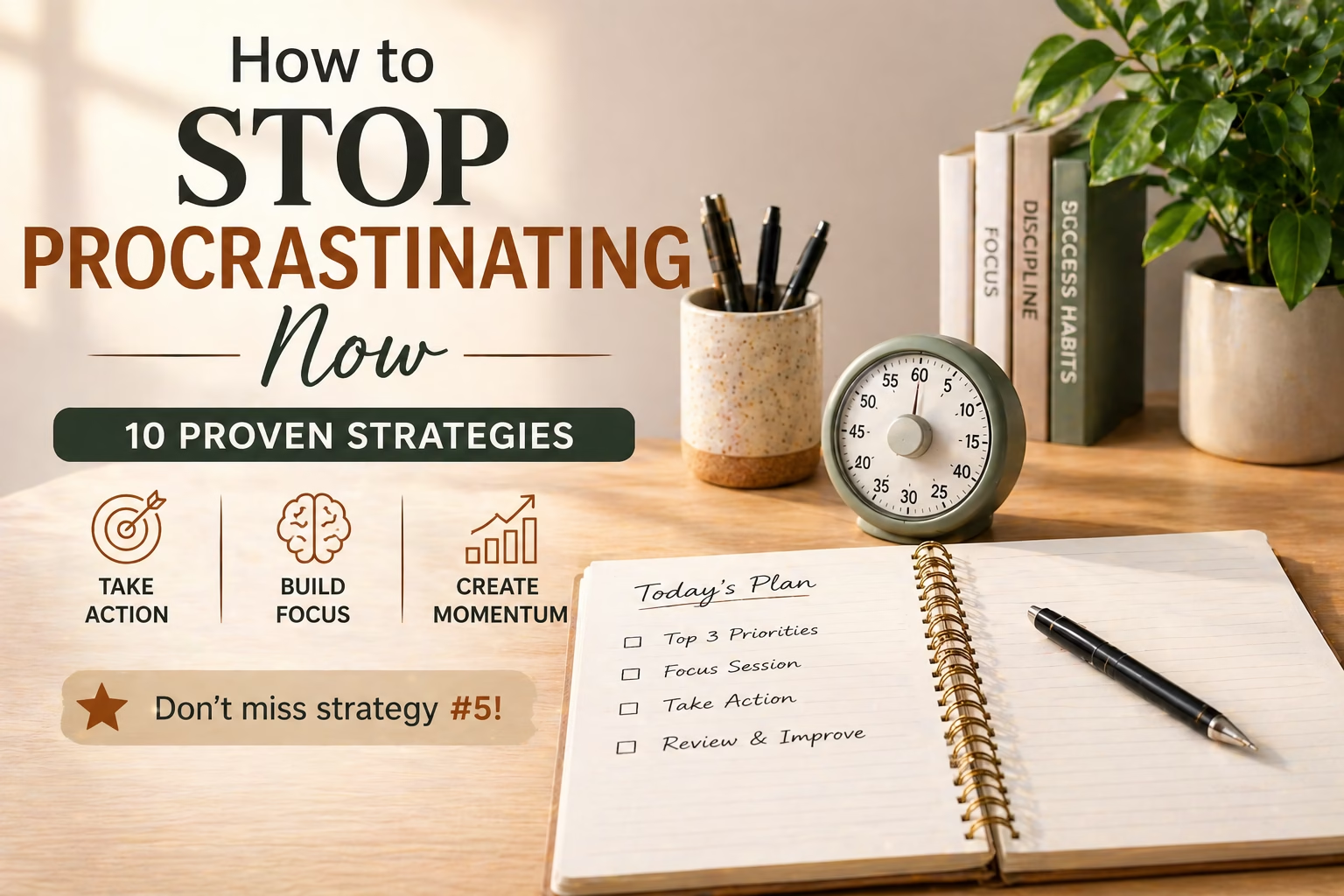
Learning how to stop procrastinating now — not someday, not next Monday, not after one more episode — is the single most direct path from where you currently are to where you genuinely want to be. Procrastination is the universal tax on human potential: it is paid daily, in the currency of unlived possibility, and it accumulates interest that compounds invisibly until the weight of what has not been done becomes heavier than any single action could ever be.
You already know what you need to do. That knowing is not the problem. If information and intention were sufficient, procrastination would not exist—because every person who procrastinates already knows, on some level, both what they should do and why they are not doing it. The problem is not knowledge. The problem is the gap between knowing and doing—a gap that behavioral neuroscience, habit psychology, and decades of performance research have studied with extraordinary depth and explained with satisfying precision.
At Apex Aesthetic, we approach procrastination the way we approach every obstacle to the extraordinary life: not as a character flaw to be shamed into submission, but as a neurological and psychological pattern to be understood, disrupted, and systematically replaced with something better. These 10 strategies are the most evidence-backed, practically structured, and immediately actionable interventions available for overcoming procrastination, drawn from the same rigorous, elegant framework that has made the Apex Mindset collection the most comprehensive personal performance resource on this blog.
The strategies begin now. Not after you finish reading. Now.
Understanding Procrastination — Why You Do It and Why Willpower Alone Won’t Fix It
Before exploring how to stop procrastinating now, you need to understand precisely what procrastination is—because the most common understanding of it is fundamentally incorrect, and that incorrect understanding is the reason most anti-procrastination advice fails.
What Procrastination Actually Is (The Neuroscience)
Procrastination is not laziness. It is not a time-management problem. It is an emotion regulation failure—a neurological response in which the brain’s limbic system (the emotion-processing center) overrides the prefrontal cortex’s (the executive function center’s) intention to begin a task in order to avoid the negative emotional states that the task triggers: anxiety, boredom, self-doubt, overwhelm, or fear of failure.
Research from Carleton University’s Procrastination Research Group, led by Dr. Fuschia Sirois and Dr. Timothy Pychyl, consistently demonstrates that procrastination is fundamentally a problem of mood management — people procrastinate to gain immediate emotional relief from tasks that feel threatening, uncertain, or uncomfortable. The relief is immediate and real. The cost is deferred and accumulating.
According to a landmark study published in Psychological Science, habitual procrastinators do not differ from non-procrastinators in their desire to complete tasks or their assessment of their own capacity—they differ primarily in their willingness to tolerate the negative emotions associated with beginning. This is the key insight: procrastination is not about the task. It is about the feeling.
Why Willpower Fails Against Procrastination
The default advice for overcoming procrastination—”just do it,” “stop making excuses,” and “be more disciplined”—fails reliably because it asks willpower to override an emotional state. Willpower is a limited, depleting resource that has never successfully defeated the limbic system in sustained conflict. The strategies that actually work do not fight the emotional avoidance response—they change the emotional experience of beginning the task, making starting feel less threatening than not starting.
The 10 Strategies to Stop Procrastinating Now
Strategy 1 — The 2-Minute Rule: Start Smaller Than You Think Is Possible
The first and most immediately actionable strategy for how to stop procrastinating now is the 2-minute rule—the deceptively simple principle that if a task can be started in 2 minutes or less, you start it immediately rather than deferring it. But for chronic procrastinators, the rule extends further: If a task feels overwhelming, you commit to doing only 2 minutes of it—nothing more.
Why the 2-Minute Rule works neurologically:
Beginning a task — even for 2 minutes — activates the Zeigarnik Effect: a well-documented psychological phenomenon in which incomplete tasks create a specific tension in working memory that motivates their completion. Once you start, the brain’s natural task-completion drive often carries you forward far beyond the initial 2-minute commitment. The resistance that makes beginning feel impossible dissolves almost immediately upon starting—which is why the starting is everything.
Implementation: When you notice yourself avoiding a task, say explicitly, “I will do this for exactly 2 minutes and then stop if I want to.” In the vast majority of cases, you will not stop. But even if you do, you have interrupted the avoidance pattern, and the next beginning will be easier.
Strategy 2 — Identify and Name the Specific Emotion Driving Your Delay
Because procrastination is an emotion regulation problem — not a time management problem — addressing the specific emotion that triggers avoidance is more effective than any productivity technique. Most procrastinators avoid their tasks without ever consciously identifying what they are actually avoiding. Naming the emotion explicitly disrupts the automatic avoidance response by engaging the prefrontal cortex’s regulatory capacity.
The Emotion Identification Practice:
When you notice yourself procrastinating, pause and answer honestly: “What emotion am I avoiding by not starting this?” Common answers include:
- Anxiety about whether you can do it well enough
- Overwhelmed by the size or complexity of the task
- Boredom with the anticipated experience of the task itself
- Fear of failure or its shadow: fear of success
- Perfectionism — the belief that you must be ready, motivated, or inspired before starting
Once you name the specific emotion, you can address it directly: “I am anxious that this will not be good enough. I will begin anyway, imperfectly, knowing that imperfect completion is worth infinitely more than perfect delay.”
This practice connects directly to the overthinking and emotional regulation frameworks explored in our guide on how to stop overthinking everything—the Apex Mindset companion post that addresses the cognitive dimension of the same pattern.
Strategy 3 — Design a Procrastination-Proof Environment
Your environment makes the majority of your behavioral decisions before your conscious mind is ever involved—and nowhere is this more consequential than in the moment of beginning a difficult task. A workspace filled with visual distractions, instant-gratification alternatives, and environmental cues associated with relaxation rather than productive focus makes procrastination the path of least resistance. Changing the environment changes the behavior—without requiring willpower.
The Apex Procrastination-Proof Environment Checklist:
- Phone in another room or inside a drawer — not face-down on the desk, which still triggers the anticipation of notifications. Out of sight and out of reach reduces phone checking by 26% (University of Texas research)
- Close all browser tabs except the one relevant to the current task—each visible tab represents an alternative destination for attention and reduces task focus measurably
- Set a specific, limited work session with a visible timer—the Pomodoro technique (25-minute focused work + 5-minute break) reduces the overwhelming infinity of “work until done” into a manageable, bounded sprint
- Clear your physical workspace completely before beginning—a clean desk is a productivity claim; a cluttered desk is a visual argument for distraction
For the complete design philosophy on creating physical environments that support focused, disciplined work without willpower, our guide on aesthetic study room ideas at home provides the full spatial design framework for a procrastination-resistant workspace.
Strategy 4 — Use Implementation Intentions: The “When-Then” Commitment
Implementation intentions—the specific mental commitment structure “When [situation], I will [behavior]”—are among the most empirically validated interventions for bridging the gap between intention and action. Meta-analyses covering hundreds of studies consistently demonstrate that people who use implementation intentions are significantly more likely to follow through on intended behaviors than those who state general intentions (“I will work on my project today”).
Why Implementation Intentions Work:
The when-then structure predetermines the behavioral response to a specific environmental cue—bypassing the in-the-moment deliberation and negotiation that procrastination exploits. Rather than asking, “Should I start now?” (which opens the door to a hundred reasons not to), the brain encounters the cue and executes the pre-committed response automatically.
Examples of Powerful Implementation Intentions for Procrastination:
- “When I sit down at my desk at 9 AM, I will immediately open the document I have been avoiding—before checking email or any other application.”
- “When I feel the urge to check my phone during a work session, I will instead write one sentence of the task I am working on.”
- “When the timer sounds after my lunch break, I will begin working on the most difficult task on my list for exactly 20 minutes before evaluating how I feel.”
Write your implementation intentions before the work session begins — not during it, when the avoidance response is already active.
Strategy 5 — Apply the Eisenhower Matrix: Prioritise With Brutal Clarity (Don’t Miss This)
One of the most common and least examined causes of procrastination is attempting to begin without clear priority—staring at a list of 15 tasks and experiencing the paralytic overwhelm that makes scrolling Instagram feel more appealing than all of them. The Eisenhower Matrix—a simple decision framework attributable to US President Dwight Eisenhower and popularized by Stephen Covey—eliminates this paralysis by forcing deliberate categorization of every task before action begins.
The Eisenhower Matrix for Overcoming Procrastination:
| Urgent | Not Urgent | |
| Important | DO immediately your most critical tasks | SCHEDULE — your most valuable long-term work |
| Not Important | DELEGATE if possible | ELIMINATE—this is what fills procrastination time |
The procrastination insight this matrix reveals: most procrastinated tasks are Important but Not Urgent—meaning they have no immediate deadline creating pressure, but their completion matters enormously to your goals, values, and long-term results. These are the tasks that get perpetually deferred in favor of urgent-but-unimportant items. The Matrix makes this pattern visible — and visibility is the precondition for change.
Implementation: Write every task on your mental or physical to-do list into one of the four quadrants. Your first working hour every day is reserved exclusively for Quadrant 2 tasks — the important, non-urgent work that, if consistently addressed, produces the most extraordinary results over time.
Strategy 6 — Understand the Procrastination-Perfectionism Connection
Perfectionism is one of the most common — and most socially acceptable — drivers of procrastination. The belief that a task must be done perfectly before it is worth starting, or that the right moment / right mood / right level of readiness must be achieved before beginning, is perfectionism operating as a procrastination mechanism. It presents itself as high standards. It functions as avoidance.
The Apex Perfectionism-Procrastination Reframe:
The reframe that most reliably dissolves perfectionist procrastination is a direct confrontation with its logic: “Is this actually better left undone than done imperfectly?” In almost every case, the honest answer is no. The unwritten email that eventually arrives late is worse than the imperfect email sent on time. The unstarted project that gets submitted rushed and incomplete is worse than the imperfect project completed with care. The fitness routine that is “not optimal” and actually maintained is infinitely superior to the perfect routine that never begins.
The Good Enough Standard in practice:
Define explicitly, before beginning each task, what “good enough” looks like — the minimum viable quality threshold that makes completion superior to non-completion. Work to that standard first. Upgrade to excellent if time and energy allow. But do not allow the pursuit of excellence to become the enemy of completion, which is the procrastinator’s most seductive trap.
Strategy 7 — Time-Block Your Day to Eliminate Decision Fatigue
Decision fatigue — the measurable degradation of decision quality and willpower that occurs after repeated decisions — is one of the most significant but least discussed contributors to procrastination. When every moment of the working day requires a fresh decision about what to do next, the accumulated cost of those decisions depletes the executive function resources that make beginning difficult tasks possible.
Time Blocking as the Productivity Procrastination Fix:
Time blocking — assigning specific, calendar-committed blocks of time to specific tasks — eliminates the repeated decision overhead of “what should I work on now?” by answering the question in advance. When 9–10:30 AM is designated as “deep work on [specific project],” no decision needs to be made at 9:01 AM. The calendar has already been decided. The only remaining action is to begin.
The Apex Time Blocking Protocol for Procrastinators:
- Block your most cognitively demanding, most-procrastinated task in the first 90-minute window of your working day—before email, meetings, or administrative tasks consume your decision-making capacity
- Use hard calendar blocking (visible, specific, named) rather than soft to-do lists—the visual commitment of a calendar block is more neurologically binding than a task list item
- Include a 15-minute “task transition” block before each major work block—use it to clear your workspace, write your implementation intention, and prepare your mind for focused work
For the complete framework on how disciplined daily scheduling transforms procrastination into production, our guide on how to build self-discipline daily provides the foundational Apex habit infrastructure that makes time-blocking sustainable and self-reinforcing.
Strategy 8 — Use Accountability to Increase the Cost of Not Starting
Procrastination thrives in privacy. When no one knows that you have been avoiding something for two weeks, the social cost of continued avoidance is zero, and zero social cost makes delay neurologically cheap. Accountability structures change this calculation by making the procrastination visible to someone whose opinion you respect—immediately increasing the perceived cost of not starting.
Effective Accountability Structures for Procrastination:
- Body doubling: Working in the physical or virtual presence of another person who is also working. The social pressure of being observed—even silently, even over video call—dramatically reduces the onset. Study halls, libraries, co-working spaces, and virtual co-working services (Focusmate is the most widely used) all leverage this mechanism
- Public commitment: Declaring specifically, to at least one person, what you will complete by when. The specificity matters—”I’ll work on my project” is not an accountability commitment. I will send my client the completed first draft by Thursday at 5 PM. ” is
- Weekly accountability check-in: A 15-minute weekly video or message exchange with one trusted person covering what you committed to, what you actually completed, and what you are committing to this week
Strategy 9 — Separate the Task From the Mood Requirement
One of the most entrenched and most damaging procrastination beliefs is the conviction that you must feel motivated, inspired, rested, or “in the right headspace” before beginning meaningful work. This belief—that the feeling must precede the action—is neurologically backward. Research consistently demonstrates the opposite: action precedes feeling. Motivation follows beginning, not the reverse.
The Action → Feeling → Motivation Sequence:
- You begin the task despite not feeling like it
- Within 5–10 minutes of working, neural engagement with the task generates mild intrinsic motivation
- As the task progresses and early results appear, motivation strengthens
- Completion triggers a dopamine release that retroactively makes the session feel rewarding
The waiting-for-motivation procrastinator never reaches step 3 or 4 because they never complete step 1. They are waiting for a neurochemical state that only the action they are avoiding can produce.
The Apex Mood-Task Separation Practice: When you notice yourself waiting to feel ready, say explicitly, “I do not need to feel like it. I need to begin.” Then take the smallest possible beginning action—open the document, write one sentence, or make one phone call. The feeling will follow.
Strategy 10 — Build a Post-Task Reward System That Reinforces Starting
The final strategy for how to stop procrastinating now addresses the most fundamental neurological driver of all behavior: reward. Procrastination wins against productive work in the short term because its reward (immediate emotional relief, pleasure of distraction) is immediate and certain, while the reward of completing meaningful work (achievement, progress, pride) is delayed and uncertain. The dopamine system, which drives behavior selection, is powerfully biased toward immediate over delayed reward.
The Apex Procrastination Reward Protocol:
- Define a specific, meaningful reward before beginning each major task — not after it is complete, but before you start. “When I complete one focused 45-minute session on this, I will [specific pleasurable activity].” The anticipated reward shifts the neurological calculation by making the immediate-reward side of the equation serve productive action rather than avoidance
- Never consume the reward before completing the task—using the phone, watching the video, or having the snack before the session eliminates the motivational leverage entirely
- Scale rewards appropriately: Small tasks warrant small rewards (a cup of tea, a 10-minute walk, a favorite song). Major completions warrant meaningful rewards (a meal out, a purchased item, a full afternoon of guilt-free leisure)
This reward protocol directly connects to the morning habits and evening routine frameworks that create the daily performance architecture supporting all 10 strategies simultaneously. For the complete picture of how morning intention-setting and evening review create the daily structure that makes these strategies self-sustaining, our guides on morning habits that change your life and evening routine for better sleep are the essential daily companions.
The Procrastination Triggers — Know Yours to Beat Them
Every person procrastinates most on specific types of tasks. Understanding your personal procrastination triggers is the diagnostic work that makes your anti-procrastination strategy most precisely effective.
| Common Trigger | What It Looks Like | Best Counter-Strategy |
| Fear of failure | Avoiding tasks where outcome determines self-worth | Emotion identification (Strategy 2) + Good Enough Standard (Strategy 6) |
| Overwhelm | The task feels too large to know where to begin | 2-Minute Rule (Strategy 1) + task decomposition |
| Perfectionism | Waiting for the “right” moment or standard | Perfectionism reframe (strategy) 6) + Implementation intentions (Strategy 4) |
| Boredom | The task is genuinely unstimulating | Time-blocking (Strategy 7) + Reward system (Strategy 10) |
| Anxiety | Fear of starting because the stakes feel high | Body doubling (Strategy 8) + Emotion naming (Strategy 2) |
| Decision paralysis | Too many tasks, unclear priority | Eisenhower Matrix (Strategy 5) + Time-blocking (Strategy 7) |
The 10-Minute Anti-Procrastination Emergency Protocol
For moments of acute, immediate procrastination—when you absolutely must begin something right now:
- Name the emotion (30 seconds): “I am feeling ___”
- Set a 10-minute timer (10 seconds): Commit only to 10 minutes
- Clear your immediate environment (2 minutes): Phone away, tabs closed, surface clear
- Write one implementation intention (30 seconds): “Right now, I will [first specific action].”
- Begin the first physical motion of the task (immediately): Open the file. Write the first word. Dial the first number.
- Do not evaluate how it feels for 10 minutes—just work
In 80% of cases, the timer will reach 10 minutes, and the work will be sufficiently underway to continue naturally. In the remaining 20%, you will have completed 10 minutes of meaningful work, which is infinitely more than zero.
How to Stop Procrastinating — Progress Timeline
| Timeline | What Changes |
| Days 1–7 | High resistance; first successful 2-minute rule applications; emotion identification beginning |
| Weeks 2–4 | Pattern recognition improving; environment redesigned; first time-blocks functioning |
| Month 2 | Habitual procrastination frequency measurably reduced; Eisenhower Matrix becoming automatic |
| Month 3 | New baseline: beginning difficult tasks within minutes, not days. Accumulating evidence of self-trust |
| Month 4–6 | Identity shift—”I am someone who begins” replaces “I am someone who procrastinates.” |
Frequently Asked Questions
Why do I procrastinate even on things I want to do?
Even desired activities trigger procrastination when they carry emotional weight—performance anxiety, perfectionism, or the pressure of meaning can make even pleasurable or valued tasks feel threatening to begin. The same emotion-regulation framework applies: identify the specific feeling, name it, and begin despite it.
Is procrastination related to ADHD?
Procrastination and ADHD share significant overlap in their neurological underpinnings—both involve difficulty regulating the prefrontal cortex’s executive function against the dopamine-seeking behavior of the limbic system. The strategies in this guide are effective for neurotypical procrastination. For procrastination as a symptom of ADHD or executive function disorder, professional assessment and targeted support (including potentially medication) produce the most significant results.
What is the fastest way to stop procrastinating right now?
The 2-Minute Rule (Strategy 1) and the 10-Minute Emergency Protocol produce the fastest immediate results. Commit to beginning for exactly 2 minutes on the task you are currently avoiding. Set the timer. Start. In the majority of cases, the momentum generated in those 2 minutes will carry you significantly further.
How is procrastination different from laziness?
Laziness is the absence of desire to do anything—a state of general motivation deficit. Procrastination is the active avoidance of a specific task while desiring (and often feeling guilty about not) completing it. Procrastinators are rarely lazy—they are often highly motivated people whose emotional avoidance system has overridden their executive intention system. Understanding this distinction removes the shame and enables the strategic response.
CONCLUSION
How to stop procrastinating now is answered not by a single insight but by the persistent application of a system—the system in this guide. Procrastination is not your character. It is a pattern. Patterns can be understood, interrupted, and replaced with better ones through exactly the kind of deliberate, evidence-based practice these 10 strategies provide.
The Apex philosophy is grounded in the same conviction: that the most extraordinary life is not built by people with exceptional talent or exceptional willpower but by people who understand their own psychology deeply enough to design systems that make their best behavior the path of least resistance. Procrastination thrives on friction. These strategies eliminate it—one 2-minute beginning, one named emotion, and one time-blocked session at a time.
You know what you need to do. The only remaining question is when you will begin. The answer the Apex life requires is the same one this guide has offered from its first sentence: now.
Close this tab. Open the thing. Start.
Explore the complete Apex Mindset collection — discipline, overthinking, morning habits, evening routine, purpose, and procrastination — and discover the full architecture of the most intentional, focused, and productive version of your daily life.
- How to Stop Overthinking Everything
- How to Build Self-Discipline Daily
- Aesthetic Study Room Ideas at Home
- Morning Habits That Change Your Life
- Evening Routine for Better Sleep