
Table of Contents
INTRODUCTION
An intentional evening routine for better sleep is the most underinvested, highest-return wellness practice available to any person living in the modern world — and the one whose absence costs you more than almost any other habit failure across your entire daily practice. We live in a culture that has spent decades glorifying early mornings, optimized productivity, and disciplined performance while systematically ignoring the equally important — and neurologically more fundamental — question of how the day closes. The morning routine gets social media attention. The evening routine does the actual work.
Sleep is not passive. It is not the absence of waking. It is one of the most metabolically active, neurologically critical, and physiologically complex processes your body performs — responsible for memory consolidation, emotional regulation, immune function, hormonal balance, skin repair, cardiovascular restoration, and the clearance of the neurotoxic waste products that accumulate in your brain during waking hours. Poor sleep does not simply make you tired. It degrades every dimension of your cognitive performance, your emotional resilience, your physical health, and your skin’s radiance simultaneously — and no morning routine, however excellent, can compensate for what damaged sleep costs you overnight.
In 2026, the Global Wellness Institute identified sleep as the fastest-growing wellness category globally, which researchers are calling “the new status symbol” of high-performing, health-conscious individuals. The shift from “I’ll sleep when I’m dead” hustle culture to “I protect my sleep like a professional athlete” intentional living is one of the most important cultural corrections of the decade. And the evening routine is the mechanism through which that protection is operationalized.
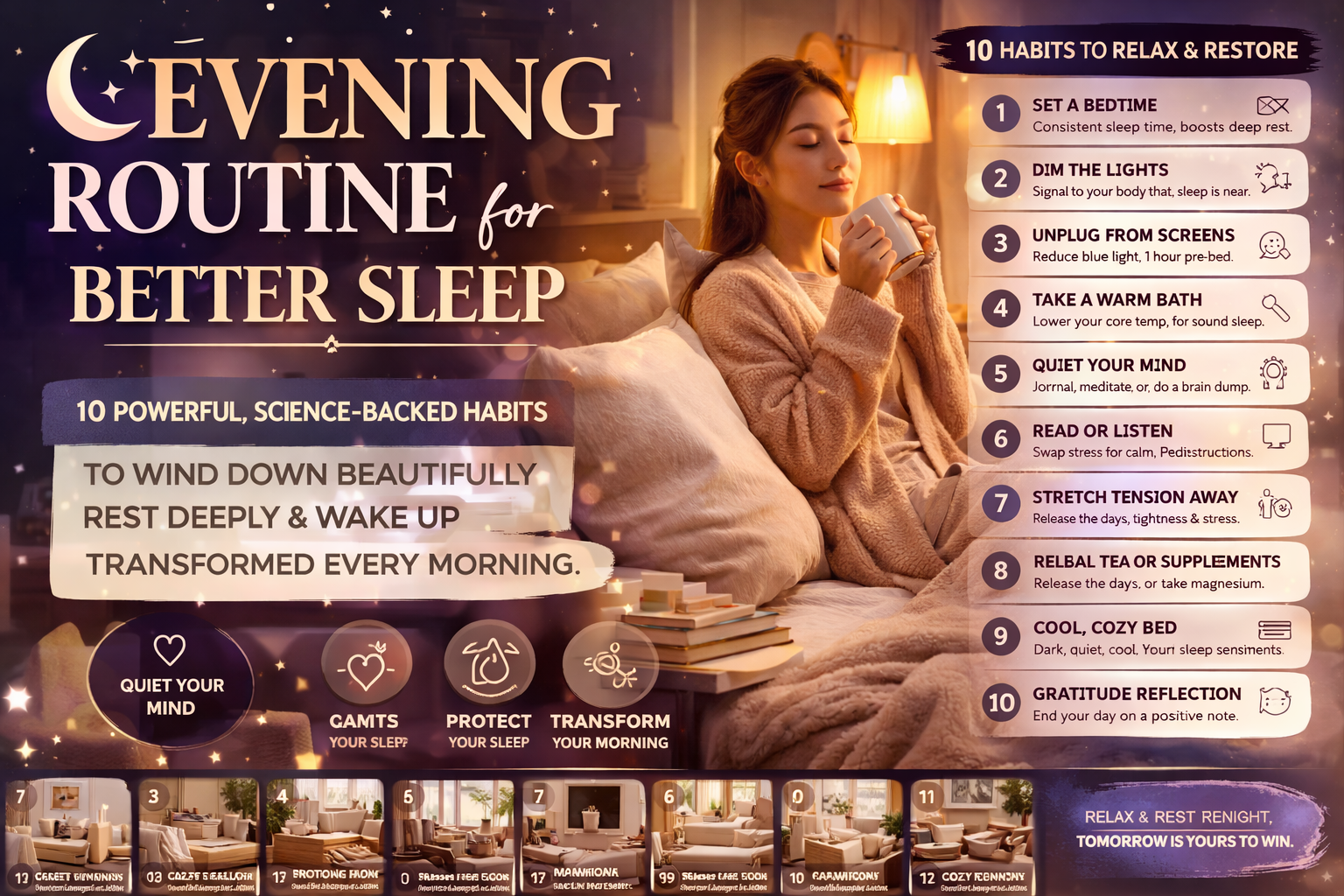
This guide presents 10 powerful, beautifully practical habits that build the most effective evening routine for better sleep available — grounded in neuroscience, chronobiology, and the Apex philosophy of elegant, sustainable daily rituals.
The Neuroscience of Sleep — Why Your Evening Routine Determines Your Sleep Quality
The quality of your sleep is not primarily determined by what happens during the 7–9 hours you are unconscious. It is primarily determined by what happens in the 2–3 hours before you close your eyes — the window in which your nervous system transitions from the sympathetic activation of waking life to the parasympathetic recovery state that enables genuinely restorative sleep.
The Sleep-Wake Biology Your Evening Routine Must Support
Melatonin and Light: Melatonin — the hormone that induces sleep — begins rising approximately 2 hours before your natural sleep time, triggered by the reduction of light (particularly blue-spectrum light) in your environment. Bright artificial light after dark, and blue light from screens specifically, suppresses melatonin production with clinical measurability. According to research from Harvard Medical School’s Division of Sleep Medicine, evening blue light exposure can suppress melatonin production by up to 85% and delay its onset by 90 minutes — directly reducing both sleep onset speed and the quality of slow-wave sleep achieved in the first half of the night.
Cortisol and the Evening Decline: Cortisol — the stress and alertness hormone — follows a natural daily cycle that peaks in the morning (the Cortisol Awakening Response) and declines progressively through the day, reaching its lowest point around midnight. Activities and information inputs that elevate cortisol in the evening — stressful news, demanding work tasks, emotionally stimulating content, heated arguments — interrupt this natural decline and directly delay the transition to sleep.
Core Body Temperature: Sleep is initiated and maintained in part by a drop in core body temperature — a process that begins naturally in the early evening and accelerates as bedtime approaches. Evening practices that support this thermal decline (warm baths, cooling bedroom environments, avoiding intense exercise near bedtime) directly accelerate sleep onset and improve sleep depth.
Adenosine and Sleep Pressure: Adenosine — the neurotransmitter that creates the “sleep pressure” that makes you feel tired — accumulates continuously throughout the waking day. Caffeine works by blocking adenosine receptors; once the caffeine clears (typically 6–8 hours after consumption), adenosine floods the receptors simultaneously, creating the characteristic mid-afternoon crash. An evening routine that includes a strict caffeine cut-off time allows adenosine to accumulate naturally to the levels needed for deep, effective sleep.
What “Better Sleep” Actually Means — The Four Sleep Architecture Goals
An evening routine for better sleep should be designed to support four specific sleep architecture outcomes:
| Avoiding alcohol, maintaining a consistent sleep schedule | What It Means | Evening Habit That Supports It |
| Faster sleep onset | Falling asleep in 15–20 minutes rather than 45–90+ | Digital sunset, temperature cooling, consistent sleep time |
| More slow-wave sleep (SWS) | Deeper, more physically restorative sleep stages | Avoiding alcohol, maintaining consistent sleep schedule |
| More REM sleep | Dream sleep critical for memory and emotional processing | Adequate sleep duration, reduced evening stimulation |
| Fewer nighttime awakenings | Sleeping continuously rather than fragmentedly | Consistent sleep environment, reduced evening fluids |
The 10-Step Evening Routine for Better Sleep
Habit 1 — Set a Consistent Sleep and Wake Time — The Chronobiology Anchor
The single most powerful habit in any evening routine for better sleep is not a supplement, a meditation practice, or a digital sunset. It is the commitment to a consistent sleep and wake time — every night, including weekends — that trains your circadian rhythm into a predictable, optimized cycle.
Why Consistency Outperforms Duration: Research from the National Sleep Foundation demonstrates that sleep timing consistency — the degree to which you sleep and wake at the same times — is a stronger predictor of cognitive performance, mood stability, and metabolic health than sleep duration alone. Social jet lag (the irregular sleep patterns created by late Friday and Saturday nights followed by earlier weekday wake times) creates a circadian disruption equivalent to a 1–2 hour time zone change — producing Monday morning performance deficits that compound across the week.
Practical Implementation: Choose a sleep time that allows 7–9 hours before your wake time. Honour it with the same non-negotiability as a professional commitment. For the first 14 days of implementing a consistent sleep schedule, expect difficulty — your circadian rhythm requires 2–3 weeks of consistent signals to fully entrain. After this period, you will begin falling asleep within minutes of your chosen time without pharmacological assistance.
Habit 2 — Implement a Digital Sunset 90 Minutes Before Bed
The digital sunset is the most clinically impactful single habit in the evening routine for better sleep — and the one most consistently resisted, because screens are the primary vehicle through which modern humans seek relaxation, entertainment, and social connection in the evening hours. The resistance is understandable. The cost is measurable.
The 90-Minute Rule: Setting a firm boundary 90 minutes before your target sleep time — beyond which no phone, tablet, laptop, or television is used — allows melatonin suppression to fully resolve, cortisol to complete its natural evening decline, and the nervous system to transition from the alert, reactive state that digital content induces to the calm, receptive state that enables sleep onset.
Creating a Digital Sunset Practice:
- Set a phone alarm for 90 minutes before sleep time, labelled “Begin Evening.”
- Charge all devices in a room other than the bedroom — the bedroom should contain no digital screens of any kind
- Replace screen time with the analog alternatives in the habits that follow
- Use “Night Mode” or blue-light filtering glasses for 30 minutes before the digital sunset if a gradual transition is required
The bedroom as a screen-free sanctuary: The association between bedroom and screens is one of the most damaging conditioning patterns in modern sleep behaviour. Your brain is extraordinarily good at associating environments with states — a bedroom used primarily for sleep produces sleepiness on entry; a bedroom used for screen content produces alertness on entry. Reclaim the association with deliberate consistency.
Habit 3 — Take a Warm Bath or Shower 60–90 Minutes Before Sleep
The warm bath or shower is among the most clinically supported and most underutilized sleep onset tools available — and it works through a counterintuitive mechanism. The warm water temporarily raises core body temperature; when you exit the bath, your body’s thermoregulatory response rapidly dissipates this heat, producing a faster-than-natural decline in core temperature that directly accelerates sleep onset.
According to a meta-analysis published in Sleep Medicine Reviews, bathing or showering in warm water (40–42°C) 1–2 hours before sleep reduces sleep onset latency by an average of 10 minutes — a clinically meaningful improvement that compounds significantly across weeks and months of consistent practice.
The Apex Evening Bath or Shower Protocol:
- Water temperature: 40–42°C (warm, not hot — extremely hot water is stimulating rather than calming)
- Duration: 10–20 minutes
- Timing: 60–90 minutes before target sleep time — this is the window in which the post-bath temperature drop has maximum effect on sleep onset
- Additions: Magnesium bath flakes (topical magnesium absorption for nervous system calming), lavender essential oil (2–3 drops), or Epsom salts for muscle relaxation
- Connect to your night skincare routine: The post-bath window is the optimal time to perform your complete night skincare routine — skin is warm, slightly damp, and maximally receptive to active ingredient absorption
For the complete night skincare routine that completes the post-bath ritual most effectively, our guide on night skincare routine for glowing skin provides the full Apex PM protocol that turns the post-bath window into the most productive skincare moment of your entire day.
Habit 4 — Complete Your Evening Journaling Practice
Evening journaling for sleep improvement is distinct from morning journaling for intention setting — it serves a different neurological purpose. Where morning journaling builds clarity and direction, evening journaling closes the psychological loops of the day, externalizes incomplete thoughts, and performs the cognitive offloading that prevents rumination from hijacking your sleep.
The Apex Evening Sleep Journal Protocol (10 Minutes):
Section 1 — Day Completion (3 minutes): Write three things from today that you are genuinely grateful for. Then write one sentence about what you accomplished that was meaningful, however small. This “day closure” practice reduces the “open task” intrusive thoughts that most commonly interfere with sleep onset.
Section 2 — Tomorrow Preparation (5 minutes): Write your three Most Important Tasks for tomorrow. Write one sentence about anything you are anxious about and one actionable step you will take tomorrow to address it. The act of writing these concerns externalizes them from working memory, reducing the load that would otherwise be processed (and, for overthinkers, ruminated) during sleep onset.
Section 3 — Release (2 minutes): Write the sentence: “Today is complete. Everything that needed to happen has either happened or has a plan. I release today and welcome rest.” This deliberate psychological closing is not self-help theatre — it is a cued relaxation response that, practiced consistently, produces measurable reductions in pre-sleep cognitive arousal.
The overthinking patterns that most frequently disrupt sleep onset are directly addressed by the practices in our guide on how to stop overthinking everything — an essential companion for anyone whose evening is disrupted by racing thoughts or anxiety spirals.
Habit 5 — Establish a Strict Caffeine Curfew
Caffeine has a half-life of approximately 5–6 hours in most adults (longer in women, older adults, and those with certain genetic variations in caffeine metabolism). This means that a 3 PM coffee still has 50% of its caffeine circulating in your bloodstream at 9 PM — actively blocking adenosine receptors and suppressing the sleep pressure your body needs to achieve rapid, deep sleep.
The Apex Caffeine Curfew Protocol:
- Standard curfew: 2:00 PM for most adults, ensuring >95% clearance by 10–11 PM
- Sensitive individuals: 12:00 PM (noon) — some individuals, particularly women and those over 50, metabolize caffeine significantly more slowly
- Sources to track: Coffee, tea (including green tea, which contains 25–50mg per cup), pre-workout supplements, energy drinks, dark chocolate (contains 20–60mg per serving), and some headache medications
The afternoon energy solution: The common 3 PM energy dip is not a caffeine deficiency — it is the natural ultradian trough of the body’s 90-minute performance cycle. Address it with a 10–20 minute “recovery nap” (set alarm for 25 minutes, including sleep onset time), a brief walk in natural light, or 500ml of water with a small protein-containing snack. All of these are more effective long-term solutions than caffeine, which simply delays the trough.
Habit 6 — Create a Warm, Dimly Lit Evening Environment
Your home’s evening lighting is not simply a practical matter of visibility — it is a powerful circadian signal that either supports or undermines your melatonin production, cortisol decline, and sleep onset biology throughout the pre-sleep window.
The Apex Evening Lighting Protocol:
- Immediately after sunset: Reduce all overhead lighting by 50–70% using dimmer switches or by turning off overhead lights and relying on table lamps and floor lamps only
- Eliminate cool white light sources after 8 PM: Cool white LEDs (4000K–6500K) are among the strongest suppressors of melatonin production — replace all post-8 PM light sources with warm white (2700K) equivalents
- Candles as the optimal evening light source: Candlelight (approximately 1800K) is the warmest, most melatonin-friendly light source available and the most deeply calming. A single candle in the bedroom or reading space produces measurable nervous system calming effects
- Smart bulb evening automation: Smart bulbs programmed to progressively warm and dim from 6 PM onward require no willpower to implement — they transform the home’s lighting environment automatically as the evening progresses
The warm, dimly lit evening environment connects directly to the design principles of the warm minimalist living room, because the most beautiful warm minimalist spaces are also naturally the most sleep-supportive. Our guide on warm minimalist living room ideas covers this connection in complete detail.
Habit 7 — Practice Breathwork or Gentle Movement for Nervous System Regulation
The body’s transition from the sympathetic nervous system dominance of waking life to the parasympathetic dominance of sleep requires an active neurological shift — and specific breathwork and movement practices accelerate this transition with clinical measurability. These are not simply “relaxation techniques” — they are physiological interventions with documented effects on heart rate variability, cortisol levels, and autonomic nervous system state.
The Apex Evening Breathwork Practices:
4-7-8 Breathing (Dr. Andrew Weil’s sleep technique): Inhale through the nose for 4 counts. Hold for 7 counts. Exhale through the mouth for 8 counts. Four to eight cycles, practiced lying down or seated. This technique activates the vagus nerve and directly stimulates parasympathetic activation — producing measurable heart rate reductions within 2–3 minutes.
Box Breathing for anxiety-driven wakefulness: Inhale for 4 counts. Hold for 4 counts. Exhale for 4 counts. Hold for 4 counts. Repeat for 4–8 cycles. Particularly effective for the overthinking, anxious pre-sleep state that most commonly disrupts sleep onset.
Yoga Nidra (Non-Sleep Deep Rest): A guided body scan and awareness practice that produces brainwave states associated with the hypnagogic threshold between waking and sleep. 20 minutes of yoga nidra produces neurological restoration equivalent to approximately 1 hour of light sleep — making it the most efficient evening recovery practice available for highly sleep-deprived individuals. The Yoga Nidra Network provides free guided practices.
Habit 8 — Read a Physical Book for 20–30 Minutes
Reading a physical book in the pre-sleep window is among the most evidence-supported sleep aids available — with a study from the University of Sussex demonstrating that 6 minutes of reading reduces psychological stress (a primary driver of poor sleep) by 68%. The key variables are physical (not digital) and not work-related — fiction, biography, philosophy, or any engaging content that occupies the mind sufficiently to prevent ruminative thinking without creating the cognitive arousal of demanding professional content.
Why Physical Books Outperform Digital:
- No blue light emission that suppresses melatonin
- No notifications, links, or algorithmic content interruptions that maintain alert cognitive engagement
- The physical act of turning pages is sufficiently motor-involving to prevent phone-checking habituation
- The inability to access social media or email through a physical book eliminates the most powerful digital sleep disruptors simultaneously
Curating a Bedside Reading Practice: Keep one fiction and one non-fiction book simultaneously on your nightstand — the fiction for evenings when you need escapist mental engagement, the non-fiction for evenings when you are reflective and interested in growth-oriented content. The act of choosing between them is itself a small act of self-knowledge and intentionality that reinforces the evening routine’s overall sense of personal agency.
Habit 9 — Design Your Sleep Environment as a Sanctuary
Your bedroom environment is a daily health intervention — and most people give it approximately zero design attention. The quality of your sleep is directly affected by the temperature, darkness, acoustic environment, air quality, and tactile comfort of your sleeping space. Optimizing each variable is not luxury — it is sleep hygiene, and sleep hygiene is health.
The Apex Sleep Sanctuary Design Protocol:
| Variable | Optimal Setting | Why It Matters |
| Temperature | 16–18°C (60–65°F) | Core body temp must drop 1–2°C for sleep initiation |
| Darkness | Complete — blackout curtains or sleep mask | Even dim light disrupts melatonin during sleep |
| Acoustic environment | Silent, or consistent white/pink noise | Intermittent noise causes micro-arousals that fragment sleep architecture |
| Air quality | Fresh, clean — open window or air purifier | Poor air quality reduces deep sleep duration measurably |
| Bedding | Natural fiber (linen, cotton, bamboo) | Breathable materials prevent night sweats that fragment sleep |
| Pillow | Support-appropriate for sleeping position | Incorrect support causes physical discomfort that creates arousals |
For the complete design philosophy that makes your bedroom the most effective sleep sanctuary possible — incorporating the aesthetic principles of warm minimalism into the most performance-critical room in your home — our guide on Japandi bedroom ideas on a budget is the ideal companion resource.
Habit 10 — Complete a Short Evening Body Care and Skincare Ritual
The final habit in the evening routine for better sleep serves double duty: it supports your skin’s overnight repair (a biological process discussed in full depth in our night skincare routine for glowing skin) while simultaneously functioning as a powerful sleep-onset ritual through its sensory and behavioural conditioning effects.
Why Beauty Rituals Improve Sleep: A consistent pre-sleep skincare practice creates what behavioural psychologists call a “sleep cue sequence” — a chain of sensory events (warm water, specific product scents, the tactile ritual of cleansing and moisturizing) that, through repetition, becomes a conditioned stimulus for sleep onset. After 3–4 weeks of consistent association, the beginning of your skincare ritual automatically begins the neurological transition toward sleep, making the routine itself a pharmacologically meaningful sleep intervention.
The Minimum Viable Evening Beauty Ritual (5 minutes):
- Double cleanse (remove SPF and day’s residue)
- Apply retinol or hydrating serum
- Rich night moisturizer + facial oil
- Under-eye treatment
- Body moisturizer applied to arms and décolletage (with a warming, calming scent — lavender, sandalwood, or chamomile)
The sensory richness of this ritual — warm water, specific scents, soft textures — activates the parasympathetic nervous system through multiple simultaneous channels, producing the calm, embodied presence that is the ideal state for sleep onset.
The Complete Evening Routine for Better Sleep — Full Schedule
| Time (Example) | Habit | Duration |
| 7:30 PM | Caffeine curfew already implemented (earlier) | Ongoing |
| 8:30 PM | Dim all lights — digital sunset begins | 1 min |
| 8:30–9:00 PM | Journaling (day closure + tomorrow prep) | 15–20 mins |
| 9:00–9:20 PM | Warm bath or shower | 15–20 mins |
| 9:20–9:35 PM | Night skincare and body care ritual | 10–15 mins |
| 9:35–9:55 PM | Physical book reading | 20 mins |
| 9:55–10:05 PM | Breathwork (4-7-8 or box breathing) | 8–10 mins |
| 10:00–10:10 PM | Final bedroom check (temp, dark, quiet) | 5 mins |
| 10:10 PM | Target sleep time | — |
Minimum Viable Evening Routine (30 minutes total): Digital sunset (ongoing) → 10-minute journaling → 5-minute skincare → 10-minute book reading → 5-minute breathwork → sleep.
Sleep Quality Improvement Timeline
| First noticeable improvements in sleep onset speed if digital sunset is practiced | What Changes |
| Night 1–3 | First noticeable improvements in sleep onset speed if digital sunset practiced |
| Week 1–2 | Consistent sleep onset within 20–25 minutes; reduced nighttime awakenings |
| Week 3–4 | Circadian rhythm entraining; falling asleep within minutes of target time |
| Month 2 | Measurably improved morning energy, mood, and cognitive clarity |
| Month 3–4 | Cumulative skin improvement from consistent overnight repair; significant wellbeing gains |
| Month 6+ | Sleep becomes the most protected and most valued investment in your daily practice |
How Your Evening Routine Connects to Your Morning Performance
The evening routine for better sleep is not separate from your morning performance — it is its most important prerequisite. The morning habits that change your life — the exercise, the journaling, the focused first 90 minutes of professional work — all depend on the neurological restoration that quality sleep provides. A brilliant morning routine built on poor sleep is a magnificent structure built on sand.
For the complete morning performance framework that your evening routine makes possible, our guide on morning habits that change your life is the natural partner to this evening practice — the two posts together forming the complete daily performance architecture of the Apex life. And for the discipline infrastructure that makes both routines sustainable over the long term, how to build self-discipline daily provides the behavioural foundation that makes consistency possible.
Frequently Asked Questions
How many hours before bed should I start my evening routine?
Begin your evening routine 90–120 minutes before your target sleep time. This provides sufficient time for the digital sunset to allow melatonin recovery, the warm bath’s thermoregulatory effect to produce its sleep onset benefit, and the journaling and reading practices to complete the neurological transition to sleep readiness.
What if I work late and cannot start 2 hours before sleep?
Apply the minimum viable version: implement a strict final 30-minute digital-free window before sleep, perform a 3-minute breathing practice in bed, and apply your night skincare products (which function as a sleep cue). Even 30 minutes of consistent wind-down produces measurable sleep quality improvement over an unstructured pre-sleep period.
Does the evening routine help with insomnia?
An evidence-based evening routine addresses the behavioural and environmental factors that cause most non-clinical insomnia (sleep onset difficulty and nighttime awakenings in otherwise healthy adults). For clinical insomnia — defined as persistent sleep difficulty despite appropriate sleep opportunity, lasting more than 3 months — Cognitive Behavioural Therapy for Insomnia (CBT-I) is the first-line evidence-based treatment recommended by sleep medicine authorities. The evening routine practices in this guide are consistent with CBT-I behavioural interventions.
Is it okay to exercise in the evening?
Light to moderate exercise (yoga, walking, gentle stretching) before 8 PM is sleep-supportive. Vigorous exercise (high-intensity interval training, heavy strength training, competitive sport) within 3 hours of sleep time elevates core body temperature, cortisol, and heart rate in ways that delay sleep onset for many adults. If evening is your only exercise window, prioritize yoga, walking, or pilates over high-intensity training.
CONCLUSION
An evening routine for better sleep is not an indulgence — it is an architecture. It is the deliberate design of the 2–3 hours before sleep that determines the quality of the 7–9 hours during it, which in turn determines the quality of every waking hour that follows. When you protect and optimize your evening with the same intentionality that the Apex philosophy brings to every other dimension of life, you are not simply improving your sleep. You are improving your skin, your cognitive performance, your emotional resilience, your physical health, and the cumulative quality of your lived experience in the most fundamental way available.
Begin tonight with two habits: implement your digital sunset and perform your night skincare ritual. Add the journaling practice in week two. Layer in the breathwork and physical book in week three. Build the routine slowly, consistently, and with the understanding that every night you invest in excellent sleep is a compound return on the extraordinary life you are building during your waking hours.
Rest is not the pause between your days. Rest is the foundation upon which all of them are built.
Sleep well. Wake transformed.
OUTBOUND LINKS
- Harvard Medical School Division of Sleep Medicine — https://sleep.hms.harvard.edu/
- National Sleep Foundation — https://www.thensf.org/research/
- Sleep Medicine Reviews (Bath/Sleep Study) — https://www.sciencedirect.com/journal/sleep-medicine-reviews
- Yoga Nidra Network — https://yoganidranetwork.org/
INTERNAL LINKS
- Night Skincare Routine for Glowing Skin — https://apexaesthetic.blog/night-skincare-routine-for-glowing-skin/
- How to Stop Overthinking Everything — https://apexaesthetic.blog/how-to-stop-overthinking-everything/
- Warm Minimalist Living Room Ideas — https://apexaesthetic.blog/warm-minimalist-living-room-ideas/
- Morning Habits That Change Your Life — https://apexaesthetic.blog/morning-habits-that-change-your-life/
- How to Build Self-Discipline Daily — https://apexaesthetic.blog/how-to-build-self-discipline-daily/
- Japandi Bedroom Ideas on a Budget — https://apexaesthetic.blog/japandi-bedroom-ideas-on-a-budget/