
Table of Contents
Introduction
Working from home gives you flexibility. It also hands you a kitchen, a phone, and zero hallway between you and a hundred small interruptions.
That’s the trade. Focus habits for remote workers exist because willpower alone can’t compete with a notification buzzing six inches from your hand.

Here’s the part that surprises most people: the workers who stay sharp aren’t more disciplined. They’ve just built routines that don’t require discipline in the first place. Stanford economist Nicholas Bloom, who has run randomised controlled trials on remote and hybrid work since 2015, found that employees working from home at a Chinese travel company completed 13.5% more calls per shift than office-based peers, largely because structured routines cut down on idle time and unplanned breaks.
This guide walks through 11 focus habits for remote workers, the research behind why they work, and the mistakes that quietly wreck remote work productivity even when you’re trying hard.
Why is focus harder in remote work environments?
Focus is harder at home because your brain doesn’t separate “work mode” from “home mode” the way an office does. Every room carries mixed signals—the couch means rest, the kitchen means food, and the desk means work, but they’re all 20 feet apart.
The hidden cost of constant digital interruptions
Switching between tasks costs more than people think. The American Psychological Association has studied this directly: psychologists conduct task-switching experiments to determine the costs of this kind of mental “juggling”, and the findings are consistent across two decades of research. Each time you stop writing a report to glance at Slack, your brain pays a measurable “switch cost” in time and accuracy before it fully returns to the original task.
A 2022 neuroimaging study out of Wake Forest backs this up at the brain level—brain activity measured by fMRI and EEG demonstrates a switch cost each time attention is redirected. That cost doesn’t disappear because you’re “good at multitasking”. Nobody is.
Why home environments blur mental boundaries
Your office had walls, a commute, and coworkers who signalled, “We’re working now.” Home has laundry baskets and a dog that wants out. Without a clear environmental cue, your brain treats every minute as up for negotiation.
Decision fatigue and attention residue
Every small choice — check email or finish the slide deck first, answer this text now or later — drains the same mental resource. By 2 p.m., that resource runs thin, and focus gets harder simply because you’ve made 200 decisions before lunch.
What does the science say about sustainable focus?
Sustainable focus comes from structure, not motivation. Three forces matter most: deep, uninterrupted work blocks, automatic habits that don’t need decisions, and an environment built for one task at a time.
Deep work and cognitive performance
Georgetown computer science professor Cal Newport popularised the term “deep work” to describe distraction-free, cognitively demanding work—the kind that actually moves a project forward, as opposed to shallow tasks like clearing an inbox. Newport’s research and writing argue that the ability to concentrate without distraction is becoming rarer and, because of that, more valuable.
Habit formation and automatic behaviors
James Clear, author of Atomic Habits, describes habits as behaviours that move from effortful to automatic through repetition tied to a consistent cue. Once a habit is automatic, it stops competing with your daily willpower budget — which is exactly why habit-based focus systems outperform “just try harder” approaches.
The role of the environment in concentration
Your environment either supports focus or fights it. A desk used only for work trains your brain to associate that spot with concentration. A desk that doubles as a dinner table, a mail pile, and a laptop charging station trains your brain to associate it with nothing in particular.
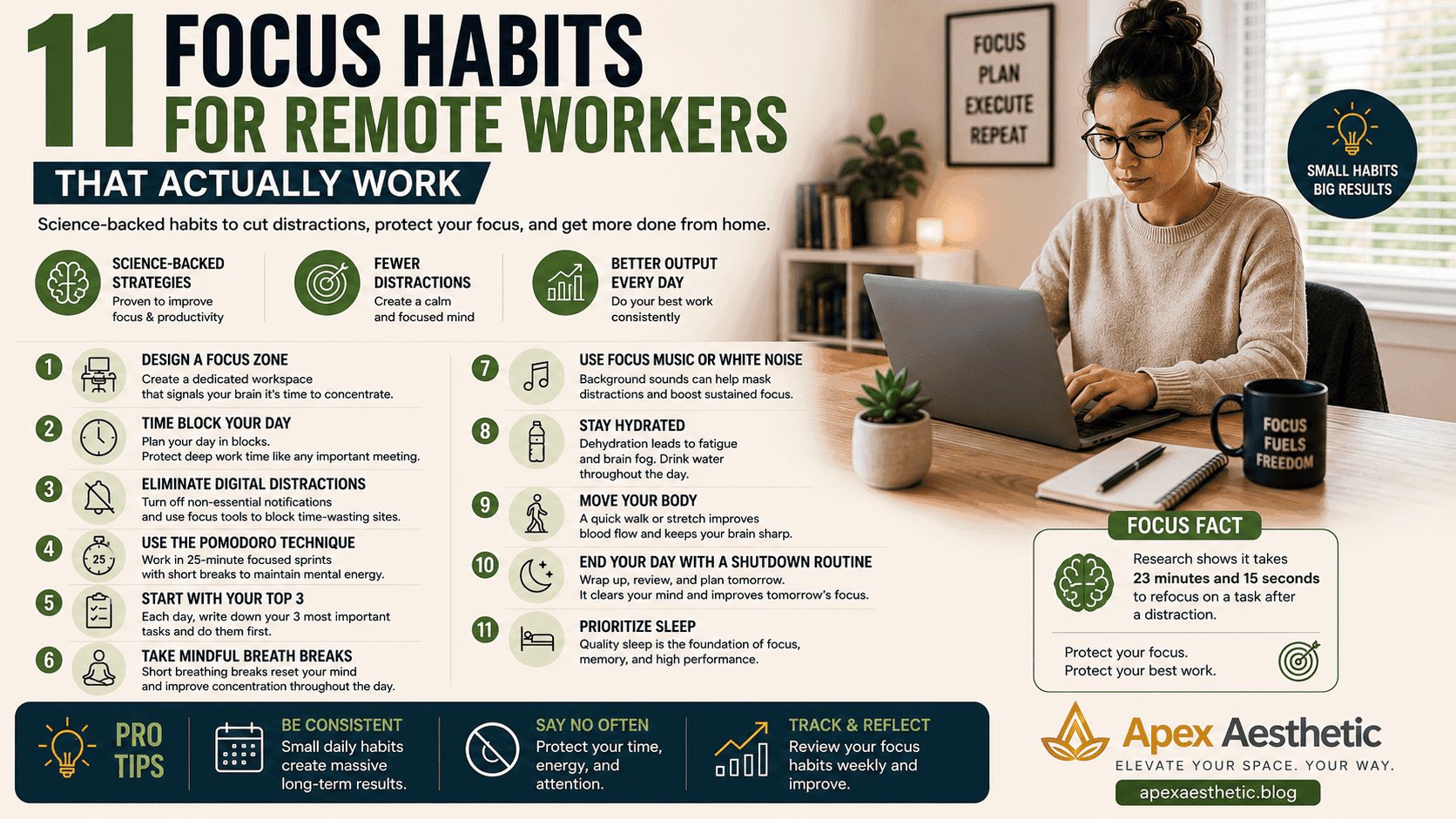
11 focus habits every remote worker should build
1. Start every day with a fixed morning routine
A repeatable morning routine for remote workers removes the first 10 decisions of the day before they can drain your focus. Wake up, same steps, same order, every day.

One pattern shows up again and again among productive remote professionals—mornings begin with routines, not decisions. Reducing early choices preserves mental energy for the work that actually matters later. A repeated 20-minute sequence (coffee, 5 minutes of planning, and dressing for the day) does more for intentional productivity than an extra 20 minutes of sleep.
2. Create a dedicated workspace
Even a small desk in a corner, used only for work, beats a rotating spot on the couch. Physical boundaries train mental ones.
People underestimate how much physical boundaries shape mental boundaries. A consistent workspace—even one that’s 3 feet by 2 feet—usually improves work-from-home focus more than an expensive monitor setup or a new productivity app.
3. Practice time blocking
Time blocking means assigning a specific task to a specific hour on your calendar instead of working from an open-ended to-do list. Productivity systems built this way reduce the constant “what should I do next” decision.
Time management software like Google Calendar or Notion makes this easier to maintain, since blocks repeat automatically and don’t rely on memory.
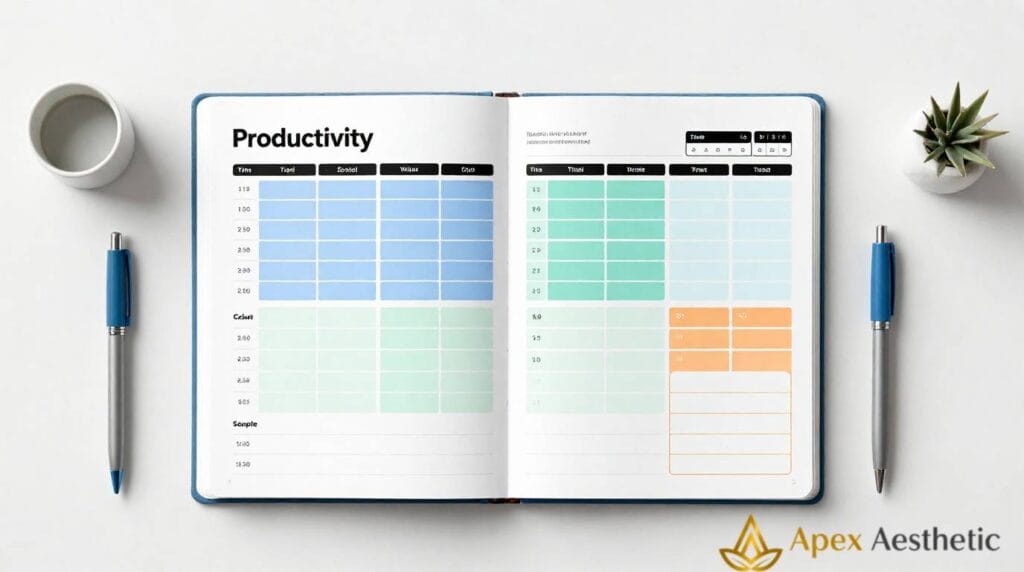
One lesson that repeatedly emerges from remote work routines is that people who schedule priorities usually outperform people who schedule availability. Blocking time for meaningful work creates structure before distractions have a chance to compete for attention.
4. Use the Pomodoro technique with intention

The Pomodoro technique breaks work into 25-minute focus sprints followed by 5-minute breaks. It’s not magic — it works because it makes starting easier. Committing to 25 minutes feels manageable in a way that “focus for 3 hours” doesn’t.
It won’t suit every task. Creative writing or deep coding sometimes needs longer, uninterrupted stretches, which is where scheduled deep work sessions (habit 6) work better than rigid 25-minute blocks.
| Method | Best for | Advantages | Limitations |
| Time blocking | Structured professionals | Clear priorities | Less flexible |
| Pomodoro technique | Short focus sessions | Prevents burnout | Interrupts flow for some |
| Deep work scheduling | Creative or complex work | Maximum concentration | Requires discipline |
| Habit stacking | Beginners building a routine | Easy to start | Slower visible results |
| Digital minimalism | Knowledge workers | Fewer distractions | Requires upfront setup |
5. Turn off non-essential notifications
Every notification you allow is a standing invitation to switch tasks. Digital wellness solutions start with deciding which apps actually need real-time access to your attention—for most remote jobs, that’s one or two, not fifteen.
Workers often assume checking a notification “just takes a second” and costs nothing. In practice, the attention residue lingers well after the screen goes dark, and most interruptions create more lost time than the interruption itself.
6. Schedule deep work sessions
Block 60 to 90 minutes, close every tab unrelated to the task, and put your phone in another room. This is where real focus and concentration techniques pay off — not during multitasking, but during single-tasking with nothing competing for attention.

7. Take strategic breaks
Breaks aren’t a productivity leak. Mayo Clinic’s research on workplace stress points to workload and lack of control as two of the biggest burnout drivers, and unstructured, nonstop work raises both. Workload is the amount of work a person is expected to do in a specified time, and pushing through without breaks increases perceived workload even when the actual task list hasn’t changed.
A 5-minute walk between deep work blocks resets attention better than scrolling a phone, which just trades one form of stimulation for another.
8. Build end-of-day shutdown rituals
A fixed shutdown routine—close the laptop, write tomorrow’s top 3 tasks, and log off at the same time—protects work-life boundaries that remote work tends to erase.
The most effective remote workers rarely work until exhaustion. They build a deliberate ending into the day, which makes recovery part of the productivity system instead of an afterthought.

9. Use habit stacking
Habit stacking means attaching a new habit to an existing one: “After I pour my coffee, I write my top 3 priorities.” James Clear’s research on habit formation shows that anchoring new behaviours to established cues makes them far more likely to stick than relying on memory or motivation alone.
10. Limit digital clutter
Digital minimalism means fewer open tabs, fewer apps competing for your home screen, and fewer half-finished documents scattered across folders. Online collaboration tools like Slack and Asana are useful — until there are 8 of them open at once, each pulling focus in a different direction.
Many professionals underestimate how much mental energy digital clutter consumes. Open tabs, unread notifications, and multiple messaging platforms create a constant sense of unfinished work, even when nothing urgent requires attention.
11. Review priorities weekly

A 15-minute Friday review—what worked, what didn’t, and what’s actually urgent next week—keeps task management apps from turning into a graveyard of forgotten to-dos.
People often overestimate what can be accomplished in a single day and underestimate what consistent habits achieve over several months. Weekly reviews help align expectations with reality and reduce unnecessary stress.
Which productivity method works best for remote workers?
| Method | Best For | Advantages | Limitations |
| Time Blocking | Structured professionals, managers, and planners | Creates clear priorities, reduces context switching, and improves time management | Less flexibility when unexpected tasks arise |
| Pomodoro Technique | Deep work sessions, students, and beginners | Prevents burnout, encourages regular breaks, improves concentration | Fixed intervals may interrupt creative flow |
| Deep Work Scheduling | Writers, developers, designers, and knowledge workers | Maximizes focus, supports high-value work, minimizes distractions | Requires discipline and protected time blocks |
| Habit Stacking | Beginners building new routines | Easy to implement, leverages existing habits, sustainable over time | Results develop gradually rather than immediately |
| Digital Minimalism | Remote professionals managing multiple tools | Reduces distractions, improves mental clarity, lowers digital fatigue | Requires intentional boundaries and ongoing maintenance |
One pattern that consistently appears among productive remote workers is that they commit to one or two systems rather than constantly searching for the next productivity trend. The best method is rarely the most sophisticated—it’s the one you can maintain consistently without adding unnecessary complexity to your daily routine.
The best method is the one you’ll actually repeat. Time blocking suits people who like structure. The Pomodoro technique suits people who struggle to start. Deep work scheduling suits creative or technical roles that need long, uninterrupted blocks.
The most productive systems are rarely the most complicated ones. Successful remote workers tend to pick one or two methods and stick with them, rather than testing a new productivity trend every month.
Common focus mistakes remote workers make
- Treating motivation as a strategy. Motivation fluctuates daily. Habits and routines don’t depend on how you feel that morning.
- Working without clear priorities. A full task list isn’t the same as a prioritised one. Without ranking, the easiest task wins over the most important one.
- Ignoring recovery and breaks. Skipping breaks doesn’t add hours of output — it adds hours of lower-quality output.
- Keeping notifications permanently active. Every app with alerts on is a standing interruption request.
- Trying too many productivity systems at once. Stacking five frameworks at the same time usually means none of them gets a fair test.
Many people fail to build lasting focus habits because they keep searching for a better tool instead of refining the routine they already have. The fix is rarely a new app—it’s running the same system for 30 days before judging it.
How long does it take for these habits to stick?
Most habit research points to weeks, not days. James Clear’s writing on habit formation argues that consistency of repetition matters more than the exact number of days—a habit tied to a stable daily cue tends to feel automatic somewhere between 3 and 8 weeks in, depending on how complex the behaviour is.
That timeline explains why so many remote workers give up on a new system too early. A time-blocking calendar that feels forced in week one usually feels close to automatic by week four, provided the blocks stay at the same time each day.
People testing a new focus routine often judge it after 3 or 4 days and decide it isn’t working. The habits that actually hold up are rarely judged fairly until they’ve run for a full month.
How do you build a sustainable remote work routine?
A sustainable routine has four parts: a fixed morning start, midday focus blocks, afternoon collaboration time, and an evening shutdown ritual. Each part runs at roughly the same time daily.
- Morning: Fixed routine, then a single most-important task before checking email.
- Midday: 2 to 3 deep work or time-blocked sessions, broken by short walks.
- Afternoon: Meetings, collaboration tools, and lower-focus admin tasks — your concentration naturally dips here for most people.
- Evening: Shutdown ritual, tomorrow’s top 3 tasks written down, laptop closed at a consistent time.
The routines that hold up long-term are usually the simplest ones a person can actually repeat, not the most detailed systems that get abandoned after two weeks.
For example, a freelance designer who blocks two uninterrupted morning hours, phones in another room, often finishes more real work than someone putting in eight fragmented hours with notifications running the whole time.
Recommended productivity tools for remote workers
These are tools worth testing, not a sponsored list. Pick one from each category rather than installing all five.
- Notion — task management and notes in one place
- Todoist—a simple, fast task management app for daily to-do lists
- Google Calendar — free time blocking and time management software
- RescueTime — tracks where your screen time actually goes
- Forest — gamifies phone-free focus sessions
The tool matters less than whether you actually open it every day. A simple list you check daily beats a complex system you set up once and abandon.
FAQ’s Focus Habits for Remote Workers
How can remote workers improve concentration?
Build a fixed morning routine, work in a dedicated space, and schedule deep work blocks with notifications off. Concentration improves through repeated structure, not single bursts of willpower.
What is the best productivity technique for working from home?
There isn’t one universal answer. Time blocking suits structured roles, the Pomodoro technique suits people who struggle to start tasks, and deep work scheduling suits creative or technical work needing longer focus blocks.
How long should deep work sessions last?
Most people sustain real focus for 60 to 90 minutes before needing a break. Shorter 25-minute Pomodoro sprints work well for tasks that feel hard to begin.
Does the Pomodoro technique actually work?
It works for many people because the short time commitment lowers the barrier to starting. It’s less effective for tasks that need long, uninterrupted flow, like writing or coding complex features.
How can I avoid distractions while working remotely?
Turn off non-essential notifications, keep your phone in another room during deep work, and use a dedicated workspace so your brain associates that spot with focus instead of rest.
What habits do successful remote workers share?
Fixed morning and shutdown routines, scheduled deep work blocks, weekly priority reviews, and a workspace used only for work. None of these requires extra willpower once they’re set up as habits.
Conclusion
Focus isn’t a talent. It’s a set of habits repeated until they run on autopilot.
The remote workers who stay sharp build systems that support attention instead of leaning on willpower alone. Consistent routines, clear boundaries, and realistic daily expectations beat any dramatic productivity overhaul.
For more strategies on building sustainable routines and improving daily performance, explore:
• How to Stop Procrastinating Now
• How to Build Self-Discipline Daily
Authority sources referenced:
- Stanford Institute for Economic Policy Research — Hybrid work research, Nicholas Bloom
- American Psychological Association — Multitasking: Switching costs
- Mayo Clinic Press — Breaking down burnout in the workplace
- Cal Newport—Deep Work: Research and writing
- James Clear — Atomic Habits, habit formation principles
2 thoughts on “Focus Habits for Remote Workers: 11 Daily Practices That Improve Concentration”