Table of Contents
Introduction

Emotional intelligence skills matter more than most job descriptions admit. Companies say they want “team players” and “strong communicators,” but what they’re really describing is emotional intelligence. You’re right to think technical skill alone doesn’t get people promoted. I’ll walk you through the 12 skills that separate people who manage their emotions well from people who let their emotions manage them, plus how to build each one starting this week.
What are emotional intelligence skills?
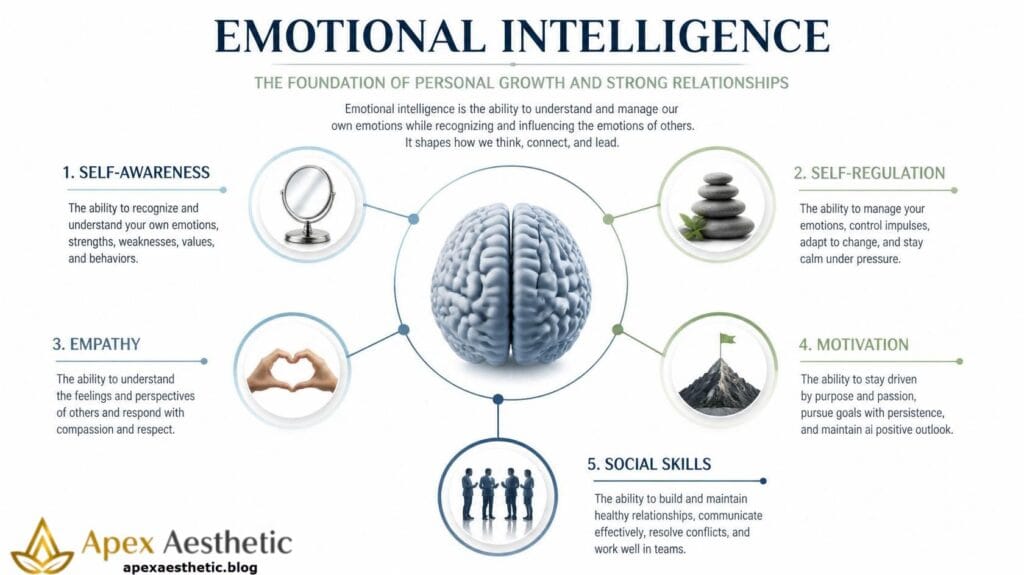
Emotional intelligence skills are the abilities you use to recognize, understand, and manage emotions, both yours and other people’s. The concept covers five areas: self-awareness, self-regulation, motivation, empathy, and social skills.
IQ measures how fast you learn and solve problems. Emotional intelligence means something different: it measures how well you handle yourself and your relationships under pressure. Psychologist Daniel Goleman popularized the term in the 1990s, building on earlier research by Peter Salovey and John Mayer. Neither IQ nor EQ replaces the other. A surgeon still needs technical training, and a manager still needs to understand the business. What changes is which one predicts how far someone goes once the baseline skill is in place.
High EQ isn’t about being nice all the time. It’s about reading a room accurately, choosing your response instead of reacting on autopilot, and staying steady when things get tense. Researchers define emotional intelligence as the ability to accurately perceive emotions, use them to support thinking, understand emotional information, and regulate emotions in yourself and others.
Early in my career, I believed technical skill alone determined who got ahead. Over time, I noticed something different. Colleagues who managed their emotions well, listened without interrupting, and stayed calm during conflict often became the strongest leaders, even when others knew more on paper. The lesson stuck with me: raw knowledge gets you in the room, but EQ decides whether people want to work with you once you’re there.
Why does this matter for your career?

Emotional intelligence in business affects almost every outcome that matters: retention, sales, promotions, and team morale. People with strong EQ build trust faster and recover from setbacks quicker than people who don’t.
Here’s what changes when your EQ improves:
- Relationships get stronger. You listen instead of waiting for your turn to talk.
- Communication gets clearer. You say what you mean without triggering defensiveness.
- Decisions get sharper. You separate the facts from the emotional noise around them.
- Stress gets manageable. You notice tension building before it takes over.
- Careers move faster. Managers promote people they trust to handle pressure.
- Conflict shrinks. Small disagreements stop turning into weeks of tension.
A study published in The Leadership Quarterly found that people with high EQ perform better and report more job satisfaction than people with lower scores. That’s not a minor detail. It’s a direct line between how you handle emotions and how far your career goes. A separate study in the same journal found teams with strong emotional intelligence competencies also showed stronger cohesion, which matters if you manage a team or hope to someday.
Emotional Intelligence Self-Assessment Worksheet
Before learning how to improve your emotional intelligence, it’s helpful to understand your current strengths. Answer the questions below honestly to identify the skills that deserve the most attention.
Self-Assessment
| Question | Your Response |
| 1. How do I usually respond when I feel frustrated or stressed? | __________________________________________ |
| 2. Do I pause before reacting during difficult conversations? | ☐ Always ☐ Sometimes ☐ Rarely |
| 3. How comfortable am I accepting constructive feedback? | ☐ Very Comfortable ☐ Somewhat Comfortable ☐ Uncomfortable |
| 4. Do I actively listen without interrupting others? | ☐ Often ☐ Sometimes ☐ Rarely |
| 5. Which emotional intelligence skill would improve my relationships the most? | __________________________________________ |
| 6. What situations most often trigger emotional reactions? | __________________________________________ |
| 7. Which one habit would I like to improve during the next month? | __________________________________________ |
| 8. What does success look like after improving my emotional intelligence? | __________________________________________ |
My 30-Day EQ Goal
Complete this sentence:
“Over the next 30 days, I will strengthen my emotional intelligence by
__________________________________________________________________________________________.”
I see this over and over again with emotionally intelligent people. They are willing to reflect before they try to change. It’s often more productive to take a few minutes to notice emotional triggers and communication patterns than to just focus on techniques or productivity tips.
What are the 12 core skills?
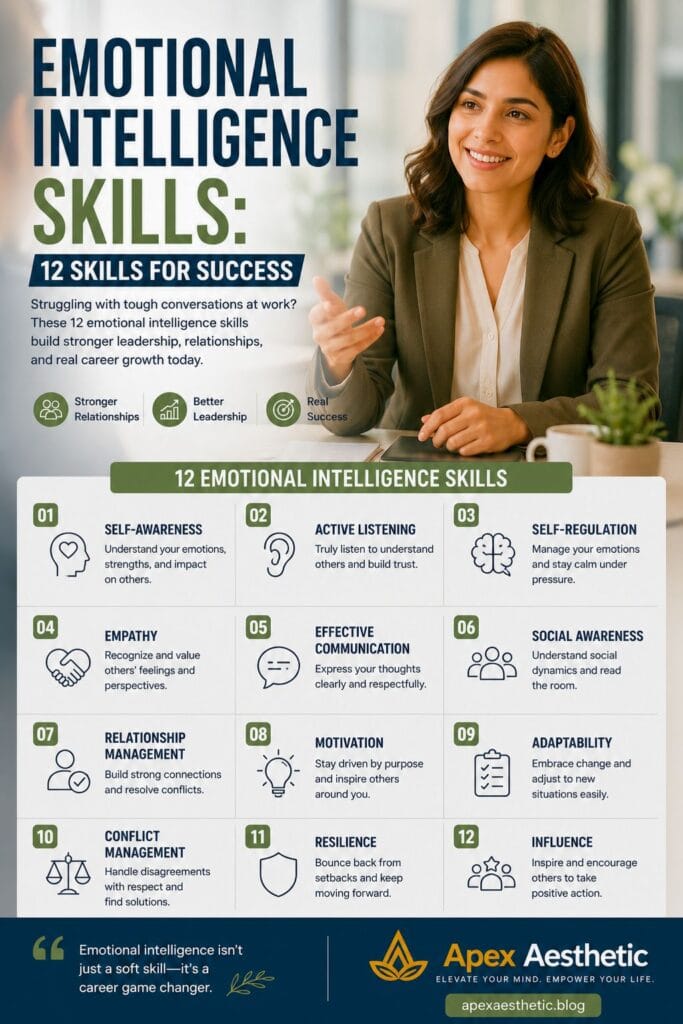
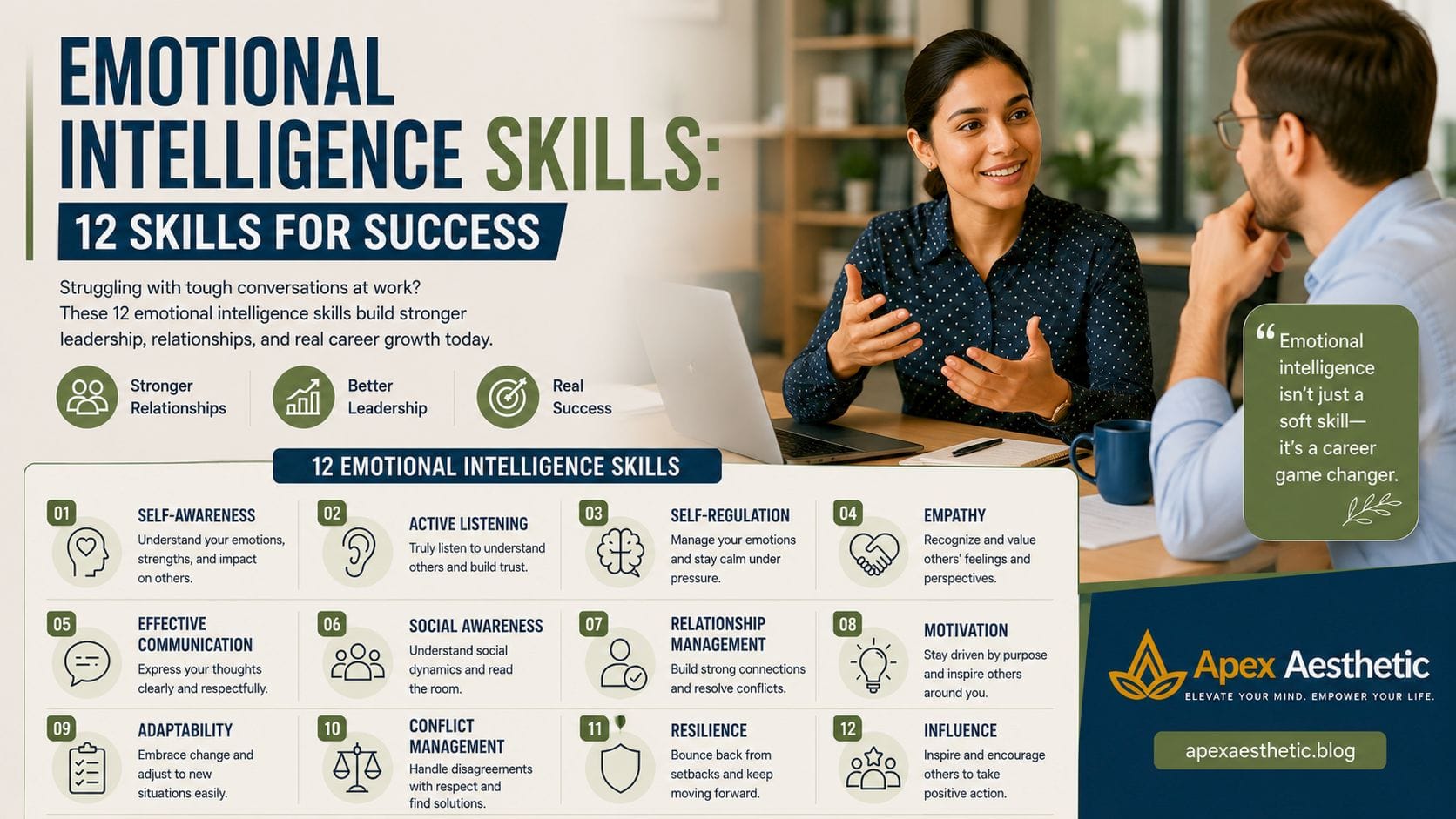
Here are all 12, broken down so you can see exactly what each one looks like in practice. None of them requires a personality transplant. They’re habits, and habits can be built.
1. Self-awareness

Self-awareness means noticing your emotions the moment they happen, not an hour later. It’s the foundation every other emotional intelligence skill builds on.
Start by naming what you feel in real time. Instead of “I’m fine,” try “I’m frustrated because this meeting ran long.” That small shift builds the habit fast. Self-awareness is the foundation on which everything else on this list is built: you can’t regulate what you can’t name.
2. Self-regulation
Self-regulation is your ability to pause before reacting. It doesn’t mean suppressing emotions. It means choosing your response instead of letting the emotion choose for you.
People strong in self-regulation rarely send an angry email at 11 p.m. They wait, breathe, and respond the next morning with a clearer head.
3. Motivation
Internal motivation drives people toward goals even when nobody’s watching. It’s different from chasing a bonus or a title.
People with strong internal motivation set specific goals, track progress, and keep going after a setback because the goal itself still matters to them.
4. Empathy
Emotional intelligence, or empathy, is the ability to sense what someone else is feeling and respond with genuine understanding, not just sympathy.
One conversation taught me that listening without interrupting often solved problems faster than jumping straight to advice. People usually want to feel understood before they want a solution handed to them.
5. Social awareness
Social awareness and emotional intelligence mean reading a room accurately. You notice tension, excitement, or hesitation before anyone says a word.
People strong here pick up on group dynamics quickly. They know when to speak up and when to let someone else finish a thought first.
6. Relationship management
Relationship management in emotional intelligence covers how you build trust, resolve conflict, and collaborate without it turning personal.
This skill shows up in how you handle disagreement. Do you attack the person or address the problem? That distinction alone predicts whether working relationships survive conflict.
7. Communication skills
Emotional intelligence communication skills combine active listening, clear non-verbal signals, and feedback that helps instead of stings.
Active listening means repeating back what you heard before responding. It sounds small. It changes almost every difficult conversation.
8. Adaptability
Adaptability is how well you handle change without losing your footing. Plans shift constantly at work, and rigid people burn out faster than flexible ones.
A growth mindset supports this skill directly. When you see a setback as information instead of failure, adapting gets easier.
9. Emotional resilience
Emotional resilience is your ability to recover from setbacks without spiraling. It’s not about avoiding stress. It’s about bouncing back from it faster each time.
People with strong resilience treat failure as data. They ask what went wrong, adjust, and move forward instead of dwelling.
10. Conflict resolution
Conflict resolution means having the hard conversation instead of avoiding it. Workplace disagreements don’t disappear when you ignore them. They usually get worse.
Finding common ground starts with stating what you both actually want, not just what you disagree on.
11. Decision-making
Strong decision makers balance emotion with logic instead of letting either one dominate. Pure logic misses context. Pure emotion misses consequences.
Before a big decision, ask what you’d advise a friend to do in the same spot. That question strips out some of the emotional bias clouding your own view.
12. Leadership
Leadership emotional intelligence shows up as trust, not volume. The best leaders ask good questions, stay calm under pressure, and make people feel heard before decisions get made.
Throughout my career, I noticed that respected leaders weren’t the loudest voices in the room. They asked thoughtful questions, stayed calm under pressure, and made people feel heard before making a call. That pattern held true across every team I watched closely.
The 12 skills at a glance
| Skill | Why it matters | Everyday example | Workplace benefit |
| Self-awareness | Better decisions | Recognising frustration as it starts | Fewer impulsive mistakes |
| Self-regulation | Emotional control | Staying calm in a tense meeting | Stronger teamwork |
| Empathy | Stronger relationships | Listening without interrupting | Higher trust |
| Communication | Clear conversations | Giving direct, kind feedback | Better collaboration |
| Adaptability | Managing change | Accepting a new process | Greater resilience |
| Leadership | Influencing others | Motivating a stalled team | Improved performance |
How Each Emotional Intelligence Skill Helps in Everyday Life
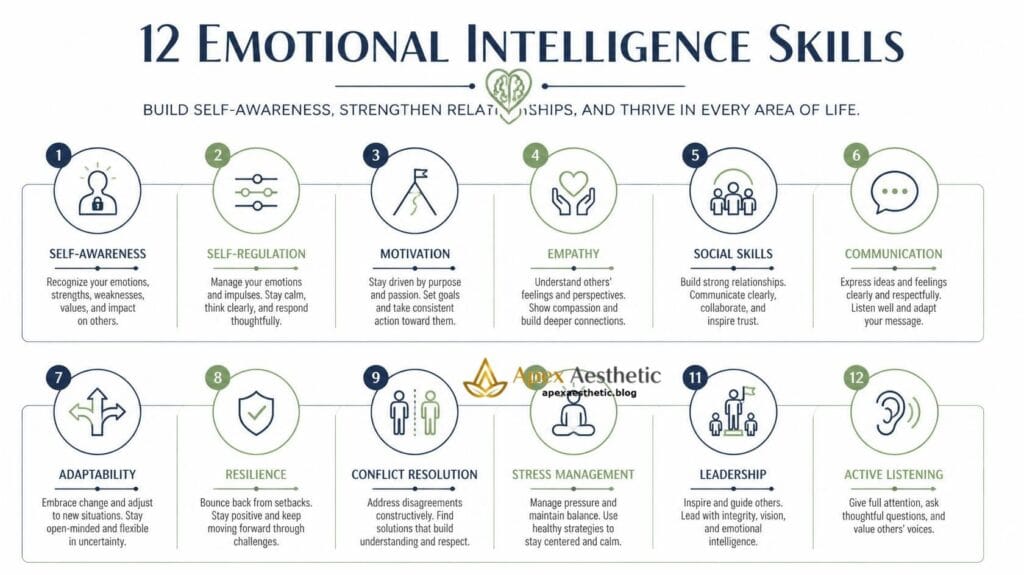
Although every emotional intelligence skill supports personal and professional growth, each one contributes in a different way. Understanding how these skills apply in everyday situations makes it easier to identify which areas deserve the most attention.
| Emotional Intelligence Skill | Primary Benefit | Everyday Example | Best For |
| Self-Awareness | Better decision-making | Recognising frustration before reacting | Personal growth |
| Self-Regulation | Emotional control | Taking a pause before replying to criticism | Managing stress |
| Motivation | Long-term consistency | Staying committed to goals despite setbacks | Productivity |
| Empathy | Stronger relationships | Understanding another person’s perspective | Teamwork |
| Social Skills | Better communication | Building trust during conversations | Leadership |
| Active Listening | Fewer misunderstandings | Listening without interrupting | Personal and professional relationships |
| Adaptability | Greater resilience | Remaining calm during unexpected changes | Career growth |
| Conflict Resolution | Healthier communication | Solving disagreements respectfully | Workplace collaboration |
| Constructive Feedback | Continuous improvement | Offering helpful suggestions with respect | Leadership and mentoring |
| Stress Management | Better mental well-being | Using breathing techniques before difficult meetings | Emotional resilience |
| Optimism | Positive mindset | Focusing on solutions instead of problems | Motivation |
| Emotional Resilience | Faster recovery from setbacks | Learning from mistakes without giving up | Long-term success |
What Matters Most
- Start with self-awareness. Understanding your emotions makes every other emotional intelligence skill easier to develop.
- Practice consistently. Small daily habits are more effective than occasional intensive efforts.
- Use empathy to strengthen relationships. Listening and understanding others often improve communication more than speaking.
- Treat emotional intelligence as a lifelong skill. Like physical fitness, it develops through regular practice rather than overnight change.
The one thing that is true for great leaders and great communicators is that they do not try to learn all emotional intelligence skills at the same time. Instead, they work on getting one or two habits right at a time. Slow and steady progress tends to yield better and more sustainable results than trying to fix everything all at once.
How does emotional intelligence show up in the workplace?

This shapes how teams handle pressure, not just how individuals feel. Leadership, sales, HR, and remote work all depend on it in different ways.
In sales and customer service, empathy shortens the distance between a complaint and a resolution. In HR, emotional intelligence helps separate a genuine grievance from a personality clash. In remote work, where tone gets lost in Slack messages, self-awareness and clear communication skills matter even more than they do in person.
Teams that talked openly about problems instead of assigning blame resolved issues faster and kept stronger working relationships over time. The teams that skipped that step spent more time managing hurt feelings than fixing the actual problem.
Career advancement tracks closely with EQ. Managers remember who stayed composed during a crisis and who made it worse.
Sales teams see it most directly in numbers. Reps who read hesitation in a prospect’s voice and adjust their pitch close more deals than reps who push the same script regardless of tone. HR teams see it in retention data: employees who feel heard by their managers stay longer, even when pay is roughly equal to that of competitors down the street.
How can you build these skills?
You build EQ the same way you build any other skill: with repetition, not willpower alone. It starts with small, specific habits, not a personality overhaul.
Here’s what actually works:
- Practice self-reflection. Spend five minutes at the end of each day reviewing what triggered strong emotions.
- Ask for feedback. Other people often see your blind spots before you do.
- Journal emotions. Writing them down slows the reaction and adds clarity.
- Improve listening. Repeat back what you heard before responding.
- Pause before reacting. Count to five before replying to anything that stings.
- Read emotional cues. Watch tone and body language, not just words.
- Practice empathy. Ask one more question before offering advice.
- Learn conflict resolution. Address the problem, not the person.
Expert tip
Pick one skill from the list above and work on it for two weeks before adding another. Trying to fix everything at once usually means nothing sticks. Developing EQ comes down to consistency, not intensity.
What does this look like in everyday life?
Emotional intelligence examples show up outside the office just as much as inside it. Here’s what it looks like in the moments that actually test you.
- Family conversations: Pausing before responding to a comment that stings.
- Workplace disagreements: Addressing the issue directly instead of venting to a coworker.
- Customer interactions: Staying calm with a frustrated customer instead of matching their tone.
- Parenting: Naming a child’s emotion before jumping to a solution.
- Friendships: Noticing when a friend needs to vent, not be fixed.
- Leadership situations: Asking questions before assigning blame after a mistake.
What mistakes limit emotional intelligence?
Most people don’t lack EQ entirely. They repeat a handful of habits that quietly cancel out the progress they’ve already made.
Watch for these patterns:
- Reacting too quickly instead of pausing first
- Assuming you know someone’s intentions without asking
- Ignoring feedback that’s uncomfortable to hear
- Listening to respond instead of listening to understand
- Avoiding difficult conversations until they become bigger problems
- Letting stress make decisions you wouldn’t make calmly
One habit that noticeably improved my communication was waiting a few seconds before responding during difficult conversations. That short pause prevented plenty of reactions I would have regretted and led to more thoughtful responses instead.
What are the best resources for building emotional intelligence?
Emotional intelligence training ranges from free reading to paid coaching, and the right choice depends on your budget and how hands-on you want the process to be.
Books work well if you’re self-directed and want a low-cost starting point. Online courses add structure and pacing. Emotional intelligence coaching gives you personalized feedback, which matters if you’re working through a specific pattern like conflict avoidance. Emotional intelligence leadership training works best for managers who need practice, not just theory.
Learning options compared
| Resource | Best for | Cost | Time commitment |
| Books | Beginners | Low | Flexible |
| Online courses | Skill development | Medium | Self-paced |
| Coaching | Personal growth | High | Ongoing |
| Workshops | Teams | Medium | 1 to 3 days |
The Greater Good Science Centre at UC Berkeley has a course on empathy and emotional intelligence at work, built around the social and emotional skills that sustain positive workplace relationships. It’s a solid starting point if you want a research-backed introduction before committing to paid coaching.
Daily Emotional Intelligence Habit Checklist
Building emotional intelligence is less about dramatic changes and more about practicing small habits consistently. Use this checklist to develop awareness, improve communication, and strengthen relationships over time.
Daily Checklist
☐ Pause before responding during emotionally charged conversations.
☐ Listen without interrupting.
☐ Ask one thoughtful follow-up question during a conversation.
☐ Identify and name your emotions instead of reacting immediately.
☐ Express appreciation to someone today.
☐ Accept feedback without becoming defensive.
☐ Practice empathy by considering another person’s perspective.
☐ Take a short break before making an important decision under stress.
☐ Reflect on one conversation that went well today.
☐ End the day by writing one lesson you learned about yourself.
Weekly Reflection
| Reflection Question | Your Notes |
| What situation challenged my emotional control this week? | __________________________________________ |
| How did I respond? | __________________________________________ |
| What could I do differently next time? | __________________________________________ |
| Which emotional intelligence skill improved the most? | __________________________________________ |
People often expect their emotional intelligence to skyrocket after reading a book or attending a workshop. The truth is that real progress tends to happen from doing small habits consistently. Listening, waiting to answer, and thinking through conversations are simple things that have the biggest long-term impact.
What daily habits build EQ?

Small daily habits build emotional intelligence faster than occasional big efforts. Consistency beats intensity here, and none of these habits take more than ten minutes.
Try adding one of these to your routine:
- Gratitude journaling: Write down three things that went well each day.
- Active listening: Practice repeating back what someone said before replying.
- Reflection: Review one interaction each evening that didn’t go as planned.
- Reading: Fiction in particular builds your ability to read other people’s emotional states.
- Mindfulness: Even five minutes of quiet attention reduces reactive responses.
- Asking better questions: Replace “why did you do that” with “what were you thinking at the time.”
Keeping a short journal of emotionally challenging situations helped me spot recurring patterns in my own reactions. Once I saw the pattern, responding thoughtfully the next time got a lot easier.
If you’re working on building better habits generally, our guide on smart time management tips pairs well with emotional intelligence work since both depend on slowing down before you react. Remote workers building focus habits often find the two skill sets overlap directly.
Frequently asked questions
What are emotional intelligence skills?
Emotional intelligence skills are the abilities you use to recognize, understand, and manage emotions in yourself and other people. They include self-awareness, self-regulation, motivation, empathy, and social skills.
Can emotional intelligence be learned?
Yes. Unlike IQ, which stays fairly stable, emotional intelligence can be built through practice like self-reflection, active listening, and pausing before reacting.
Is emotional intelligence more important than IQ?
They matter differently. IQ predicts how fast you learn technical material. Emotional intelligence predicts how well you handle relationships, stress, and leadership, which often decides career growth more than raw IQ does.
How do I improve emotional intelligence?
Start with one skill, like self-awareness or active listening, and practice it consistently for two weeks before adding another. Journaling emotional reactions also speeds up the process.
What are examples of emotional intelligence?
Pausing before responding to a frustrating email, listening to a friend without immediately offering advice, and staying calm with an upset customer are everyday examples.
Why is emotional intelligence important in leadership?
Leaders with high emotional intelligence build trust faster, manage conflict better, and keep teams steady under pressure, which directly affects performance and retention.
Conclusion
Building better EQ, one habit at a time

These skills are learnable. Nobody’s born with all 12 mastered, including the people who look calm under pressure now. Small daily habits, like pausing before reacting or journaling a tough conversation, create real change over weeks, not overnight.
Better emotional awareness pays off in careers, relationships, and how you feel at the end of a hard day. Pick one skill from this list. Practice it for two weeks. Then add the next one. That’s how real emotional intelligence gets built, one habit at a time, not through a single weekend course. Give it a month before you judge whether it’s working. Most people notice the shift in how conversations feel long before they notice it anywhere else.
If leadership is where you want to grow next, our guide to leadership qualities breaks down what strong leaders actually do differently. For anyone rebuilding focus and follow-through alongside emotional intelligence, our confidence habits guide and our guide on beating procrastination tackle the same root problem: reacting instead of choosing. And if productivity is the next stop, this productivity routine picks up right where this leaves off.
Sources:
- American Psychological Association: Students do better in school when they can understand, manage emotions
- Yale Center for Emotional Intelligence: Yale School of Medicine, Child Study Center
- Harvard Business Review: What Makes a Leader?
- MindTools: Emotional Intelligence
- National Institutes of Health (PMC): Emotional Intelligence, Belongingness, and Mental Health in College Students
- Greater Good Science Center, UC Berkeley: Empathy