
Table of Contents
INTRODUCTION
The best minimalist kitchen decor ideas resolve the single most persistent design tension in the modern home: the kitchen is the most used room in the house — and therefore the room that accumulates the most visual noise, functional clutter, and aesthetic chaos — while simultaneously being the room where the benefits of calm, order, and beauty are most immediately and most daily felt. A cluttered kitchen does not just look messy. It generates low-grade stress every time you enter it, slows your morning preparation, and makes the simple act of cooking feel like a battle against your environment rather than a pleasure within it.
Minimalist kitchen decor is the design solution that addresses all of this simultaneously. Not through expensive renovation, not through tearing out cabinets and installing marble counters, but through the intelligent application of the same principles that make every great minimal space work: thoughtful subtraction, natural material, tonal coherence, and the radical clarity that comes from allowing a room to contain only what it needs and nothing else.
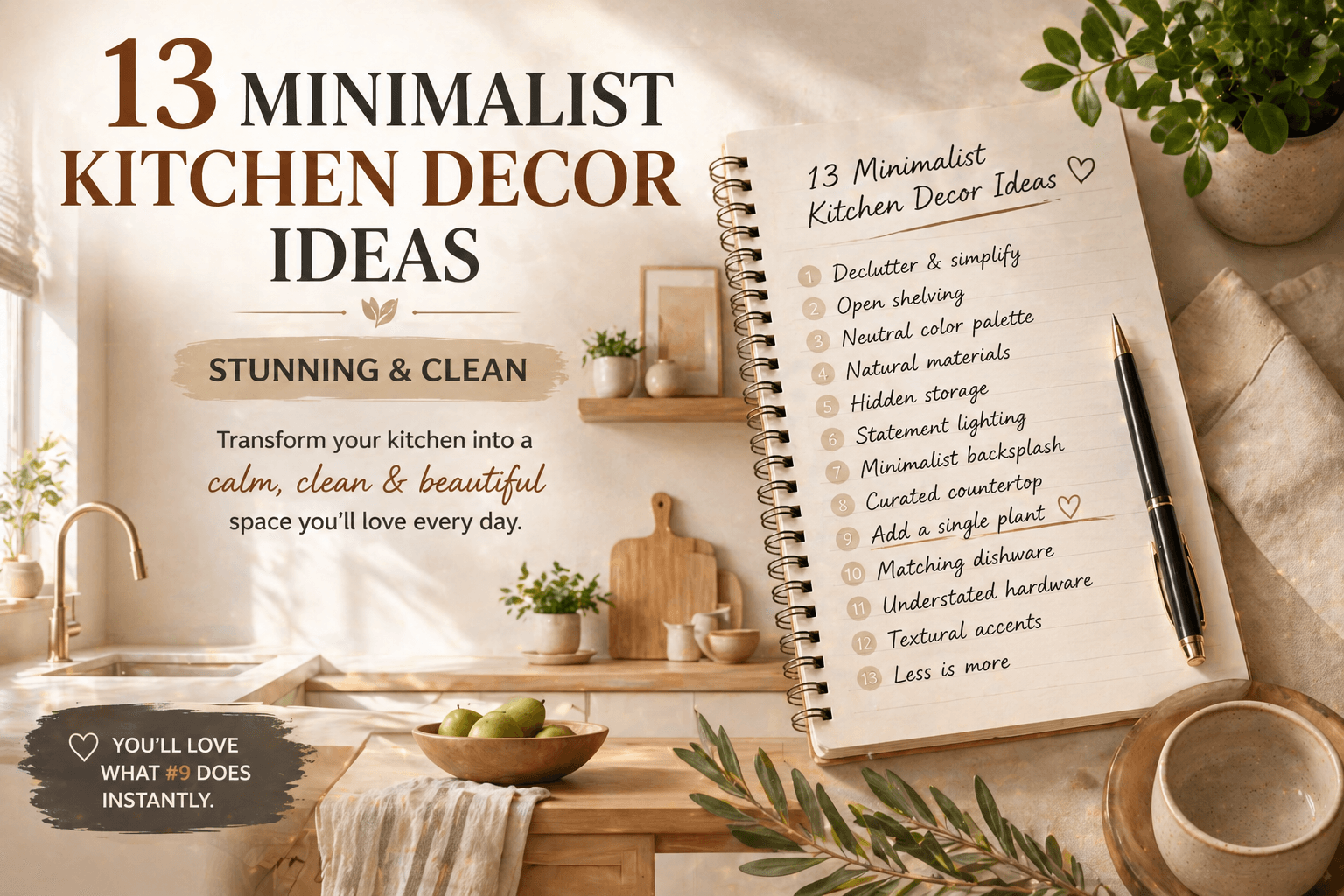
In 2026, the minimalist kitchen is not cold or sterile—the dominant aesthetic trend, confirmed by Pinterest’s annual report and Pantone’s Mocha Mousse Color of the Year, is warm minimalism: spaces that are calm and uncluttered but deeply human, natural, and inviting. This guide presents 13 minimalist kitchen decor ideas that bring exactly that quality to any kitchen — rented or owned, galley or open-plan, city apartment or family home. Every idea is achievable without structural renovation. Every idea produces an immediate, visible transformation. And every idea is grounded in the same Apex Design philosophy that has made our bedroom, living room, bathroom, and study guides the most comprehensive design resources on this blog.
Why the Minimalist Kitchen Is the Most Transformative Room Design Investment
The kitchen occupies a unique position in home psychology. Research published in the Environment and Behavior Journal demonstrates that kitchen clutter is directly associated with elevated cortisol levels and increased stress-eating behavior—meaning that the visual state of your kitchen has documented physiological effects on your body and your choices. A clean, minimal kitchen does not just look better. It makes you feel better, eat better, and function better in the most literal neurological sense.
What Makes a Kitchen Minimalist vs. Simply Empty
There is a critical distinction between a minimalist kitchen and an empty one. A minimalist kitchen is not bare — it is edited. Every visible element serves a purpose, communicates a clear aesthetic value, and contributes to the room’s overall tonal and material coherence. What defines the minimalist kitchen is not the absence of things but the intentionality of everything that remains.
The Four Principles of Minimalist Kitchen Design:
| Principle | What It Means | What It Eliminates |
| Functional clarity | Every visible item earns its counter space | Appliances used less than weekly |
| Material honesty | Natural materials—wood, stone, ceramic, metal | Plastic accessories, fake-wood laminates |
| Tonal coherence | Two or three complementary tones only | Competing colours, mismatched packaging |
| Negative space | Generous empty counter and wall surface | The urge to fill every available surface |
13 Stunning Minimalist Kitchen Decor Ideas
1 — Edit the Counter to Its Essential Three
The single most impactful minimalist kitchen decor idea — and the one that costs nothing — is applying the “essential three” rule to every counter surface: a maximum of three intentional objects per section of counter, with all other items stored inside cabinets or removed entirely.
The Essential Three Counter Philosophy:
Most kitchen counters host between 8 and 20 objects simultaneously—a toaster, a kettle, a coffee machine, cooking oils, a fruit bowl, a knife block, paper towels, mail, chargers, and the slow accumulation of objects that arrived with no assigned home. The visual noise this creates is the primary reason kitchens feel overwhelming rather than inviting.
Your Essential Three (choose for each counter section):
- One functional appliance (kettle, coffee maker, or toaster — never all three visible simultaneously)
- One natural element (a ceramic bowl with two or three pieces of seasonal fruit, a small plant, or a stone jar with kitchen utensils)
- One beautiful functional item (a wooden chopping board leaned upright, a ceramic oil dispenser, a single beautiful bottle of olive oil)
Everything else — every appliance, every gadget, every single-use tool — lives inside a cabinet. The radical act of putting the toaster away when not in use transforms a kitchen more visibly than almost any purchased design element.
2 — Decant Pantry and Cooking Staples Into Matching Containers
The visual chaos of a kitchen is disproportionately created by the packaging of its contents—the mismatched fonts, colors, and branding of commercial food packaging competing chaotically with each other on open shelves and inside glass-front cabinets. Decanting pantry and cooking staples into a cohesive set of matching containers is the most immediately transformative, simple kitchen decor idea available—and one that improves both aesthetics and daily function simultaneously.
The Apex Minimal Kitchen Decanting System:
- Pantry staples (dry goods): Matching glass or ceramic canisters with airtight lids for pasta, rice, oats, lentils, flour, and sugar—labelled with simple printed or handwritten labels. A set of six matching jars ($20–$45) replaces a cabinet of twelve competing packages
- Oils and vinegars: Decant into matching glass bottles with cork or steel stoppers—the visual difference between a beautiful glass oil bottle and a plastic supermarket bottle on the counter is enormous
- Spices: A unified spice organization system—matching glass jars in a drawer, on a magnetic strip, or on a single shelf—replaces the avalanche of different-sized, differently branded jars that characterise most spice collections
Budget reality: A complete kitchen decanting set from IKEA’s KORKEN glass jar range or Amazon’s basic glass canister sets costs $25–$60 and produces an immediately magazine-quality minimal kitchen aesthetic.
3 — Choose a Two-Tone Neutral Colour Palette and Commit
Color is the fastest route to either a calm, coherent minimalist kitchen or a visually fragmented one—and the most common kitchen color error is not bold choices but the accumulation of too many neutrals without a conscious tonal relationship between them. A warm white wall beside a cool grey cabinet beside a beige tile beside a dark brown floor creates four competing neutral tones that read as visual noise rather than intentional minimalism.
The Apex Minimalist Kitchen Palette Formula:
- Primary tone (60% of visual space): Warm white, ivory, or warm greige — walls, upper cabinets, light countertops
- Secondary tone (30%): Natural wood (oak, walnut, mango), warm stone (travertine or beige marble), or warm charcoal—lower cabinets, countertops, flooring
- Accent (10% maximum): One warm natural tone—sage green, terracotta, warm brass, or aged bronze hardware only
The rule: all tones must share the same warmth direction (all warm-undertoned or all cool-undertoned — never mixed). A warm white paired with a cool grey creates unconscious visual tension. A warm white paired with aged oak creates visual harmony. This single palette decision, applied consistently to existing cabinets through paint and new hardware, can transform a kitchen without touching the structure.
4 — Upgrade Cabinet Hardware: The Lowest-Cost Highest-Impact Minimalist Change
Cabinet hardware is the jewelry of the kitchen—the small metal details that, when upgraded, elevate the entire room’s quality level disproportionately to their cost. Standard kitchen cabinet hardware (chrome knobs, brass pulls from 2008) often dates a kitchen more than any other single element. Replacing it is a screwdriver-only task that costs $2–$8 per piece and takes 30 minutes for an entire kitchen.
The Minimalist Kitchen Hardware Selection:
- Aged brass / unlacquered brass: The warmest, most on-trend hardware choice for 2026 — develops a beautiful patina over time and pairs beautifully with warm neutrals and natural wood
- Matte black: Crisp, modern, graphic — works best with white or light grey cabinets as a strong contrast accent
- Brushed nickel: The most neutral hardware choice — works with almost any palette without dominating
- Minimal bar pulls (128–160mm): The longest, most architecturally simple pull form—creates a clean horizontal line that reinforces the minimalist aesthetic with every use
For the complete design philosophy on how hardware, material, and finish selection function as the signature details of a curated, elevated home aesthetic, our guide on quiet luxury home decor ideas provides the full Apex material intelligence that applies directly here.
5 — Create a Natural Material Kitchen with Wood, Stone, and Ceramic
Natural materials are the foundation of the clean kitchen aesthetic—they are what separates a minimal kitchen that feels warm, alive, and genuinely beautiful from one that feels cold, clinical, and merely uncluttered. In the minimalist kitchen, every material tells a story of honesty and quality — and the accumulation of natural material details creates the sensory richness that prevents minimalism from reading as emptiness.
Natural Material Integration for the Minimalist Kitchen:
- Wooden chopping boards: A beautiful, solid wood chopping board (teak, acacia, or maple) leaned upright against the backsplash when not in use is simultaneously a functional tool and a natural material display—one of the most recognisable natural kitchen decor details
- Ceramic bowls and vessels: A handmade or artisan ceramic bowl holding seasonal fruit, a ceramic oil cruet, a stoneware mug collection on an open shelf—these objects communicate craft and authenticity in a way that mass-produced equivalents cannot
- Stone or slate accessories: A marble pastry board, a slate serving board, or a stone mortar and pestle on the counter adds geological weight and natural visual texture
Brass or copper accents: A brass kettle, copper measuring cups, or aged brass utensils in a ceramic holder—warm metal that develops character over time.
6 — Install Open Shelving Strategically (Edit Before You Open)
Open shelving is one of the most polarising minimalist kitchen decor ideas—adored in design photographs and regretted in daily life by people who installed it without understanding its demands. Open shelving is beautiful when it is curated. It is catastrophic when it becomes a storage space for everything that no longer fits in the cabinets. The decision to open any shelving must be preceded by the decision to edit everything that will live on it.
The Apex Open Shelf Curation Rules:
- Only objects you find genuinely beautiful go on open shelves—functional items that are visually disruptive (cereal boxes, plastic containers, miscellaneous tools) stay inside closed cabinets always
- Group by material and colour: stack white ceramics together, line wooden items together, create visual clusters rather than chaotic assortments
- Leave a minimum 30% empty space on every open shelf—the negative space around the objects is as important as the objects themselves
- Maximum five objects per shelf in a minimalist kitchen—more than five creates the visual density that defeats the purpose
What works beautifully on open kitchen shelves: A cohesive ceramic collection (mugs, bowls, and plates in matching or complementary glazes); a small collection of beautiful cookbooks with spines facing outward in tonal groupings; glass jars of decanted pantry items; a single trailing plant; and one or two beautiful functional objects (a cast iron pan hung on a hook and a handmade pottery piece).
7 — Tackle the Kitchen Sink Area: The Room’s Most Visible Focal Point
The sink area is the visual center of most kitchens—the place the eye returns to most frequently and the surface that communicates the kitchen’s cleanliness and care standards most immediately. In a minimalist kitchen, the sink area is treated with the same editorial discipline as the rest of the room.
The Minimal Kitchen Sink Area Protocol:
- Maximum three items visible: Dish soap in a ceramic or glass pump dispenser (never plastic), a small plant or single stem in a bud vase, and one clean, folded dishcloth in a natural linen or cotton
- Concealed everything else: Sponges, scrubbers, bottle brushes, and cleaning products all live under the sink—out of sightlines
Soap dispenser upgrade: A $12–$20 ceramic, glass, or stone soap dispenser replacing a plastic washing-up liquid bottle is one of the most immediately impactful simple kitchen decor ideas available—it transforms the most-seen surface in the kitchen instantly
8 — Introduce Purposeful Plants and Fresh Herbs
Plants in the minimalist kitchen serve a dual purpose—they introduce the natural life and organic texture that prevents minimalism from feeling sterile while simultaneously providing functional value that justifies their counter presence. A small pot of fresh herbs on the windowsill or countertop satisfies both the natural kitchen decor philosophy and the Japanese principle of wabi-sabi functional beauty.
Best Plants and Herbs for the Minimalist Kitchen:
| Plant / Herb | Why It Works | Light Requirement | Placement |
| Pothos | Trailing, lush, near-indestructible | Low–medium | Top of cabinet or shelf |
| Fresh basil | Functional + beautifully aromatic | Full sun | Windowsill |
| Rosemary (potted) | Architectural, fragrant, culinary | Full sun | Windowsill or counter |
| Snake plant | Architectural, minimal, thrives on neglect | Low light | Counter corner |
| Aloe vera | Sculptural, useful (skin burns) | Medium light | Windowsill |
One well-placed, thoughtfully potted plant communicates more design intelligence than ten purchased decorative objects — and connects the kitchen directly to the natural material philosophy that defines the best minimalist interiors.
9 — Solve the Refrigerator: The Minimalist Kitchen’s Biggest Challenge (You’ll Love This)
The refrigerator is the single most visually disruptive element in most modern kitchens — a large, white or silver appliance covered in magnets, photographs, children’s artwork, delivery menus, and accumulated visual clutter that directly contradicts every minimalist kitchen principle. And yet it is also the least addressed element in most kitchen design guides.
The Minimalist Refrigerator Protocol:
Step 1 — Clear everything from the outside completely. Every magnet, every photograph, every note. The refrigerator surface should be completely bare.
Step 2 — Evaluate what genuinely belongs there. In most cases, nothing. A clean refrigerator surface communicates kitchen authority and design confidence more powerfully than any other kitchen change.
Step 3—If you choose to reintroduce elements: One small meaningful photograph in a minimal frame attached with a single clear adhesive strip, or one curated pinboard in a designated corner (never the refrigerator door)—contained, curated, and never accumulated. The hidden benefit: Research from Cornell University’s Food and Brand Lab consistently demonstrates that kitchen environments that signal order and calm are associated with healthier food choices and reduced stress eating—making your minimalist refrigerator approach a genuine wellness investment, not just an aesthetic one.
10 — Light Your Kitchen With Warmth and Layered Intention
Kitchen lighting is almost universally the most neglected element of kitchen design—the bright overhead fluorescents that illuminate most kitchens are among the least flattering, most cortisol-elevating, and least atmospheric light sources in any residential environment. The minimalist kitchen in 2026 layers warm, task-appropriate lighting that makes the space feel as beautiful to cook in at 7 PM as it is functional at 7 AM.
The Apex Minimalist Kitchen Lighting System:
- Replace overhead bulbs with warm white (2700–3000K): This single $15–$20 change transforms the kitchen’s atmospheric quality immediately and completely. The warm colour temperature shifts the room from clinical to welcoming
- Under-cabinet LED strips: Warm white LED strips underneath upper cabinets provide the most functional task lighting available for counter work while adding the ambient warmth of a secondary light source
- A pendant light over the island or table: A natural material pendant—rattan, ceramic, blown glass, or hammered brass—over the kitchen island or dining table becomes both the room’s primary architectural lighting element and its most beautiful design feature
11 — Style Your Kitchen Window as a Design Element
The kitchen window is one of the most underutilised design assets in any kitchen—typically blocked by dense curtains, obscured by accumulated windowsill objects, or left completely unstyled. In the minimalist kitchen, the window is celebrated as both a source of natural light and a beautifully simple design moment.
The Minimal Kitchen Window Styling:
- Remove heavy curtains and replace with sheer linen panels or nothing at all (privacy permitting)—maximising the natural light that is the most beautiful illumination any kitchen can receive
- Style the windowsill as a curated mini-display: one small potted herb, one beautiful ceramic object, a small glass with a single flower stem—the rule of three applied to your most naturally lit surface
- If privacy is needed, sheer linen cafe curtains (covering only the lower half of the window) provide privacy while flooding the upper kitchen with natural light
12 — Create a Clutter-Free Kitchen Through Intentional Organization Systems
The clutter-free kitchen is not a kitchen with less stuff—it is a kitchen where everything that exists has a designated, logical home. The visual chaos of most kitchens is not caused by excess possessions but by the absence of systems—the drawer where everything accumulates because nothing has a designated place and the shelf where items end up because they had nowhere else to go.
The Apex Kitchen Organization System:
- Drawer dividers: Every drawer is divided by category—cutlery, cooking tools, and baking tools—with every item having a specific position it returns to after every use. The act of returning is the habit; the divider is the system that makes it automatic
- The one-in-one-out kitchen rule: Every new kitchen item that arrives must displace an existing one. This single commitment prevents the slow accumulation that defeats every minimalist kitchen redesign within six months of completion
- The “does it earn its counter space?” audit: Applied monthly—any item that has not been used in the past week is either stored away or donated
13 — Add Signature Scent: The Minimalist Kitchen’s Invisible Design Layer
The final minimalist kitchen decor idea is the one most design guides never mention—because it is invisible and unphotographable, and yet it may be the most immediately powerful sensory element of any kitchen experience. The kitchen’s scent communicates cleanliness, warmth, and intentional care before a single visual element is processed.
The Apex Minimalist Kitchen Scent Design:
- Natural cooking scents deliberately cultivated: Simmering a pot of water with a sliced lemon, a cinnamon stick, and a few rosemary sprigs creates a natural, non-synthetic kitchen fragrance that communicates warmth and domestic artistry
- A reed diffuser in a corner away from heat sources: White tea, citrus + herb, or bergamot + green tea — clean, fresh scent profiles that communicate the natural kitchen decor philosophy
- Fresh herbs as ambient scent: A pot of fresh basil, rosemary, or mint on the counter releases a gentle natural fragrance throughout the day, connecting the kitchen’s scent directly to its natural material aesthetic
Minimalist Kitchen Decor Budget Guide
| Idea | Budget Range | Visual Impact |
| Counter edit (remove items) | $0 | ⭐⭐⭐⭐⭐ |
| Decant pantry into matching jars | $25–$60 | ⭐⭐⭐⭐⭐ |
| Warm white bulb replacement | $15–$25 | ⭐⭐⭐⭐⭐ |
| Cabinet hardware upgrade | $40–$120 | ⭐⭐⭐⭐⭐ |
| Ceramic soap dispenser + plant | $15–$35 | ⭐⭐⭐⭐ |
| Open shelf edit and restyle. | $0–$20 | ⭐⭐⭐⭐ |
| Wooden chopping board (display) | $20–$50 | ⭐⭐⭐⭐ |
| Under-cabinet LED strips | $20–$45 | ⭐⭐⭐⭐ |
| Drawer divider system | $15–$40 | ⭐⭐⭐ |
| Reed diffuser | $12–$25 | ⭐⭐⭐ |
| Total full transformation | $162–$420 | Complete |
Frequently Asked Questions About Minimalist Kitchen Decor
Can a small kitchen be minimalist?
Small kitchens benefit most from minimalist principles. The reduction of visual clutter, the tonal coherence of a two-tone palette, and the strict counter-editing rule all produce an immediately larger-feeling, calmer, and more beautiful kitchen regardless of physical size. A small kitchen with three intentional counter items feels spacious; the same small kitchen with twenty items feels oppressive.
What colors work best in a minimalist kitchen?
Warm white (slightly cream or yellow-toned), warm greige, natural wood tones, and warm sage are the most universally effective minimalist kitchen colors in 2026. Avoid stark cool white (clinical and aging), grey (2015–2020 trend, now dating quickly), and multiple competing neutrals without a unifying warm undertone relationship.
How do I keep my minimalist kitchen from looking bare?
Natural materials, plants, and intentional warm lighting prevent minimalism from reading as emptiness. A kitchen with warm wood surfaces, a ceramic bowl of fruit, fresh herbs on the windowsill, and warm (2700K) lighting feels full of life and intention—it is the presence of the right things, not the absence of all things, that defines successful minimalism.
Do I need to renovate to get a minimalist kitchen?
No renovation is required for any idea in this guide. The most transformative minimalist kitchen changes—counter editing, decanting, palette selection through paint and hardware, and warm lighting—are all achievable in a weekend for under $200. A rental kitchen can achieve the full minimalist kitchen aesthetic without altering a single structural element.
CONCLUSION
Minimalist kitchen decor ideas are ultimately a declaration that you value your daily environment enough to make it beautiful, that you respect your own wellbeing enough to create the physical conditions for calm, and that you understand—as the Apex philosophy has always held—that the most luxurious spaces are the most intentional ones, not the most expensive ones.
The kitchen is where your day begins and often where it ends — where your morning coffee becomes a ritual, where evening cooking becomes an act of self-care, and where the quality of your daily domestic life is most immediately and most tangibly shaped by your design choices. Make it beautiful. Make it calm. Make it yours.
Start today: clear three items from your counter, replace one bulb, and put one plant on the windowsill. The minimalist kitchen you have always imagined is three decisions away from beginning.
Explore the full Apex Home & Decor collection—bedroom, living room, bathroom, study, and now kitchen—and discover the complete Apex home design framework for a beautifully intentional, genuinely extraordinary daily life.
OUTBOUND LINKS
- Environment and Behavior Journal
- Cornell Food and Brand Lab
- YouTube — The Minimalist Kitchen Transformation (Architectural Digest)
INTERNAL LINKS
- Quiet Luxury Home Decor Ideas — https://apexaesthetic.blog/quiet-luxury-home-decor-ideas/
- Warm Minimalist Living Room Ideas — https://apexaesthetic.blog/warm-minimalist-living-room-ideas/
- Spa Bathroom Ideas on a Budget — https://apexaesthetic.blog/spa-bathroom-ideas-on-a-budget/
- Japandi Bedroom Ideas on a Budget — https://apexaesthetic.blog/japandi-bedroom-ideas-on-a-budget/
- How to Stop Procrastinating Now — https://apexaesthetic.blog/how-to-stop-procrastinating-now/
- Glow Up Routine for Beginners — https://apexaesthetic.blog/glow-up-routine-for-beginners