
Table of Contents
Introduction

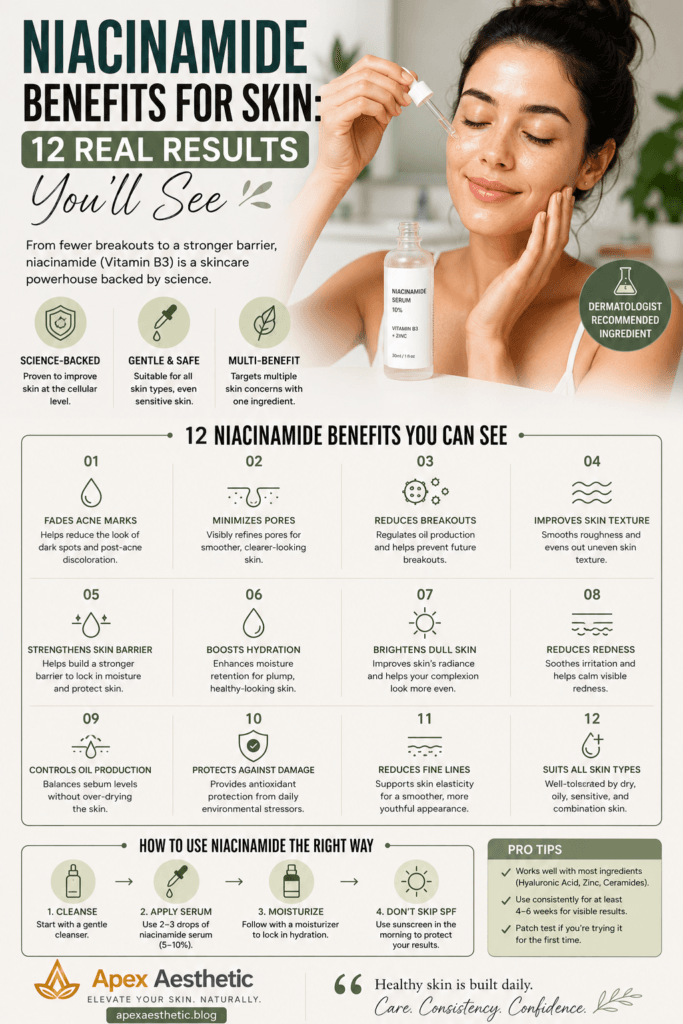
Niacinamide benefits for skin show up fast: less oil by afternoon, fewer new breakouts within a few weeks, and a barrier that stops skin from feeling tight after washing. That’s the honest, short version. The rest of this guide explains why it works and how to use it without wasting money or irritating your face.
Skincare has no shortage of trendy ingredients that fade in a year. Niacinamide isn’t one of them. It’s a form of vitamin B3, and dermatologists have studied it since the 1970s. It’s cheap, it’s stable in a bottle, and it plays well with almost every other active ingredient you already own.
Here’s what you’ll get from this guide: what niacinamide actually does at the cellular level, the 12 benefits with real evidence behind them, how to fit it into a morning and evening routine, and the mistakes that waste people’s money on serums that never get the chance to work.
What is niacinamide, exactly?
Niacinamide is a water-soluble form of vitamin B3. Your skin converts it into two coenzymes, NAD+ and NADH, that power cell repair and lipid production. That’s the short answer. The longer one explains why that matters for your face.
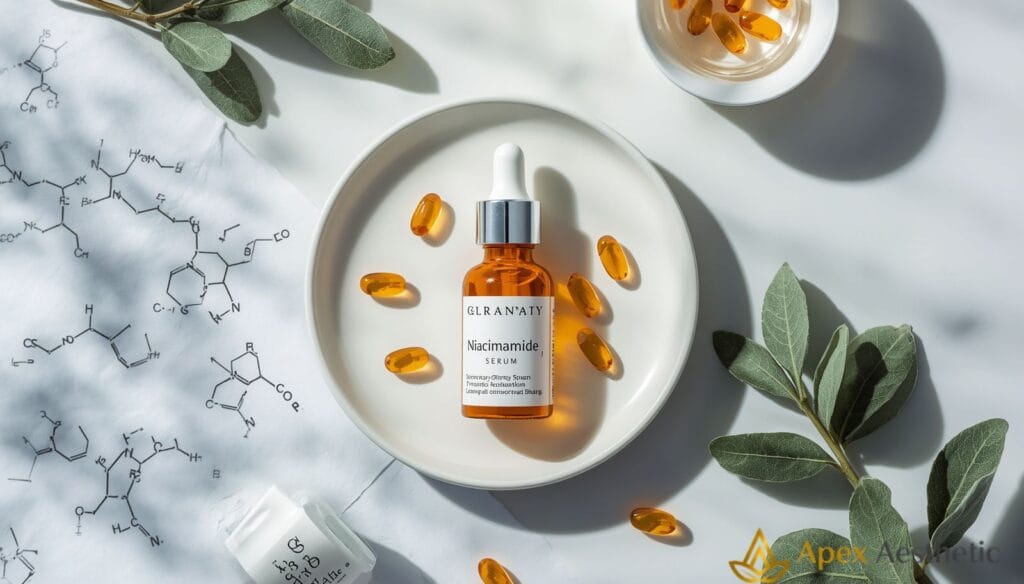
Most people know niacinamide from a serum bottle. Fewer know it’s the same compound your body makes when it breaks down niacin from food. Cleveland Clinic describes niacinamide as a form of vitamin B3 that supports many aspects of health, including brighter, smoother, and younger-looking skin. That’s a strong claim from a source that doesn’t sell skincare, which is part of why dermatologists keep recommending it.
How does niacinamide work in the skin?
Niacinamide works by feeding your skin cells the raw material for ceramide production. More ceramides mean a stronger barrier. A stronger barrier means less water loss and less irritation from everything else in your routine.
Research published through the National Institutes of Health explains the deeper mechanism. Niacinamide restores the cell’s NAD+ supply and supports mitochondrial energy production, which lowers oxidative stress and inflammation while strengthening the skin’s structural matrix and barrier function. It also slows the pigment transfer process, which is why dark spots fade with steady use rather than overnight.
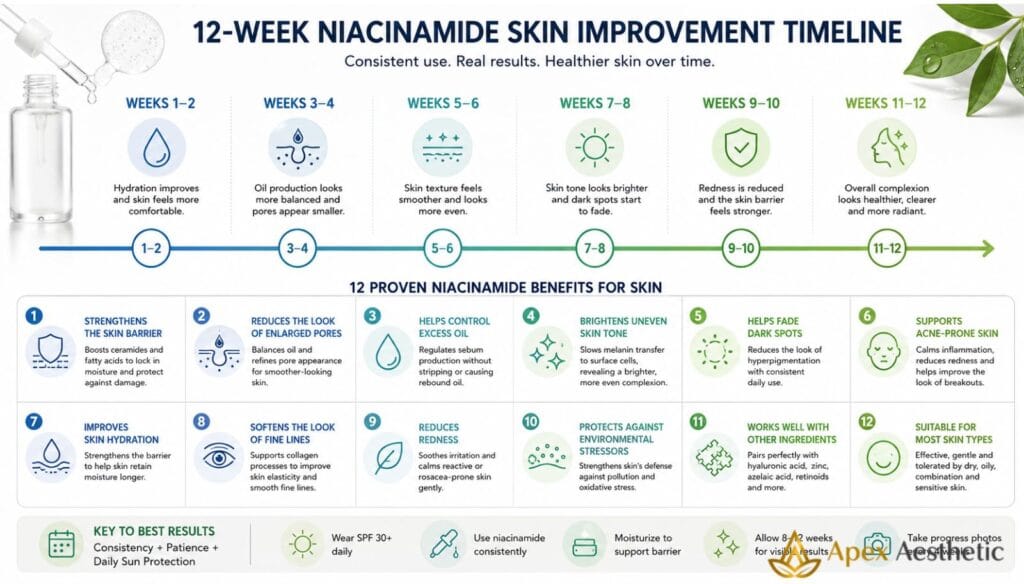
| Skin Concern | How Niacinamide Helps | Typical Timeline |
| Excess oil | Regulates sebum production | 1–2 weeks |
| Enlarged pores | Improves overall appearance | 4–8 weeks |
| Uneven skin tone | Supports gradual brightening | 6–12 weeks |
| Skin barrier damage | Strengthens moisture barrier | 2–4 weeks |
| Fine lines | Improves hydration and elasticity | 8–12 weeks |
Does it work as an oral supplement too?
Topical use is more common, but the oral form has real research behind it as well, mostly around skin cancer prevention rather than cosmetic results. A 2024 study published in the Journal of the American Academy of Dermatology found that the oral form had a favourable preventive effect in high-risk patients with a prior history of non-melanoma skin cancer, according to a summary from Baylor College of Medicine’s dermatology department.
That’s a different use case than a brightening serum. Dermatologists interviewed for that summary noted that oral doses should stay under 1 gram per day and aren’t recommended for people with severe liver disease, active peptic ulcers, or diabetes without monitoring blood sugar. Sunscreen and sun avoidance still matter more than any supplement for actual skin cancer prevention. Don’t confuse it with plain niacin, which is a different compound used for cholesterol management and can cause flushing at higher doses.
What are the 12 proven niacinamide benefits for skin?
The benefits below aren’t ranked by importance. Some matter more to oily skin; others matter more to dry or sensitive skin. Read the ones that match your actual concern first.
1. Strengthens the skin barrier
Niacinamide pushes skin cells to make more ceramides and fatty acids. Those lipids sit in the outer layer and hold water in.
A weak barrier shows up as tightness, flaking, or stinging when you apply anything acidic. Add it for 4 to 6 weeks, and that reaction usually fades because the barrier has more material to work with. Pair it with a barrier-focused routine like our skin barrier repair guide if your skin still feels reactive.
Healthy skin barriers rarely improve overnight. Most noticeable changes come from several weeks of consistent care rather than frequently switching between products. Sticking with a gentle cleanser, moisturiser, sunscreen, and niacinamide often produces better long-term results than constantly adding new active ingredients.
2. Reduces the look of enlarged pores
Pores don’t shrink permanently, but oil regulation makes them look smaller. Less oil sitting in the pores means less stretch and shine.
This benefit is gradual. Most people notice a smoother texture around week 3, not day 3.
3. Helps control excess oil
Niacinamide regulates sebum output at the cellular level instead of stripping oil the way some cleansers do. That distinction matters for combination and oily skin.
Stripping oil often triggers more oil production later in the day. It doesn’t create that rebound effect, which is why it’s a common pick for anyone whose skin runs oily by 2 p.m.
4. Brightens uneven skin tone
Uneven tone from old breakouts or sun exposure comes from excess melanin sitting in one spot. It slows the transfer of that pigment to the surface.
A 2021 study published in the journal Antioxidants found that topical niacinamide slows the transfer of melanin from pigment-producing cells to skin cells, which helps reduce visible discolouration over time. Expect several weeks before the difference is obvious in daylight.
5. Helps fade dark spots
Dark spots respond to it the same way general unevenness does, just at a smaller scale. Consistency beats concentration here.
A 5% niacinamide serum used daily for 8 to 12 weeks tends to outperform a 10% version used twice a week. Skipping sunscreen cancels out most of the progress, since fresh sun exposure keeps creating new pigment.
Many people expect dark spots to fade within a week or two. In reality, gradual improvement is far more common. Consistent daily use over several weeks usually produces more noticeable and longer-lasting results than changing products too quickly.
6. Supports acne-prone skin
Redness and inflammation from acne calm down faster with this active in the mix. It doesn’t clear active breakouts on its own, but it makes the skin around them less angry.
In a clinical study, a ceramide-and-niacinamide moisturiser was found to be better than a standard hydrophilic cream in improving the appearance of acne lesions and decreasing irritation, while providing better hydration and less water loss through the skin. That combo—oil control plus less inflammation—is what gets it into so many acne regimes.
Another common observation among skincare professionals is that the best acne results usually come from combining evidence-based treatments rather than relying on a single product. Niacinamide works best as part of a consistent routine alongside gentle cleansing, appropriate moisturisers, and daily sun protection.
7. Improves skin hydration
A stronger barrier holds onto water better. That’s the entire mechanism, and it’s the reason this ingredient helps dry skin as much as oily skin.
Dehydrated skin often overproduces oil to compensate. Fixing hydration first can quietly fix an oil problem, too.
8. Softens the look of fine lines
It supports collagen-related processes in the dermis, which can soften fine lines over months, not days. It’s a slow benefit, and anyone promising overnight results is overselling it.
Pair it with a retinoid at night for a bigger effect. Our retinol routine for beginners covers how to layer the two without irritation.
9. Reduces redness
Niacinamide’s anti-inflammatory action calms reactive skin, including rosacea-prone skin. It’s one of the gentler activities available for people who react to almost everything else.
Sensitive skin should still start at 2% rather than jumping to 10%. Redness reduction happens at low concentrations just as well.
10. Protects against environmental stressors
Pollution and daily oxidative stress wear down the moisture barrier over time. A stronger barrier resists wear better, though niacinamide isn’t a sunscreen substitute and shouldn’t replace SPF.
11. Works well with other skincare ingredients
Niacinamide pairs cleanly with hyaluronic acid, zinc, and azelaic acid. Hyaluronic acid adds water; niacinamide keeps it in. Zinc adds extra oil control. Azelaic acid adds brightening from a different angle.
The old idea that it cancels out vitamin C came from outdated lab conditions that don’t reflect how modern formulas are stabilised. Most current serums list both without issue.
12. Suitable for most skin types
Dry, oily, mature, combination, or sensitive skin all tolerate it well at the right concentration. That range is rare among actives, which is why it’s often the first serum people add after a basic cleanser-moisturiser-sunscreen routine.
Niacinamide vs other popular skincare ingredients
| Ingredient | Best for | Daily use? | Beginner-friendly? |
| Niacinamide | Oil control, barrier support, dark spots | Yes | Excellent |
| Hyaluronic acid | Hydration | Yes | Excellent |
| Vitamin C | Brightening | Usually | Good |
| Retinol | Fine lines, acne | Night only | Moderate |
| Azelaic acid | Redness, acne | Usually | Good |
What real use reveals
Skin that looks fine in the mirror can still be losing water fast. Water loss through the skin doesn’t always show as visible dryness right away. It shows up first as increased sensitivity to other products.
A tingling reaction to a vitamin C serum that never happened before often means the barrier weakened, not that the serum changed.
Track how your skin reacts to your other products, not just how it looks, when judging whether niacinamide is working.
Adding niacinamide and three new products at once makes it impossible to know what helped. Skin reactions can take days to appear, so overlapping changes hide the actual cause.
Someone who adds a niacinamide serum, a new cleanser, and a new moisturiser in the same week can’t isolate which one caused a breakout.
Introduce one new product at a time and give it two full weeks before judging results.
Daily Niacinamide Routine Checklist
Whether you’re new to niacinamide or refining your skincare routine, this simple checklist can help you use the ingredient consistently and safely. Small daily habits often produce better long-term results than frequently switching products.
| Step | Morning Routine | Evening Routine |
| 1. Cleanse | ✔ Use a gentle cleanser to remove oil and impurities. | ✔ Remove makeup and sunscreen and cleanse thoroughly. |
| 2. Apply Niacinamide Serum | ✔ Apply a 2–5% niacinamide serum to clean, dry skin. | ✔ Apply niacinamide after cleansing and before heavier treatments. |
| 3. Moisturize | ✔ Use a lightweight moisturiser to support the skin barrier. | ✔ Apply a nourishing moisturiser to lock in hydration overnight. |
| 4. Sun Protection | ✔ Finish with a broad-spectrum SPF 30 or higher every morning. | ✘ Not required at night. |
| 5. Optional Active Ingredients | ✔ Vitamin C may be used if your skin tolerates both ingredients. | ✔ Retinol, peptides, or hyaluronic acid can be layered according to your skincare routine. |
| 6. Consistency | ✔ Use daily for the best long-term results. | ✔ Continue consistently rather than increasing the concentration too quickly. |
Weekly Skin Check
Take a few minutes each week to evaluate how your skin is responding.
☐ My skin feels hydrated and comfortable.
☐ Redness or irritation has decreased.
☐ Oil production feels more balanced.
☐ My complexion looks brighter.
☐ My skin barrier feels healthier.
☐ I have used sunscreen every morning.
☐ I have avoided introducing too many new products at once.
One pattern that skincare professionals often notice is that people expect dramatic improvements after only a few applications. In reality, niacinamide delivers its best results when used consistently as part of a simple routine. A well-formulated serum applied every day is usually more effective than frequently switching between multiple active ingredients.
Quick Reminder
For most people, consistency matters more than concentration. A quality 2–5% niacinamide serum, paired with a gentle cleanser, moisturiser, and daily sunscreen, is often enough to support healthier-looking skin over time without unnecessarily complicating your skincare routine.
How do you use niacinamide in a daily routine?
Use it once in the morning and once at night, after cleansing and before moisturiser. That order lets it absorb before heavier products seal the skin.
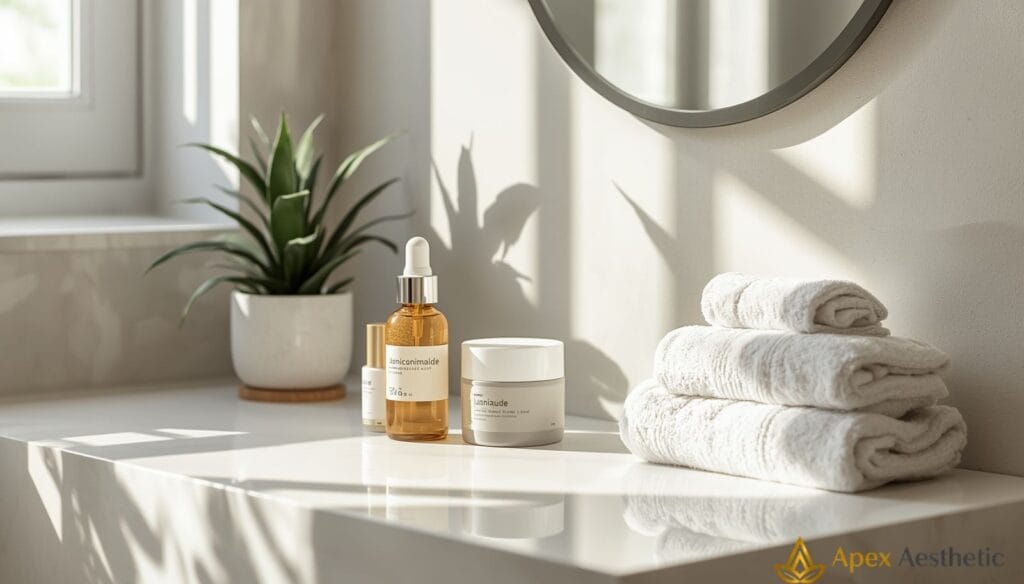
Morning routine:
- Cleanser
- Niacinamide serum
- Moisturizer
- Sunscreen (non-negotiable if you want the dark-spot benefits to hold)
Evening routine:
- Cleanser
- Niacinamide serum or treatment serum
- Moisturizer
Consistency matters more than the exact order. Skipping days slows every benefit on this list.
How do you choose the right niacinamide serum?
Pick a concentration between 2% and 5% if you’re new to it or have sensitive skin. Save 10% of formulas for skin that’s already tolerating this active well.
Look for fragrance-free versions if you have reactive skin, since fragrance is a common irritant that gets blamed on the active ingredient instead. Do a patch test on your inner arm for 48 hours before applying anything new to your face. Packaging matters too: opaque bottles or tubes protect the formula better than clear jars exposed to light and air.
A 2002 clinical trial in the British Journal of Dermatology tested a 2% concentration in a daily SPF formula on 120 people and found measurable skin-lightening effects over the study period. That’s worth knowing because plenty of marketing pushes higher percentages as automatically better. In practice, 2% to 5% is where most of the published research sits, and it’s also where irritation risk stays lowest.
One pattern dermatologists frequently observe is that beginners often assume a higher percentage delivers faster results. In practice, consistent daily use of a well-formulated 2% to 5% niacinamide serum typically provides excellent long-term benefits while minimising the risk of irritation. For most people, a simple, consistent routine is more effective than choosing the strongest product available.
Expert tips for getting more out of niacinamide
- Layer thin to thick. Apply niacinamide serum before heavier creams, never after. Thinner, water-based formulas always go on first.
- Give it a full product cycle. A split-face clinical study published in Dermatologic Surgery tracked niacinamide users for 12 weeks before measuring real improvement in fine lines and blotchiness. Judging results at week 2 sets you up to quit early.
- Store it away from heat and light. Niacinamide is stable, but a hot bathroom shelf or a car dashboard still shortens shelf life faster than a cool drawer.
- Don’t chase the highest percentage on the shelf. According to a medically reviewed overview from WebMD, niacinamide’s anti-inflammatory action works by blocking the same immune chemicals at low and high concentrations, so a 10% serum isn’t automatically doing more work than a 5% one.
Who should be careful with niacinamide?
Most people tolerate niacinamide without any issue, but a small number react to high concentrations with flushing or a warm, prickling sensation. That’s more common at 10% and above, and it usually settles down once you drop back to a lower strength.
Anyone using strong exfoliating acids, prescription retinoids, or benzoyl peroxide at the same time should introduce niacinamide slowly rather than adding it to an already-full routine overnight. If you’re managing a diagnosed skin condition like eczema, rosacea, or active cystic acne, run any new product past your dermatologist first. A serum ingredient list is never a substitute for a treatment plan from someone who has actually examined your skin.
Build Your Personalized Niacinamide Routine
Before adding niacinamide to your skincare routine, take a few minutes to understand your skin’s needs. This simple worksheet can help you choose products more confidently and build a routine that works for your goals.
Niacinamide Skincare Planning Worksheet
| Planning Question | Your Answer |
| 1. What is your skin type? (Oily, Dry, Combination, Sensitive, Normal) | __________________________________________ |
| 2. What is your main skincare concern? (Acne, Redness, Dark Spots, Large Pores, Fine Lines, Dryness) | __________________________________________ |
| 3. Are you currently using a niacinamide product? | ☐ Yes ☐ No |
| 4. What concentration are you using or planning to buy? | ☐ 2% ☐ 5% ☐ 10% ☐ Not Sure |
| 5. Which products are already part of your skincare routine? | __________________________________________ |
| 6. Do you use sunscreen every morning? | ☐ Yes ☐ No |
| 7. Which active ingredients are you currently using? (Vitamin C, Retinol, Hyaluronic Acid, AHAs, BHAs, Peptides, None) | __________________________________________ |
| 8. What result would you most like to achieve over the next 8–12 weeks? | __________________________________________ |
My Daily Skincare Routine
| Time of Day | Products I Plan to Use |
| Morning | __________________________________________ |
| Evening | __________________________________________ |
My Skin Progress Tracker
Review your skin every two weeks and note any changes.
| Week | Hydration | Oil Control | Redness | Dark Spots | Overall Improvement |
| Week 2 | ☐ | ☐ | ☐ | ☐ | __________________________________ |
| Week 4 | ☐ | ☐ | ☐ | ☐ | __________________________________ |
| Week 8 | ☐ | ☐ | ☐ | ☐ | __________________________________ |
| Week 12 | ☐ | ☐ | ☐ | ☐ | __________________________________ |
Healthy Skin Habits Checklist
Check the habits you’d like to follow consistently:
☐ Cleanse gently twice a day.
☐ Apply niacinamide to clean, dry skin.
☐ Moisturise after applying serum.
☐ Wear SPF 30 or higher every morning.
☐ Avoid introducing too many new active ingredients at once.
☐ Stay consistent with the same routine for at least 8 weeks.
☐ Drink enough water and maintain a balanced diet.
☐ Take progress photos once a month instead of checking your skin every day.
One pattern that skincare professionals frequently notice is that people who keep their routines simple often see more consistent improvements than those who change products every few days. Tracking your routine for several weeks makes it much easier to identify which products are helping your skin and which ones may need to be adjusted.
Quick Reminder
Everyone’s skin responds differently. This worksheet is designed to help you stay organised and build consistent habits. If you experience persistent irritation or have a diagnosed skin condition, consult a board-certified dermatologist before making significant changes to your skincare routine.
What mistakes should you avoid with niacinamide?
Don’t stack niacinamide with four other new actives in the same week. Don’t skip sunscreen and expect brightening results to stick. Don’t expect visible change before week 3 or 4.
Overusing a 10% formula daily can cause more redness than it solves, especially on skin that hasn’t built tolerance. And skipping the patch test is the single most common reason people give up on it after one bad reaction that a lower concentration would have avoided.
Can remote workers benefit from a niacinamide routine?
Yes. Long hours under artificial light and dry, climate-controlled air pull moisture from skin faster than most people realise. A routine built around niacinamide offsets some of that daily wear.
Video calls also put skin under more visual scrutiny than most people experienced a decade ago. A simple three-step routine, cleanser, niacinamide serum, and moisturiser, is easier to keep up during a packed workweek than a ten-step one. Building consistent habits around a desk job connects to more than skin, too. Our guide on focus habits for remote workers covers routines that support both.
For evening recovery after a long screen day, a night skincare routine built around niacinamide and a barrier-supporting moisturiser tends to hold up better than switching products constantly.
Frequently asked questions
Is niacinamide good for all skin types?
Yes. Dry, oily, combination, mature, and sensitive skin all tolerate it well at 2% to 5% concentrations.
How long does niacinamide take to work?
Most people notice oil control within 1 to 2 weeks. Brightening and fine-line benefits take 6 to 12 weeks of daily use.
Can I use niacinamide every day?
Yes, both morning and night. Niacinamide is one of the few actives considered safe for twice-daily use.
Can niacinamide be combined with vitamin C?
Yes. Modern, stabilised formulas layer well together despite an outdated myth that says otherwise.
Does niacinamide help acne scars?
Niacinamide helps fade the red or dark marks left after acne clears. It doesn’t fix textured or pitted scarring, which needs a dermatologist’s help.
What percentage of niacinamide is best?
Start at 2% to 5% for daily use. Reserve 10% for skin that already tolerates the ingredient without irritation.
Conclusion
Niacinamide earns its reputation because it does several jobs at once: barrier repair, oil control, and gradual brightening, all with a low irritation risk. Start at a low concentration, give it a full month, and keep sunscreen in the routine so the results actually stick.
For related reading, check our guides on simple skincare for busy professionals and red light therapy for skin if you’re building out a fuller routine.

Special Note:
This article is for general information and doesn’t replace advice from a board-certified dermatologist, especially for persistent acne, scarring, or skin conditions.