
Table of Contents
Introduction
You want outdoor kitchen ideas on a budget, not a $16,000 invoice. Good news: you can build a backyard cooking space that looks custom for a fraction of that. The trick is choosing the right three or four upgrades instead of trying to copy a magazine spread.
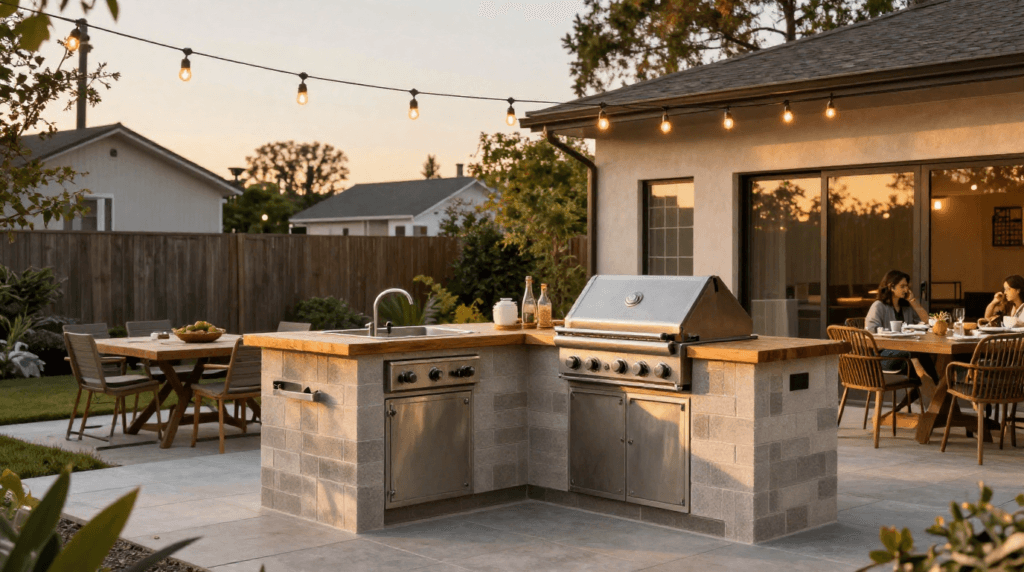
A full custom outdoor kitchen build runs $5,060 to $17,280, with most homeowners landing near $13,180. Other industry estimates put the realistic range even higher, between $6,285 and $26,925 once labour and finishes are factored in. That’s the number that stops most homeowners before they even start sketching a layout.
Here’s the part most cost guides skip: you don’t need the $13,000 version. A grill, a sturdy prep surface, decent lighting, and a place to sit will get you 80% of the experience. Labour alone makes up 20% to 40% of a typical outdoor kitchen budget, and most of that cost disappears the moment you do the build yourself.
This post walks through 14 budget outdoor kitchen ideas, what each one really costs, and the mistakes that turn a weekend project into an expensive one. Every price below comes from current home-improvement cost data, not guesswork, so you can plan a real number before you buy anything.
Why build an outdoor kitchen at all?
It adds usable living space and real resale value. Real estate agents rank it high on buyer wish lists, and outdoor kitchens recover roughly 71% of their cost at resale, according to National Association of Realtors data cited by HomeLight.
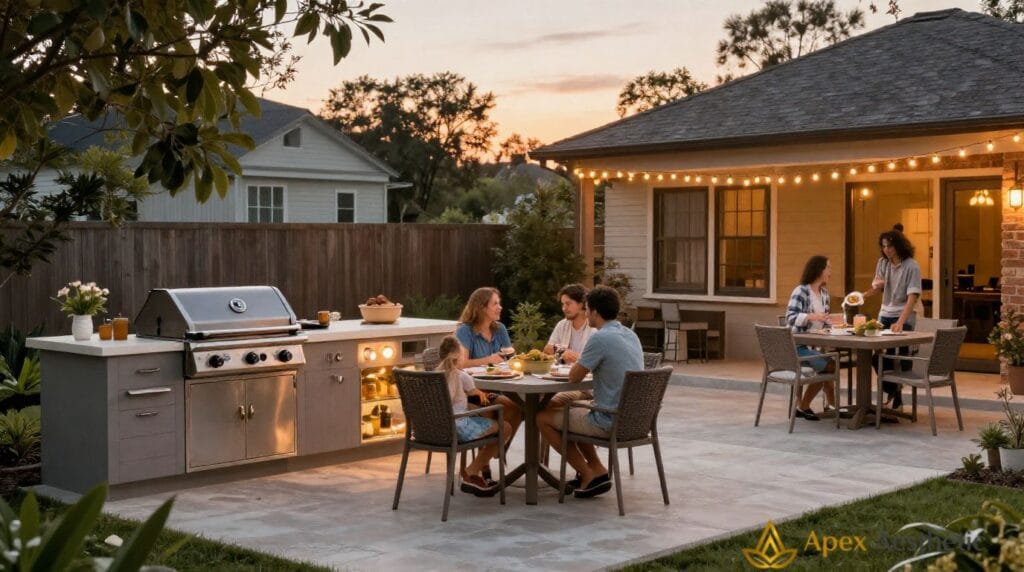
It also changes how you use your yard. A grill on a cart is a chore. A dedicated counter with storage turns into the spot where people gather, plates in hand, while dinner cooks.
You don’t need a “kitchen” in the indoor sense. You need a cooking zone, a counter, and a reason to stay outside after the sun drops. Most homeowners who build one say the same thing afterwards: they use it more than they expected, mainly because the setup removes the friction of carrying everything outside and back in every time.
A budget outdoor kitchen also extends the cooking season. Solid lighting and a wind-blocking layout mean grilling in October instead of stopping after Labour Day.
What does a budget outdoor kitchen actually cost?
Plan on $800 to $3,000 for a simple grill-and-counter setup built with budget materials and DIY labour. That’s a fraction of the $13,000+ custom average, because you’re skipping plumbing, gas lines, and built-in appliances.
| Build type | Typical cost | What you get |
| Grill cart upgrade | $150–$600 | Mobile station, no construction |
| DIY cinder block island | $800–$2,000 | Fixed counter, storage below |
| Prefab BBQ island kit | $1,500–$6,000 | Pre-built frame, drop-in grill |
| Full custom build | $13,180 average | Plumbing, electrical, and stone finish |
The jump from row two to row four is almost entirely utilities and stone veneer. Skip both, and the price drops fast.
Which Outdoor Kitchen Idea Gives the Best Value for Money?
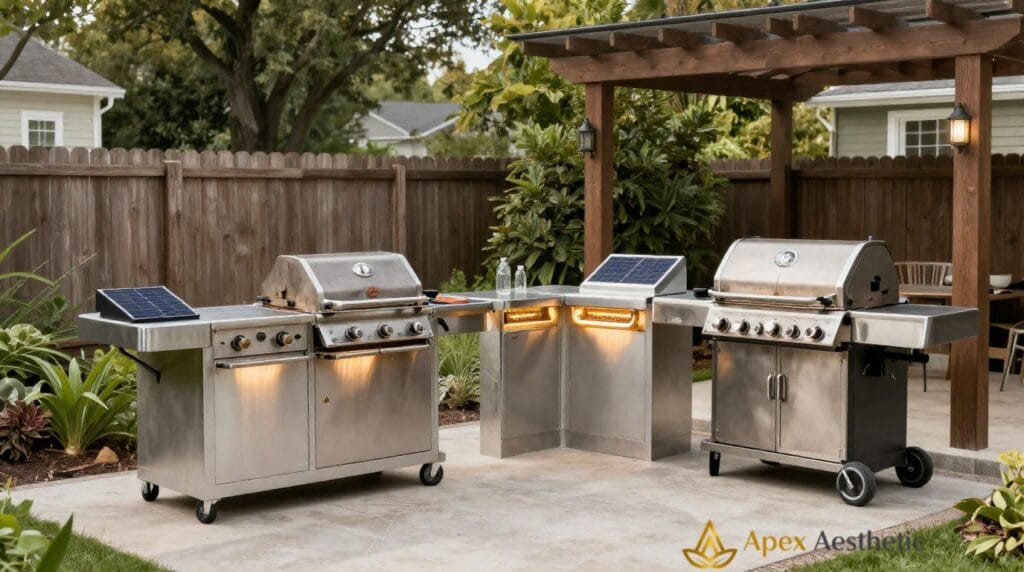
Not every upgrade delivers the same return. After reviewing dozens of DIY backyard kitchen projects, one pattern stands out: homeowners often get the biggest improvement from adding prep space and lighting before investing in expensive appliances.
If your goal is to maximize function without overspending, start with the essentials and expand later.
| Outdoor Kitchen Idea | Estimated Cost | DIY Difficulty | Visual Impact | Overall Value |
| Rolling Grill Cart | $150–$600 | Easy | Medium | High |
| Cinder Block Grill Island | $800–$2,000 | Medium | High | Excellent |
| Solar Lighting Setup | $30–$150 | Easy | High | Excellent |
| Pergola Kit | $600–$3,000 | Medium | Very High | High |
| Pizza Oven Kit | $300–$1,500 | Medium | Very High | High |
| Outdoor Bar Cart | $50–$250 | Easy | Medium | High |
For most homeowners, a combination of a grill island, outdoor prep station, and solar lighting creates the biggest transformation while keeping costs manageable.
One common mistake DIY builders make is spending most of the budget on a premium grill while neglecting counter space and lighting. In practice, guests tend to gather around prep areas, seating zones, and illuminated entertaining spaces far more than the grill itself.
That is why many successful backyard kitchen designs focus first on functionality and flow before luxury appliances.
How do you plan a budget outdoor kitchen layout?
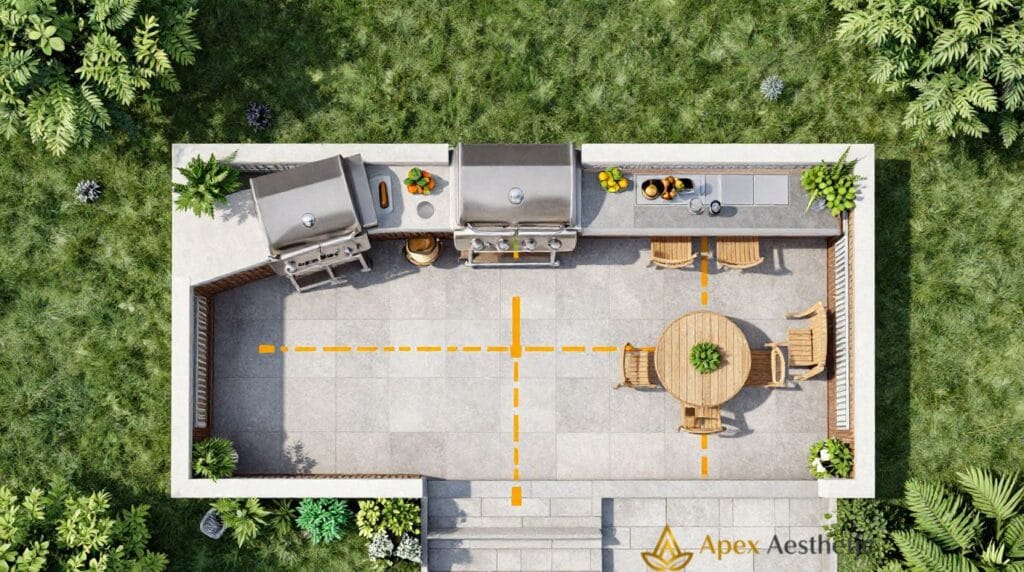
Start with what you already have. A patio or deck saves $500 to $1,800 in concrete or paver work, since you’re not building a pad from scratch.
Measure before you buy anything. A grill cart needs at least 3 feet of clearance on the open side for safe cooking and another 2 feet behind it for movement. Sketch the space on paper with a tape measure in hand before ordering cinder blocks or a kit.
Decide between freestanding and built-in early. A freestanding setup, like a cart or a kit on legs, can move if you change your mind about layout. A built-in cinder block or stone structure can’t. If you’re new to outdoor cooking, start freestanding and upgrade once you know your habits.
Plan utilities last, not first. Plumbing for a sink adds $500 to $2,000, and a gas line extension runs $20 to $35 per linear foot plus connection fees. Most budget builds skip both and use a portable propane tank and a garden hose instead.
Quick checklist before you buy materials
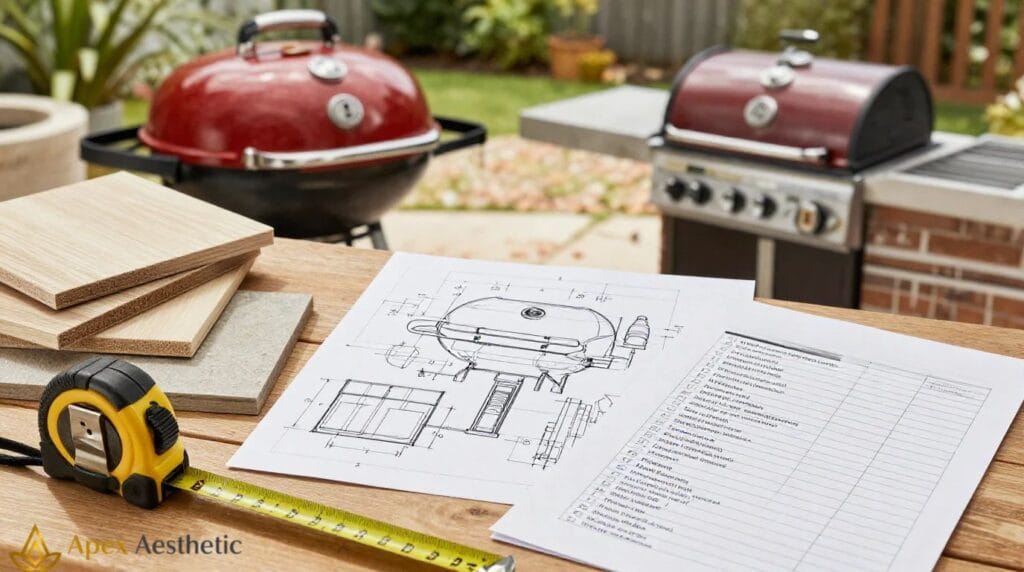
- Measure the space and mark 3 feet of clearance around any grill.
- Decide freestanding vs. built-in before ordering blocks or a kit.
- Pick one structural material and stick with it.
- Price the grill first; it’s usually the biggest single line item.
- Confirm whether your area requires a permit for gas or electrical work.
- Choose a sealant for any wood or concrete surface before the first rain.
A short list like this keeps an outdoor kitchen project from drifting into a pile of half-finished purchases, which is the most common way a budget build quietly turns into an expensive one.
1. Build a grill island from cinder blocks
Stack standard 8x8x16 cinder blocks into a U-shaped frame, then top it with a butcher block or concrete slab. No mortar required if you’re not stacking past three rows. Paint the blocks with exterior masonry paint so the finish doesn’t scream “construction site.”
A basic version runs $300 to $500 in materials, well under the framework rate of $200 to $700 per linear foot that custom builders charge.
2. Turn a rolling cart into a kitchen island
Skip construction entirely. A stainless steel utility cart with shelving underneath becomes a mobile prep station you can wheel against the wall in winter. Add a cutting board insert and a few S-hooks for tools.
Cost: $80 to $250, depending on size and material. This is the fastest idea on this list. You’re cooking on it the same afternoon you buy it.
3. Pour your own concrete countertop
Stone countertops run $35 to $80 per square foot installed. A DIY concrete pour costs closer to $8 to $15 per square foot in materials, and it holds up just as well outdoors when sealed properly.
Build a plywood form, pour a 1.5-inch slab, and seal it with a food-safe concrete sealer after curing. Concrete also takes colour additives, so you’re not stuck with grey.
4. Add a BBQ island kit instead of a custom build
Prefab kits run $1,500 to $6,000 installed, against $10,000 to $35,000 for a fully custom structure with the same footprint. The trade-off is less customization, but most kits already include drawers, a side burner cutout, and a stone-veneer wrap.
If you want a built-in look without a contractor, this is the shortcut.
5. Skip the built-in fridge for a portable cooler drawer
A built-in outdoor refrigerator costs $675 to $2,500 installed. A high-quality rolling cooler with drainage runs $80 to $200 and does 90% of the job for weekend use.
Save the built-in fridge for phase two once you know how often you actually grill outside.
6. Use solar lights instead of wired fixtures
Wired outdoor kitchen lighting averages $500 to $3,000 total, or about $260 per fixture. Solar string lights and stake lights cost $15 to $60 per set and need zero electrical work.
Hang string lights over the prep area and stake path lights along the walkway. You get the same evening ambience without an electrician’s invoice.
7. Build a fire pit instead of a full patio heater system
Fire pits run $250 to $2,200, averaging around $830, far less than a built-in outdoor fireplace. A simple steel ring or stacked-paver pit gives you the same gathering spot for a tenth of the cost.
Place it 10 feet from any structure and away from low branches. That’s the main safety rule people skip.
8. Repurpose pallets into a bar cart
Sand and seal two or three shipping pallets, stack them into a small bar shelf, and add cup hooks underneath. Material cost is close to zero if you source pallets free from local businesses; sealant and hardware run $30 to $60.
This is the cheapest item on the list, and it doubles as a drink station at parties, keeping your main counter clear.
9. Add a pergola kit instead of a roofed structure
A fully covered patio roof costs $10,000 to $22,500. A freestanding pergola kit runs $2,220 to $8,960, and a basic 8×8 wood pergola kit from a home improvement store can come in under $600 before staining.
It won’t block rain, but it cuts direct sun, which matters more for comfort during a 2-hour cookout.
10. Build vertical herb planters into your workspace
Mount a tiered planter or repurposed pallet planter on the wall behind your grill station. Fresh herbs within reach save grocery trips and fill the dead vertical space most budget kitchens ignore.
Materials run $20 to $50 for a basic version using cedar boards and planter liners.
11. Use pavers instead of poured concrete for the base
A poured concrete pad costs $500 to $1,500. Interlocking pavers laid over a sand base can come in lower if you DIY the install, and you can expand the footprint later without breaking up a slab.
This matters most if you’re not sure yet how big you want the final space. Pavers let you add a row next summer instead of re-pouring.
12. Add a folding prep table instead of fixed counter space
A collapsible stainless or wood prep table gives you extra counter room only when you need it, then folds flat against a wall or in a shed for winter. These run $40 to $150, depending on size and material.
This solves the most common budget-build problem: not enough counter space once food, drinks, and tools all need a surface at the same time.
13. Use a stackable brick pizza oven kit
Stackable fire-brick pizza oven kits let you DIY a wood-fired oven without mortar or a mason. Basic kits start around $300 to $600, against $500 to $3,000 for a fully built-in version with a chimney and stone surround.
It won’t out-cook a $3,000 commercial oven, but it gets you real wood-fired pizza on a weeknight, and it becomes the centerpiece guests photograph first.
14. Convert a storage bench into seating and overflow storage
A weatherproof deck box doubles as bench seating with a cushion on top and dry storage underneath for cushions, tools, or charcoal. These cost $80 to $250, well under custom-built-in bench seating, which runs into the hundreds per linear foot once cushions and waterproofing are added.
Place it along the edge of your kitchen zone so guests have somewhere to sit without pulling chairs from inside.
Best Outdoor Kitchen Materials for Long-Term Savings
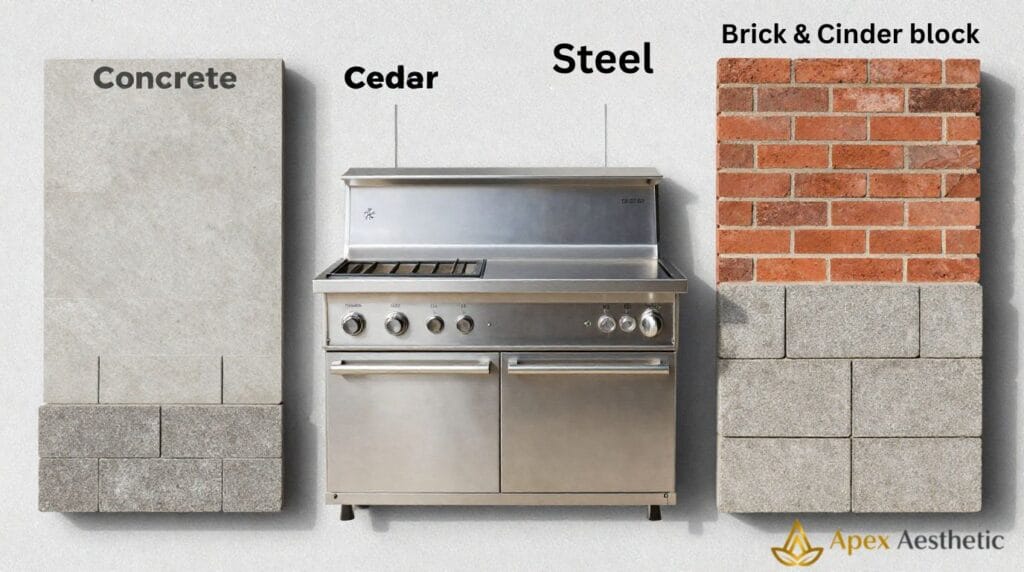
Choosing the right materials can save hundreds of dollars in maintenance and replacement costs over time. While many homeowners focus on upfront pricing, durability often determines the true value of an outdoor kitchen.
Concrete
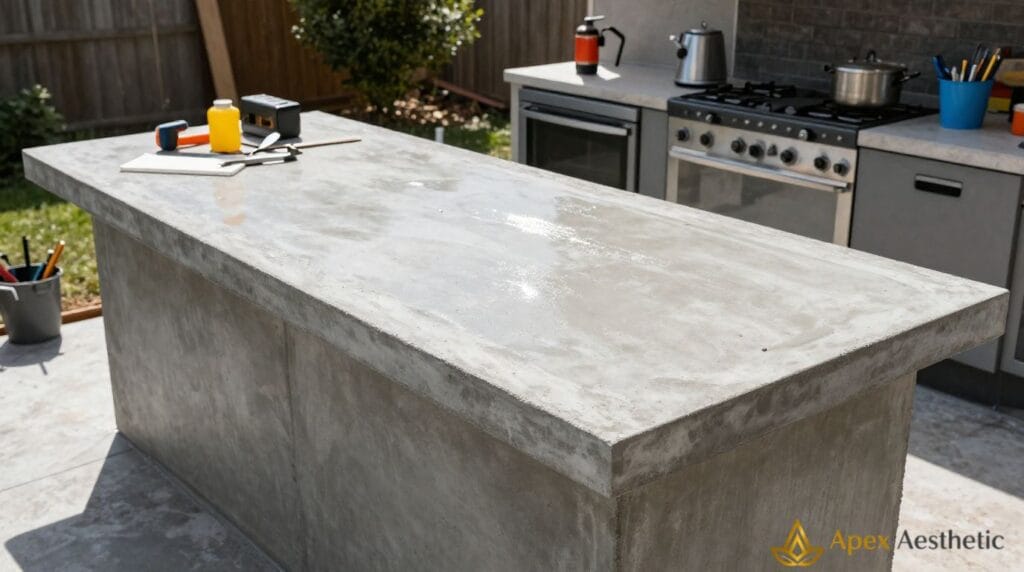
Concrete remains one of the most budget-friendly countertop materials available. It is durable, weather-resistant, and significantly less expensive than natural stone.
Best for:
- DIY countertops
- Grill islands
- Prep stations
Pressure-Treated Wood
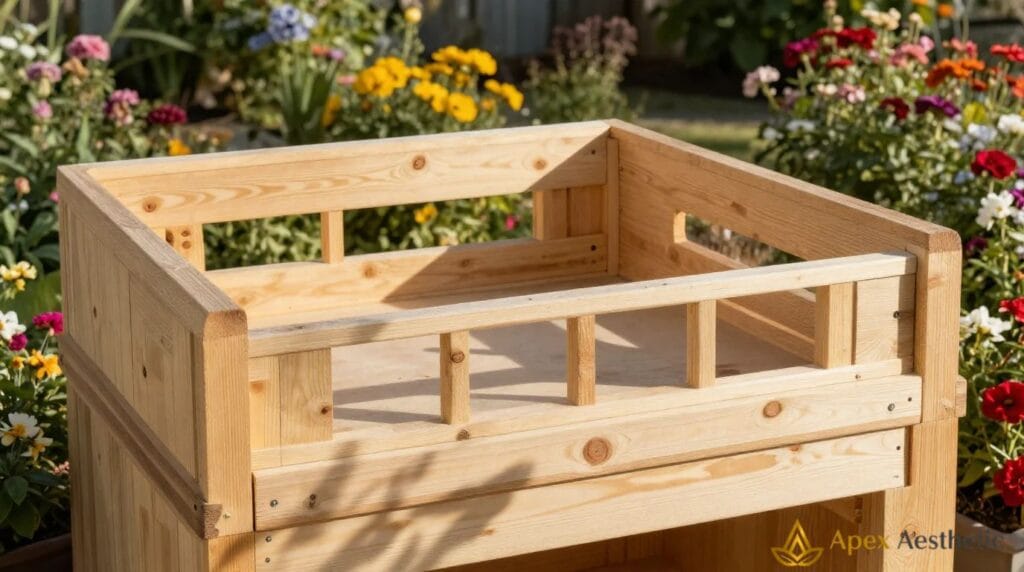
Pressure-treated lumber offers an affordable framework solution for outdoor structures such as pergolas, storage cabinets, and seating.
Best for:
- Outdoor kitchen frames
- Bench seating
- Shelving
Cedar
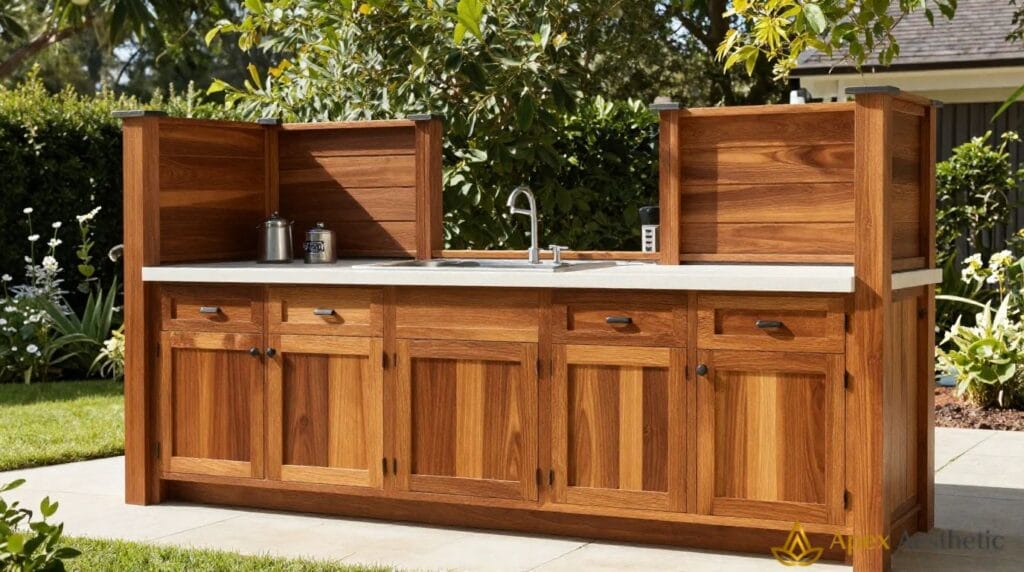
Although slightly more expensive, cedar naturally resists moisture, insects, and decay, making it a strong long-term investment.
Best for:
- Outdoor cabinetry
- Decorative panels
- Privacy screens
Stainless Steel
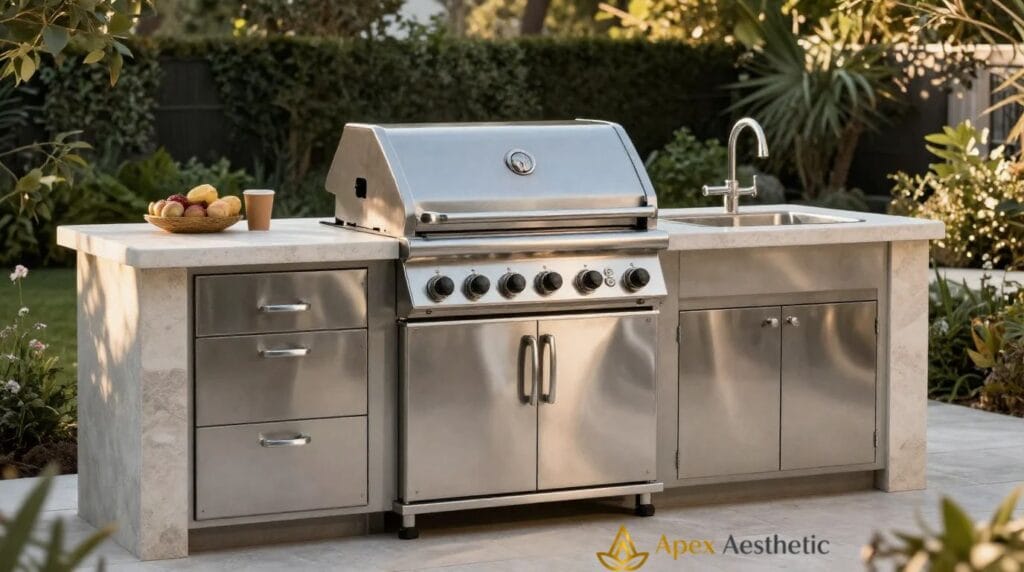
Stainless steel remains the preferred choice for outdoor kitchen appliances because it withstands weather exposure and requires minimal maintenance.
Best for:
- Grills
- Sinks
- Outdoor refrigerators
- Storage drawers
Brick and Cinder Block
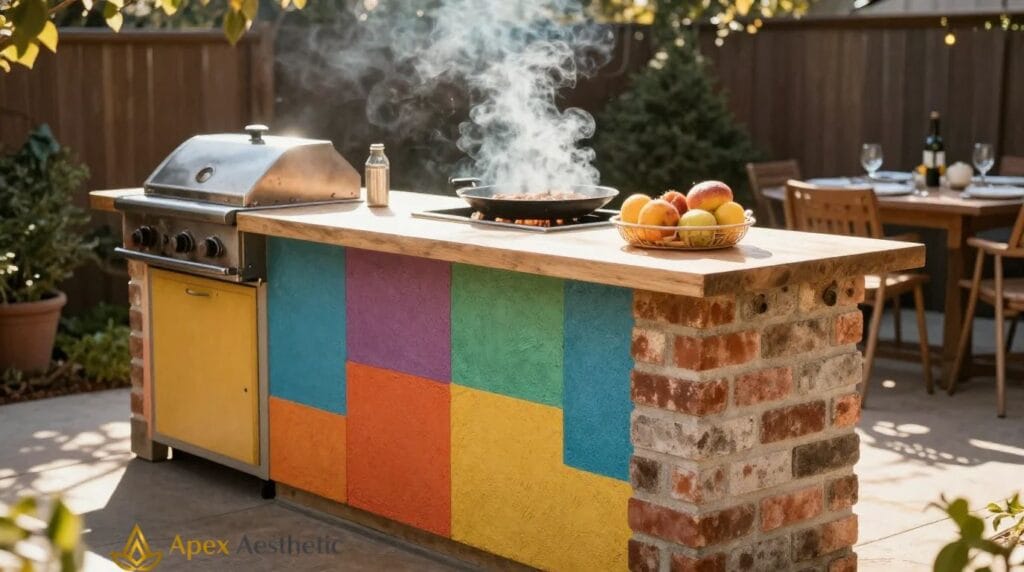
Bricks and cinder blocks are among the most cost-effective structural materials for DIY outdoor kitchens. They provide excellent durability and can be finished with paint, stone veneer, or stucco.
Best for:
- Grill islands
- Pizza oven bases
- Outdoor counters
One thing that stands out across DIY outdoor kitchen projects is how often material choices determine whether the build lasts five years or fifteen.
Homeowners frequently save money upfront by using indoor cabinets or untreated wood, only to replace them after a few harsh seasons. Durable, weather-resistant materials cost more initially, but they usually deliver a better long-term investment.
What mistakes turn a budget build into an expensive one?
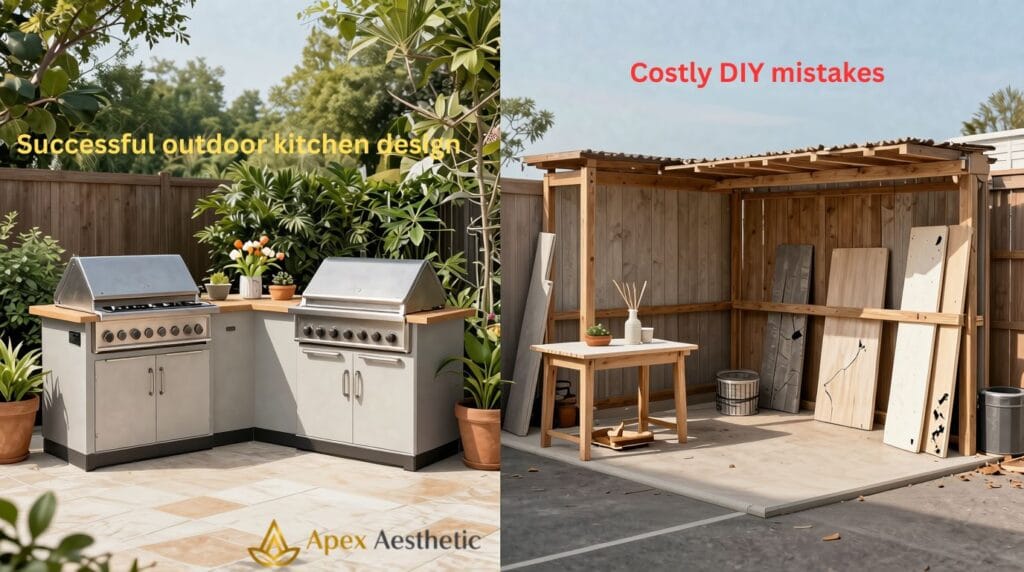
Buying the cheapest grill first is the most common one. A grill that fails in two seasons costs more long-term than spending an extra $150 upfront on a better burner and grates.
Skipping the location plan is the second. A grill needs 3 feet of clearance from siding, railings, and anything flammable. Moving a finished island later costs more than planning it correctly once.
Mixing too many finishes is the third. One material for the structure (cinder block, wood, or stone) and one accent material keep the build looking intentional instead of pieced together.
Ignoring weather exposure is the fourth. Untreated wood and unsealed concrete both break down fast outdoors. A $20 can of sealant protects a $300 countertop for years; skipping it means redoing the work within a season.
Where do you find cheap materials for a DIY outdoor kitchen?
Check classifieds and marketplace apps first. Grills, carts, and patio furniture get listed constantly by people upgrading or moving, often at half the retail price or less.
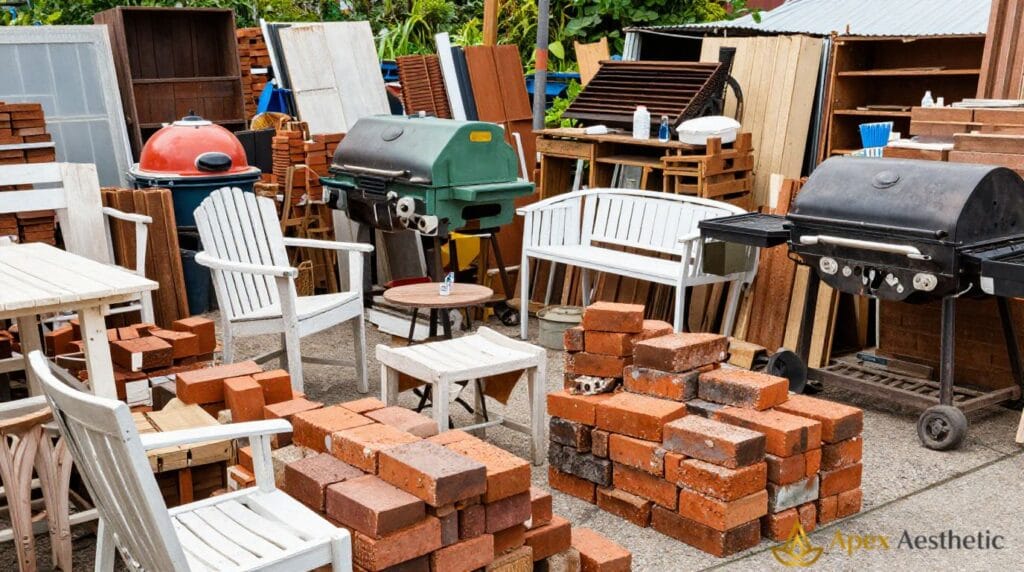
Salvage yards carry cinder blocks, brick, and leftover stone veneer at a fraction of big-box prices. Call ahead, since stock changes daily.
Home improvement stores run seasonal clearance on outdoor furniture and grills in late summer and early fall. Waiting eight weeks past peak season can cut 30% to 50% off the list price on the same items.
Local cabinet shops and countertop fabricators often sell remnant pieces too small for a full kitchen job but plenty large for an outdoor prep counter, usually at a steep discount from a full slab price.
How long does a budget outdoor kitchen build take?
A cart upgrade or pallet bar takes an afternoon. A cinder block island with a sealed top usually takes a weekend plus a few days of cure time before the countertop gets heavy use.
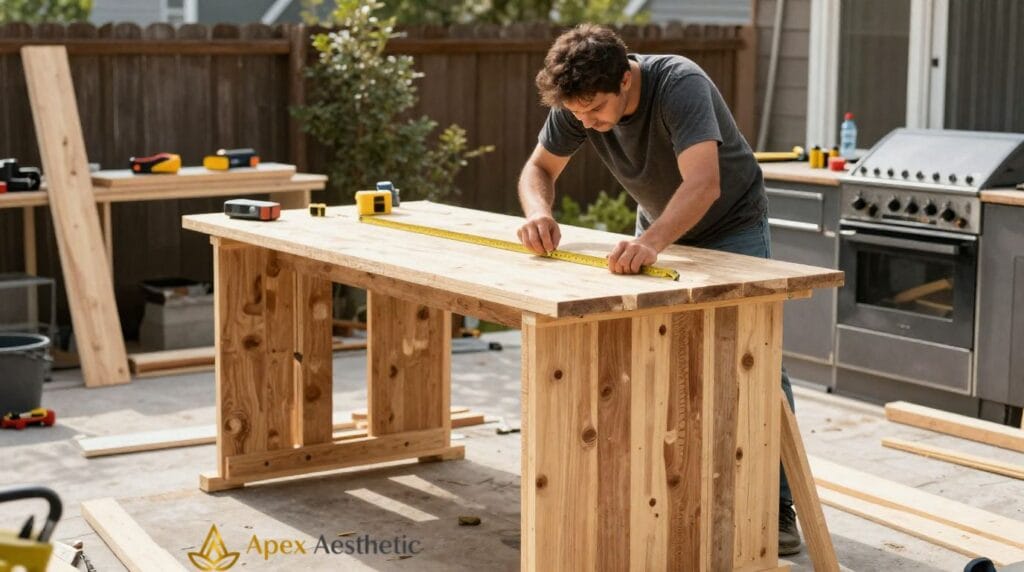
A prefab kit install runs one to two days, depending on site prep. Anything involving a gas line or plumbing adds a licensed contractor’s schedule on top of your own timeline, which is exactly why most budget builds skip that step.
How much should you actually budget?
For a grill-and-counter setup with lighting and seating: $800 to $2,500. For the same setup with a prefab island kit and a pergola: $3,000 to $7,000. For anything closer to plumbing, built-in appliances, and stone veneer, you’re back in custom territory, $13,000 and up, per national cost averages.
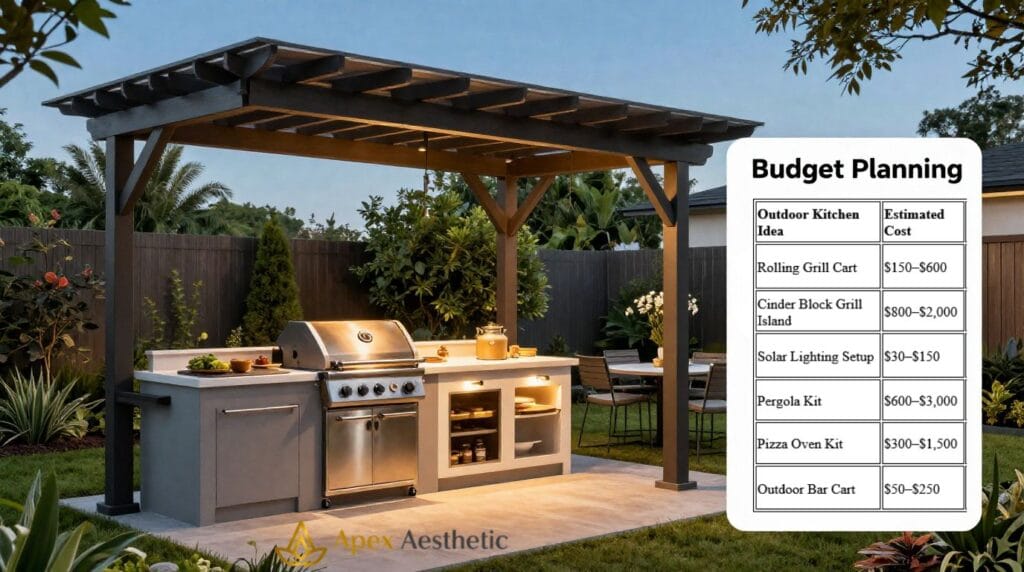
Start with the grill and counter. Add the pergola, lighting, and fire pit in phase two once you know how often you’re actually using the space.
FAQ’s: Outdoor Kitchen Ideas on a Budget
What’s the cheapest outdoor kitchen idea that still looks intentional?
A cinder block island with a painted finish and a butcher block top. It costs under $500 and looks built-in once painted.
Do I need a permit for a DIY outdoor kitchen?
Usually, only if you’re adding gas lines, plumbing, or a permanent roof structure. A freestanding grill cart or cinder block island typically doesn’t require one, but check your local code before you pour concrete.
Are outdoor kitchens worth the investment?
Real estate data points to a 71% return on cost at resale, which is high compared to most home upgrades. Even a budget version adds buyer appeal.
Can I build an outdoor kitchen on a wood deck?
Yes, but check weight limits first. Decks generally need to support 50+ pounds per square foot before adding heavy stone or concrete elements.
What should I buy first if I’m building in phases?
The grill. It’s the one piece that gets used every time, and a better burner now saves a replacement purchase in two years.
How much does a small outdoor kitchen cost compared to a full custom build?
A small grill-and-counter setup costs $800 to $3,000, against the $13,180 average for a full custom outdoor kitchen with utilities and a stone finish. The difference comes almost entirely from labour, plumbing, and gas line work.
Does a budget outdoor kitchen still add resale value?
Yes. Buyers respond to the feature itself, not the price tag behind it. A clean, functional grill station with decent lighting still reads as a backyard upgrade at resale.
Where to go from here
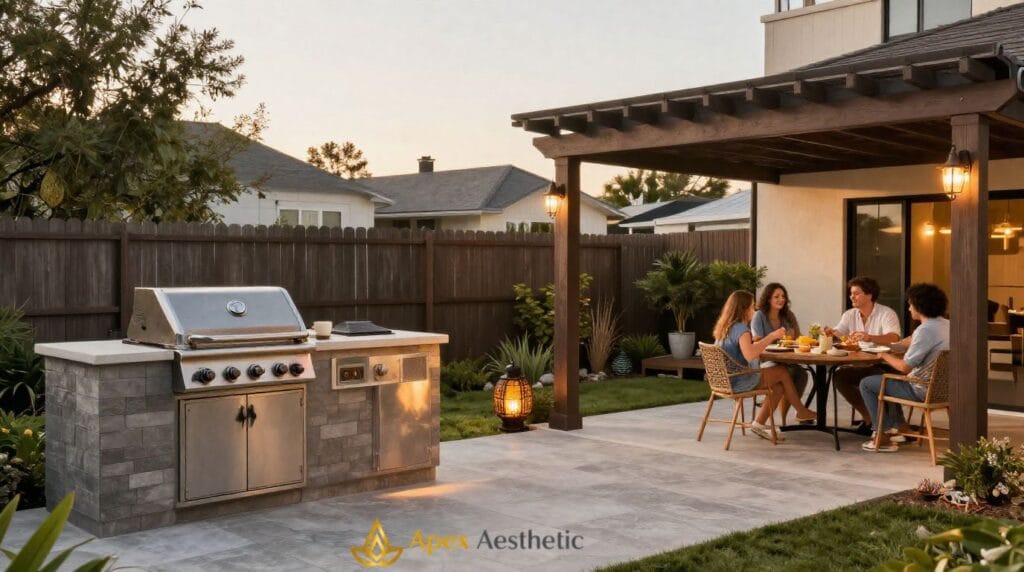
Start with one upgrade this month, not all fourteen. A grill island and a string of solar lights already change how your backyard gets used on a Friday night.
Pick the two ideas with the lowest cost and the highest use for your household. For most homeowners, that means the cinder block island or rolling cart paired with solar lighting. Add the pergola, fire pit, and pizza oven later, once the core space proves itself useful.
A budget outdoor kitchen doesn’t need to look unfinished. Consistent materials, good lighting, and one or two intentional upgrades go further than a long list of mismatched pieces.
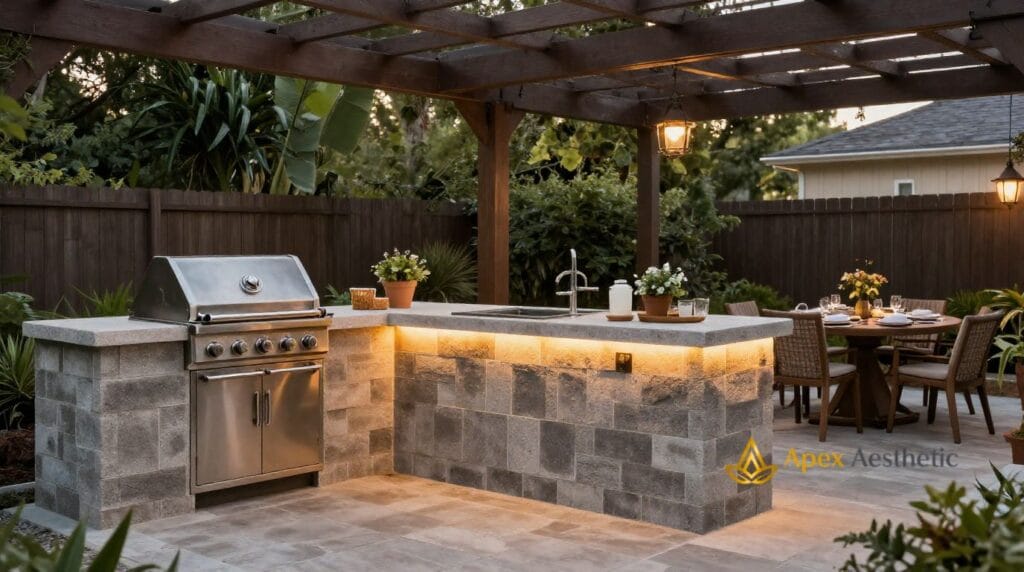
If you’ve already worked on lighting, our guide on outdoor solar lighting ideas covers placement and fixture choices in more depth. And if pollinators are part of your yard plan, see our pollinator garden ideas post for plant choices that work alongside a patio kitchen.
For visual inspiration before you build, this walkthrough of budget outdoor kitchen builds on YouTube shows several of these ideas in action.
3 thoughts on “14 Outdoor Kitchen Ideas on a Budget That Wow Guests”