
Table of Contents
Introduction
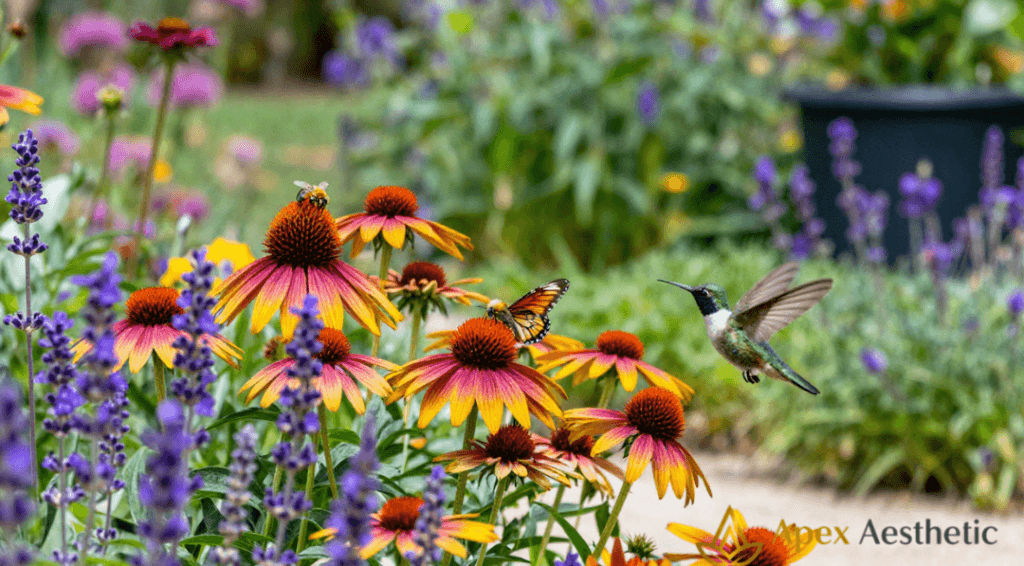
There is a way to make your yard a feeding ground for bees, butterflies, and hummingbirds with the right pollinator garden ideas. These creatures are in short supply of habitat these days, more so than most gardeners give them credit for. The numbers bear it out: a study in Science from the Xerces Society puts the drop in U.S. butterfly populations at 22% over the last two decades. Honeybees have it even harder. Entomologists at Washington State University put 2025 hive losses at up to 70%, on top of the 30% beekeepers have been putting in the ground each year for the better part of ten years.
You can see that kind of decline in a quieter yard and a lack of produce. After all, the Xerces Society’s conservation program says pollinators are behind the reproduction of some 85% of flowering plants on the planet and well over two-thirds of our food crops.
But you don’t have to put in acres to be of service; a row of flowering pots on the balcony rail will do. We have put together a guide with 15 pollinator garden ideas for any size yard, along with the design choices and pitfalls that determine if you will actually get visitors.
What is a pollinator garden?
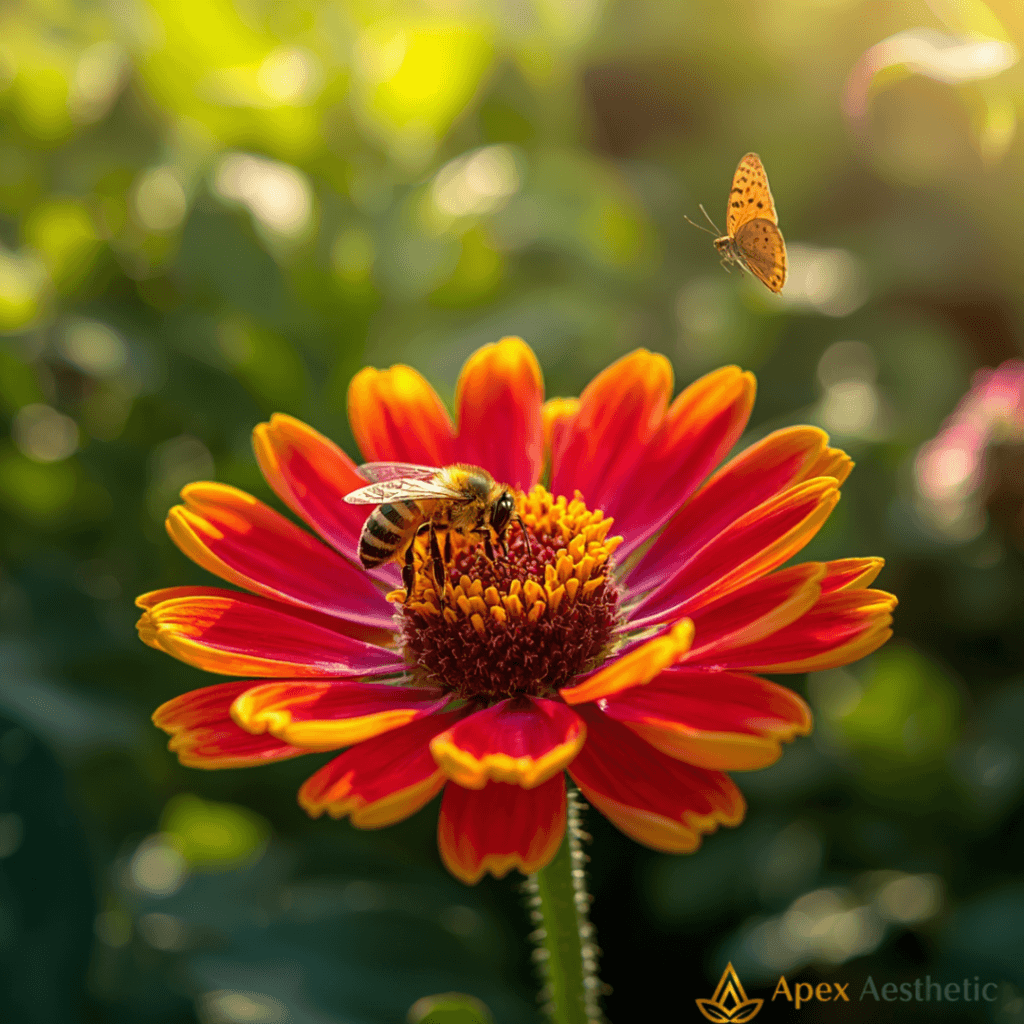
In a nutshell, a pollinator garden is what you make of it. It might be a native meadow or a window box, but its purpose is not to be decorative. It is to put out food and shelter in a way that is accessible from spring to fall. And they are worth the effort.
Why pollinators matter. Bees, butterflies, and other pollinators are responsible for an estimated $3 billion a year in agricultural value in the U.S. alone, according to the Xerces Society. Without them, crops like apples, blueberries, and squash see sharply reduced yields.
Common garden pollinators. Different pollinators have different tastes, falling into five general types:
Bees—Bees go for the flat or clustered coneflower and sunflower
Butterflies—Butterflies like the tubular milkweed or a zinnia
Moths—Moths want something pale and fragrant to find at dusk
Hummingbirds — Hummingbirds are after the red and orange of salvia and bee balm
Beetles — Beetles will crawl into open, bowl-shaped flowers
You might be wondering why so many homeowners are turning to pollinator gardens
The answer is in the work they put in; a pollinator garden justifies its place by outperforming an ornamental bed in every way.
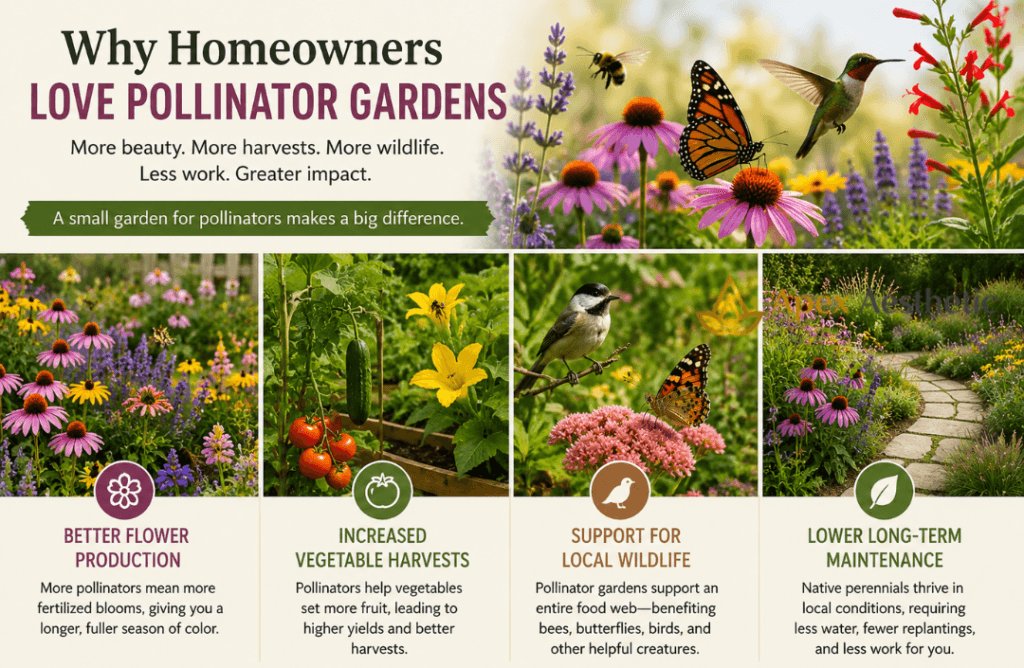
Better flower production. The flowers put on a better show. With more pollinators around, you get more fertilized blooms and a longer, fuller season from the very plants you have now.
Increased vegetable harvests. Your vegetables will do the same. Put a patch of pollinators next to your squash, cucumbers, or tomatoes, and you’ll see them set more fruit thanks to the steady bee traffic. In most cases, that vegetable bed will put up higher yields than if it were on its own.
Support for local wildlife. You are supporting a whole food web, not just one species. Native bees and butterflies make their home there, as do the birds that feed on their larvae.
Lower long-term maintenance. Many of the best pollinator plants are native perennials, so they can make it on local soil and rainfall without the constant watering, replanting that an annual flower bed would demand.
15 pollinator garden ideas for every size yard
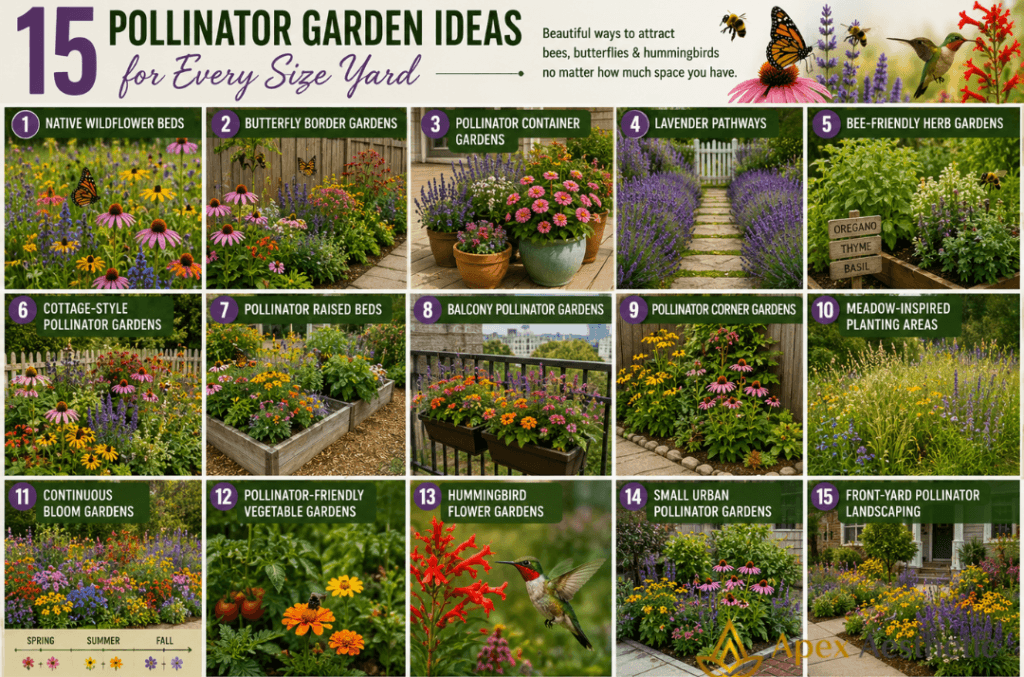
You can make these 15 layouts suit any space, be it a quarter-acre or the balcony of a studio apartment.
- Native wildflower beds. Sowing a dense patch of regionally native wildflowers provides pollinators with the kind of food they have evolved to rely on. In fact, this is the most impactful item on our list: you will see about four times as many pollinator visits to natives as you would to non-native ornamentals.
- Butterfly border gardens. You don’t need to give over your whole yard to catch butterflies in transit; a narrow border of milkweed, zinnias, and coneflower along a fence or path will do. A 2-foot-wide run alongside a 20-foot fence is typically all it takes to make a statement.
- Pollinator container gardens. Put three or four pots of salvia, lavender, and zinnia out on the porch, and you have nearly as good a setup for bees and smaller butterflies as a ground bed. Make sure to put the pots in a cluster instead of spreading them around; it is easier for the insects to put their hands on a group of blooms.
- Lavender pathways. There is something to be said for a walkway lined with lavender. It makes for a nice-smelling path when you brush by and gives bees a corridor of flowers to work through. Plus, lavender doesn’t mind the dry, well-drained soil that is typical of a walkway.
- Bee-friendly herb gardens. If you let your oregano, thyme, and basil go to flower rather than trimming them back all the time, your kitchen herb bed becomes a regular stop for bees. You can still take leaves from the unflowered stems while the rest are put to use feeding pollinators.
- Cottage-style pollinator gardens. Go for a layered look with coneflower, black-eyed Susan, and salvia at varying heights. It has that classic cottage feel and does its job for the pollinators. Just put the taller ones in the back or middle so they don’t rob the sun from a shorter plant.
- Pollinator-raised beds. They have an advantage in that they warm up sooner in spring and shed water better after a rain, giving you a longer bloom window. For some ideas on how to build a layout for this, have a look at our raised garden bed ideas post, which covers layouts built for exactly this kind of planting.
- Balcony pollinator gardens. Even ten stories up, a rail planter with lantana, zinnia, and salvia is a reachable spot for bees. We have some layouts in our apartment balcony garden ideas post that are made for just such a space.
- Pollinator corner gardens. Take an awkward bit of dead space and put in a few tall natives; by midsummer, it will be one of the busiest spots in the yard. And if the corner is up against a wall or fence, you are giving the butterflies some wind cover they will appreciate.
- Meadow-inspired planting areas. Let a part of the lawn be what it wants to be, with a mix of native grass and wildflowers. You save on mowing and provide a place for ground-nesting bees to dig in. The Xerces Society says 70% of native bee species nest in sparsely vegetated soil, so a meadow is as much housing as it is food.
- Continuous bloom gardens. Don’t let pollinators starve outside of June’s big show; plant for staggered blooming from spring to fall. A good rule of thumb is to check each plant’s bloom window before you make a purchase and see where the gaps are.
- Pollinator-friendly vegetable gardens. Tuck in some sweet alyssum or zinnia between the rows, and you’ll be pulling in the same bees that are on your tomatoes and squash. Borage is especially good for this since it seems to keep blooming once it gets going, and the bees will return to the bed all season.
- Hummingbird flower gardens. Bee balm, trumpet vine, and other tubular reds and oranges will draw hummingbirds in from spring well into fall. Once you have an established bed, they tend to come back year after year because they remember where the good feeding is.
- Small urban pollinator gardens. In a city lot or shared courtyard, a 4-by-4-foot bed of natives is a real stop for bees between larger green spaces. Those small patches count for more in dense neighborhoods where there isn’t much green to begin with.
- Front-yard pollinator landscaping. Most yards have plenty of unused sun out front, so why not put in some native perennials? It is a better use of the space than a strip of lawn, and, once the bed is in, you won’t be putting as much water into it as you did the turf.
Best pollinator plants to grow
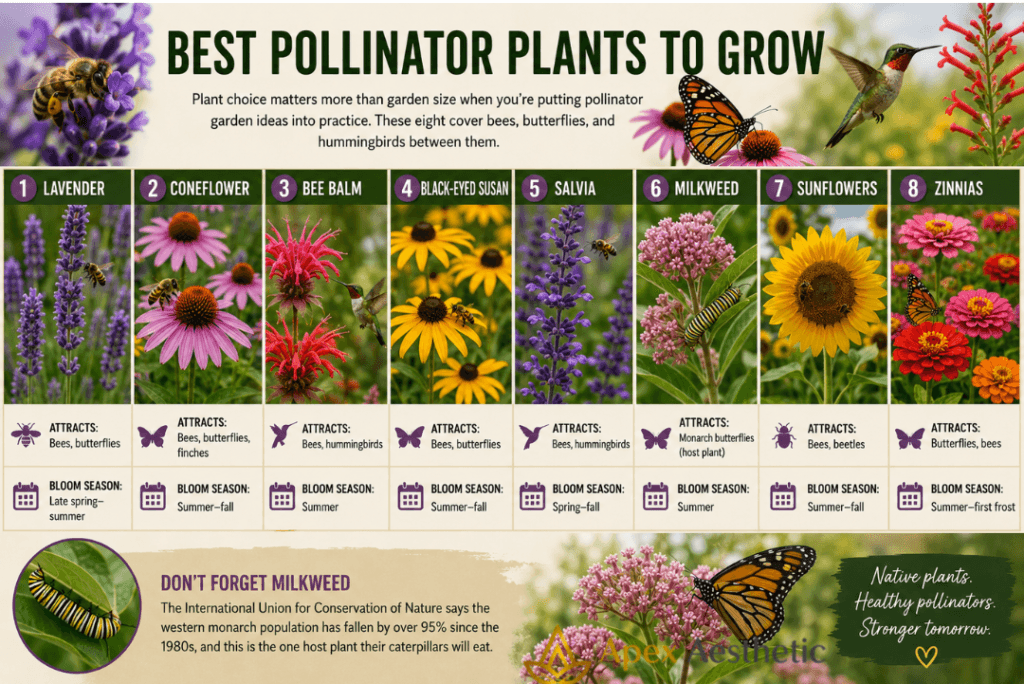
Plant choice matters more than garden size when you’re putting pollinator garden ideas into practice. These eight cover bees, butterflies, and hummingbirds between them.
| Plant | Attracts | Bloom season |
| Lavender | Bees, butterflies | Late spring–summer |
| Coneflower | Bees, butterflies, finches | Summer–fall |
| Bee balm | Bees, hummingbirds | Summer |
| Black-eyed Susan | Bees, butterflies | Summer–fall |
| Salvia | Bees, hummingbirds | Spring–fall |
| Milkweed | Monarch butterflies (host plant) | Summer |
| Sunflowers | Bees, beetles | Summer–fall |
| Zinnias | Butterflies, bees | Summer–first frost |
You have to make a point of mentioning milkweed. The International Union for Conservation of Nature says the western monarch population has fallen by over 95% since the 1980s, and this is the one host plant their caterpillars will eat.
Native plants vs. non-native plants
You can put it in Penn State’s Center for Pollinators. Research shows native plants will draw in some four times the pollinator traffic of non-native ones. It is a matter of evolution, not how they look.
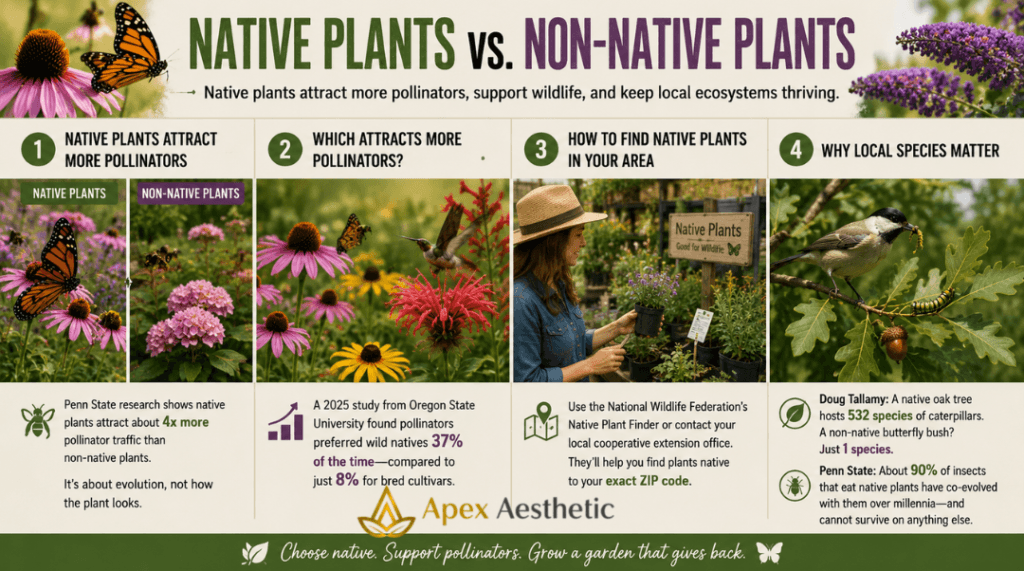
Which attracts more pollinators? Take the question of what is more appealing to pollinators, and the answer is always the native plant. In fact, a 2025 study from Oregon State University has pollinators showing a preference for wild natives over their bred cultivars 37% of the time, as opposed to only 8% for the latter.
How to find native plants in your area. As for where to get your hands on some native stock for your yard, the National Wildlife Federation’s Native Plant Finder or your local cooperative extension office can point you in the right direction. They will tell you what is indigenous to your exact ZIP code rather than the region at large.
Why local species matter. Then there is the issue of why local species are so important. Doug Tallamy, an entomologist, has done the numbers: a native oak is home to 532 caterpillar species while a non-native butterfly bush puts up with one. And according to Penn State, roughly 90% of the insects that eat native plants have co-evolved with them over the millennia and cannot subsist on anything else.
Pollinator garden design tips
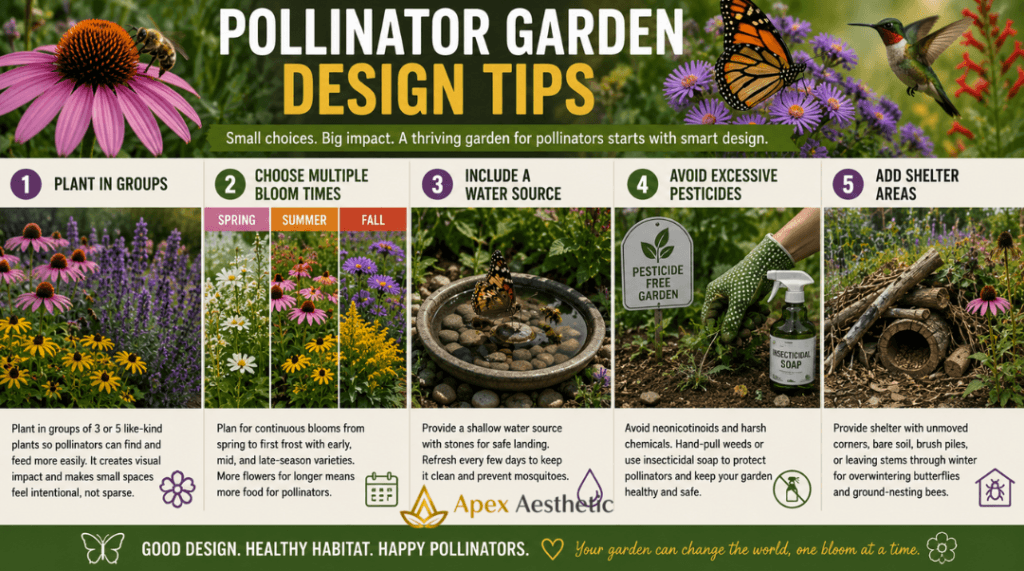
You will find that how and when you put things in the ground is every bit as important as the plants you pick. Five habits tell the difference between a garden people make use of and one they don’t.
- Plant in groups. Make your plantings into groups. Bees can more readily locate and feed from a cluster of 3 or 5 like-kind plants than if you have them all over the place in a bed. It also gives a small area some intention instead of looking sparse.
- Choose multiple bloom times. Don’t let the garden go quiet for most of the year. Put in a mix of early, mid, and late-season varieties, so you have flowers to show from spring right up to the first frost. If your garden only has a two-week peak, you are only feeding the pollinators part-time.
- Include a water source. A shallow dish with a couple of stones to stand on is all it takes for a bee or butterfly to have a drink without any risk. Just be sure to refresh it every few days so you don’t end up with mosquitoes.
- Avoid excessive pesticides. The EPA would have you stay off neonicotinoid products in your home garden because they linger in the nectar and pollen well after you put them down. You can do just as well by hand-pulling your weeds or using an insecticidal soap; it spares the pollinators that a broad spray would put down.
- Add shelter areas. Give them somewhere to put down roots. Not just to eat but to live. An unmoved corner, a patch of bare earth, or a brush pile will do for overwintering butterflies and ground-nesting bees. And there is no cost to leaving the spent stems in through the winter instead of doing a fall clean-up.
Want to see this laid out in a real yard? Ask This Old House landscape contractor Roger Cook walks through planting a pollinator garden step by step, from bed prep to plant selection.
Common pollinator garden mistakes
Here are some of the more common errors you will find in a pollinator garden. For the most part, if a garden is not doing its job, it is for one of four reasons, but there is no need to start from scratch to put things right.
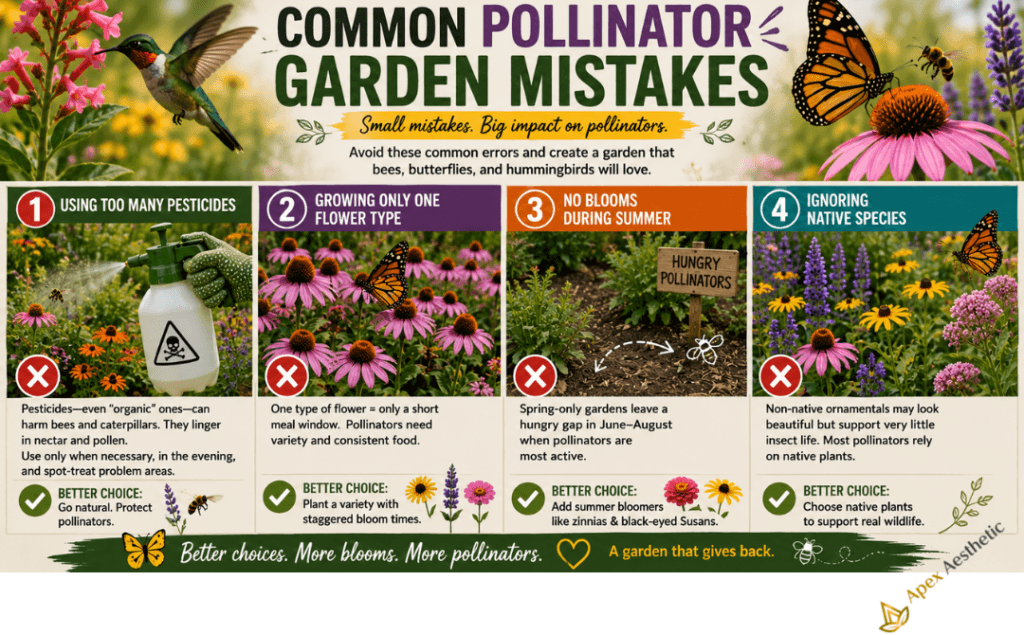
- Using too many pesticides. Overuse of pesticides. This includes “organic” sprays, which can be as harmful to bees and caterpillars on contact as any other. Try to limit your use of them; if you must, do so in the evening when the bees have settled down and only spot-treat where there is an issue rather than dousing the entire bed.
- Growing only one flower type. Sticking with just one kind of flower. You might have a single species in bloom for three weeks, but that is all the food you are putting out for three weeks. The whole idea of a pollinator garden, as opposed to a regular flower bed, is to have mixed bloom times so they are fed for months on end.
- No blooms during summer. A dearth of summer flowers. If your garden is spring-only, you will have a hungry void between June and August, right at the height of activity for butterflies and bees. A couple of heat lovers, like Zinnias or black-eyed Susans, will see you through.
- Ignoring native species. You may have a bed of non-native ornamentals that looks fine, but it is supporting a tiny fraction of the insect life compared to a native planting. Most insects simply cannot make use of plants they have not co-evolved with.
Pollinator garden ideas for small spaces
You don’t need a yard to have a pollinator garden. Here are four ways to put one in a small space of 20 square feet or less.
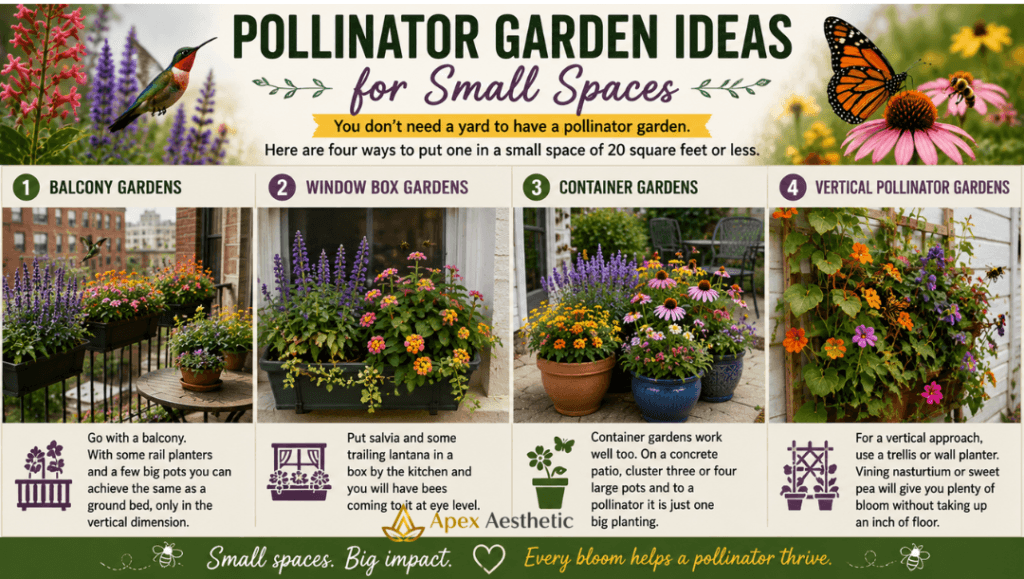
- Balcony gardens. Go with a balcony. With some rail planters and a few big pots, you can achieve the same as a ground bed, only in the vertical dimension.
- Window box gardens. Put salvia and some trailing lantana in a box by the kitchen, and you will have bees coming to it at eye level.
- Container gardens. Container gardens work well, too. On a concrete patio, cluster three or four large pots, and to a pollinator, it is just one big planting.
- Vertical pollinator gardens. For a vertical approach, use a trellis or wall planter. A vining nasturtium or sweet pea will give you plenty of blooms without taking up an inch of floor.
If your whole outdoor space is small to begin with, our small garden ideas on a budget post and our privacy plants for a backyard post both cover layouts that pair well with a pollinator-focused planting plan.
Pollinator garden benefits beyond flowers
There are advantages to a pollinator garden that go well beyond the flowers. The rewards are felt in the rest of the yard and by those who make use of it.
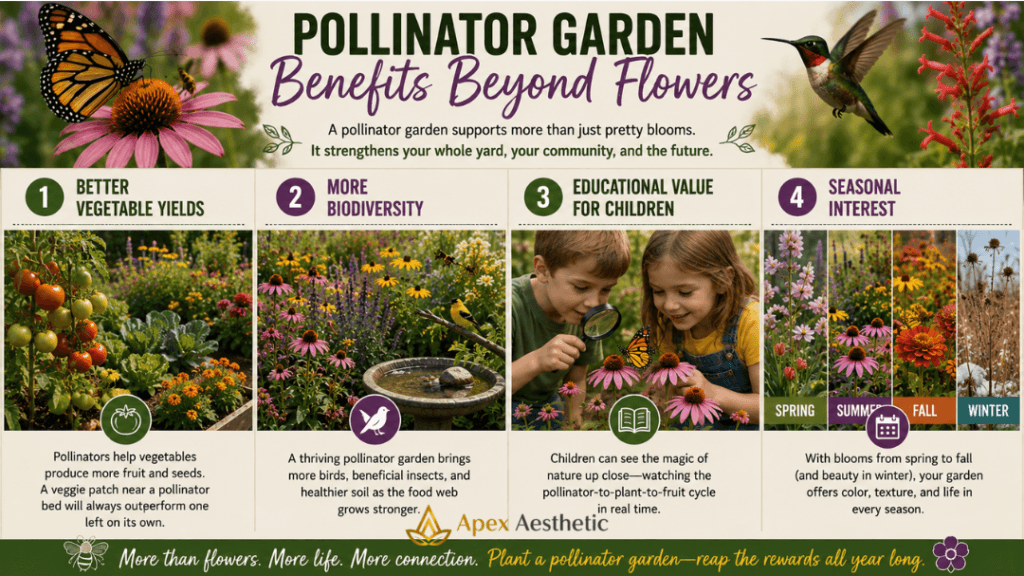
Better vegetable yields. Take your vegetables, for instance. A veggie patch put in near a pollinator bed will reliably produce more fruit than one left to its own devices.
More biodiversity. You get more biodiversity as well. As the bed and the food web surrounding it come of age, you will see an improvement in soil health and an increase in birds and the good kind of insects.
Educational value for children. For children, there is an educational side to it. It is rare in a garden to have a spot where they can see cause and effect at work before their eyes, from the flower to the bee and on to the fruit.
Seasonal interest. There is the matter of seasonal interest. If you have planned for blooms to carry on, the garden won’t just go flat once the first spring show is done; it has a different look in April than it does in July or October.
FAQ Pollinator Garden Ideas
What flowers attract the most bees?
Coneflower, black-eyed Susan, salvia, and lavender consistently rank among the top bee draws in pollinator research. Flat or clustered flower shapes make it easiest for bees to land and feed, which is why single-petaled natives usually outperform double-petaled ornamental varieties.
How large should a pollinator garden be?
There’s no minimum. A single 4-foot by 4-foot bed or a few large containers can work as a real pollinator stop, especially in a neighborhood with other nearby gardens contributing to the same corridor of habitat.
Do pollinator gardens attract wasps?
Some wasps will visit flowering plants, but most pollinator gardens see far more bees and butterflies than wasps. Avoiding overripe fruit and open meat near the garden keeps wasp visits to a minimum, since wasps are drawn more to protein and sugar sources than to nectar specifically.
Can I create a pollinator garden in containers?
Yes. Salvia, zinnia, lavender, and trailing lantana all do well in pots and attract the same bees and butterflies as an in-ground bed. Use the largest pots your space allows; bigger root volume means less watering and a longer bloom window per plant.
What is the best time to plant pollinator flowers?
Spring, after the last frost, is the standard window for most annuals and perennials. Fall planting works well for many native perennials, which use the cooler months to establish roots before next year’s bloom, often resulting in a stronger plant by the following summer than one planted in spring.
Conclusion
You can put any yard, balcony, or courtyard to work for pollinators. There is no need for a big bed to make an impact; in fact, some of the unpretentious ideas here, be it a handful of containers or a modest native bed, will outperform a showy display that has been planted with the wrong species.
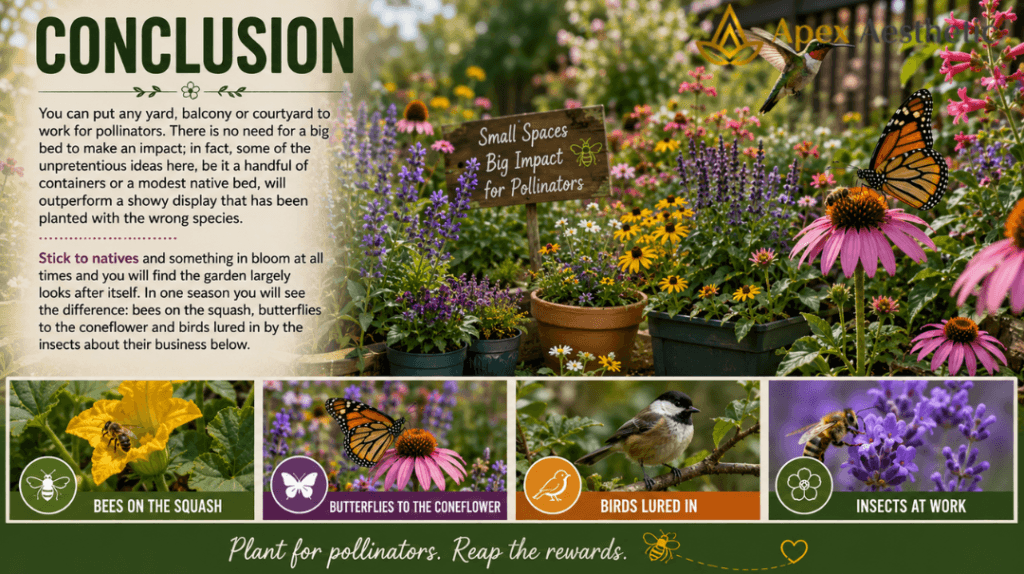
Stick to natives and something in bloom at all times, and you will find the garden largely looks after itself. In one season, you will see the difference: bees on the squash, butterflies on the coneflower, and birds lured in by the insects about their business below.
If you want to enjoy the bed after sunset, tuck a couple of low solar up-lights behind the taller plants, and they will carry the view well into the evening. Our outdoor solar lighting ideas post covers fixtures that won’t disturb a pollinator bed’s daytime sun exposure.